
A September 2 webinar hosted by the Fiber Optic Sensing Association (FOSA) put a spotlight on a shift already underway in how Distributed Temperature Sensing (DTS) is used across energy infrastructure: from a technology that simply reports temperature to one that feeds directly into decisions about capacity, maintenance, and risk.
Titled “DTS for Modern Energy Systems: Early Fault Detection Across Solar PV and Underground Cables,” the session paired two speakers working on opposite ends of the power system. Ralf Albrecht of AP Sensing covered underground transmission and distribution cables, focusing on how DTS data can support dynamic cable ratings. Mark Horton, International Operations Director at SAMM Technology, addressed solar PV and battery energy storage systems (BESS), where the priority is catching abnormal heating before it becomes a fire or an outage. Dane Langen of Luna Innovations moderated on FOSA’s behalf.
This is a distinct, post-event technical recap of the session; readers looking for the original participation announcement can see SectechMedia’s earlier piece, FOSA Webinar to Explore DTS for Early Fault Detection in Solar PV and Underground Cables.
Why the Grid Needs a Different Kind of Monitoring
The premise both speakers returned to: the energy transition isn’t just adding renewable capacity, it’s changing how that capacity behaves. More solar generation, larger installations, high-capacity underground cable runs, and a growing base of BESS assets all add variability that traditional inspection methods struggle to track continuously.
Thermal cameras, drone surveys, and periodic site visits remain useful, but each one captures a single moment in time. A loosening connector or a slowly warming cable section can develop in the days between inspections and go unnoticed until the next scheduled check.
DTS addresses that gap differently: instead of a handful of fixed sensors, the optical fiber itself becomes the sensing element along its entire length. Laser pulses sent through the fiber generate backscattered light that, when analyzed, yields a temperature reading roughly every meter, over distances up to about 50 kilometers on a single system. The practical effect is a continuous thermal map of an asset rather than scattered data points.
Underground Cables: From Fixed Limits to Real-Time Capacity
Albrecht’s presentation reframed DTS as more than a fault-detection tool for buried cables — it’s also a lever for getting more usable capacity out of existing infrastructure.
Cable operators set maximum current limits based on conductor temperature, since excess heat accelerates insulation aging and raises failure risk. The issue, as Albrecht explained, is that standard Static Cable Rating calculations tend to assume worst-case conditions — high soil thermal resistivity and similar conservative inputs — baked in at the design stage. Real operating conditions are frequently better than those assumptions, meaning a cable’s actual safe capacity can exceed its official rating.
Real-Time Thermal Rating (RTTR), also called Dynamic Cable Rating (DCR), replaces some of those fixed assumptions with live data. DTS temperature readings are combined with current electrical load, soil conditions, and thermal models built on IEC and CIGRE methodologies to estimate actual conductor temperature — not just the temperature around the cable — and from that, how much current it can carry safely right now. Albrecht described systems that go a step further, projecting dynamic or emergency ratings 24, 48, or 72 hours out.
That turns a static design question (“what was this cable rated for?”) into an operational one (“what can it carry today?”) — a distinction Albrecht suggested matters more as renewable-driven load patterns become less predictable. In some cases, unlocking that extra headroom on existing cable routes could reduce or delay the need for new transmission builds.
One technical wrinkle Albrecht flagged: the sensing fiber isn’t always physically adjacent to the conductor. It may sit within the cable structure, be strapped to it, or run through a nearby duct, and heat takes time to travel from the conductor to wherever the fiber actually measures. He pointed to field examples — including 33 kV double-circuit installations with fiber positioned at varying distances from the cable — to illustrate why DCR systems need thermal modeling layered on top of raw DTS readings, rather than treating the fiber’s temperature as a direct stand-in for the conductor’s.
Albrecht also touched on overhead lines, where wind cooling — not soil conditions — governs safe current limits. Fiber inside an Optical Ground Wire (OPGW) can’t read conductor temperature directly, but he noted that Distributed Acoustic Sensing (DAS) can analyze vibration patterns in the same fiber to infer wind conditions relevant to Dynamic Line Rating (DLR) calculations — a reminder that DTS and DAS running on infrastructure that already carries fiber can extend well beyond their original design purpose.
Solar PV: Catching the Problem Before the Fire
Horton’s presentation shifted the discussion to a different failure mode. In solar PV and BESS installations, the goal isn’t optimizing capacity — it’s catching abnormal heat before it turns into equipment damage, downtime, or fire.
He listed several common hotspot sources: loose electrical connectors, damaged DC cabling, installation defects, rodent damage, aging components, and rising resistance at connections over time. Left undetected, any of these can escalate from a minor thermal anomaly into a serious failure. The core distinction Horton drew was between detecting a fire and detecting the conditions that lead to one — the earlier the anomaly surfaces, the more room maintenance teams have to intervene.
Drone thermography, he noted, has real value but the same limitation as underground-cable inspections: it’s a snapshot. A connector that starts failing a week after a drone flight stays invisible until the next flight. Routing sensing fiber across a site — from the backs of modules to combiner boxes, inverters, transformers, AC/DC cabling, BESS units, and grid-connection equipment — turns that into continuous coverage instead. Because fiber doesn’t carry current or pick up electromagnetic interference, it’s also well suited to sitting close to high-voltage equipment.
Solar sites present their own complication for alarm design: normal temperatures already swing widely with sun angle, ambient conditions, cloud cover, and season, so a single fixed threshold generates excessive false alarms. Horton described layering three approaches instead — absolute maximum-temperature thresholds, rate-of-rise detection for unusually fast heating, and trend/baseline comparisons that flag when a specific asset starts behaving differently from its own historical pattern. That combination is what turns DTS from a long thermometer into an actual condition-monitoring input.
He also addressed a less glamorous but practical question: fiber survives decades of module swaps, repairs, and maintenance work by being secured behind panels with UV-resistant ties (movable when a module is replaced) and by leaving service loops of spare fiber for future splicing. Depending on a system’s optical budget, a single channel can typically absorb somewhere around 10 to 15 splices before a longer section needs replacing outright — a detail that matters for a sensing system expected to remain functional for the life of the asset.
Two Problems, One Underlying Shift
Albrecht and Horton were solving different problems — maximizing safe throughput on kilometers of buried cable versus catching a localized hotspot on a solar module or battery unit — but both talks pointed to the same underlying change: replacing periodic, point-based checks with continuous, distributed measurement.
The broader theme of the session was that DTS data is increasingly being wired into other systems — thermal models, DCR platforms, SCADA, alarm logic, and maintenance workflows — rather than reviewed in isolation. In cable networks, that can mean determining whether extra transmission capacity is genuinely available. In solar and storage assets, it can mean flagging a developing problem early enough to act on it. Across both applications, the fiber itself is being asked to do more than sense temperature — it’s becoming an input to real operating decisions.
This article is based on a summary account of FOSA’s September 2, 2026 webinar “DTS for Modern Energy Systems: Early Fault Detection Across Solar PV and Underground Cables,” featuring presentations from Ralf Albrecht (AP Sensing) and Mark Horton (SAMM Technology), moderated by Dane Langen (Luna Innovations). FOSA typically posts recordings of its webinars to its public archive after the fact; readers seeking the full session, including technical Q&A, should check FOSA’s website directly.
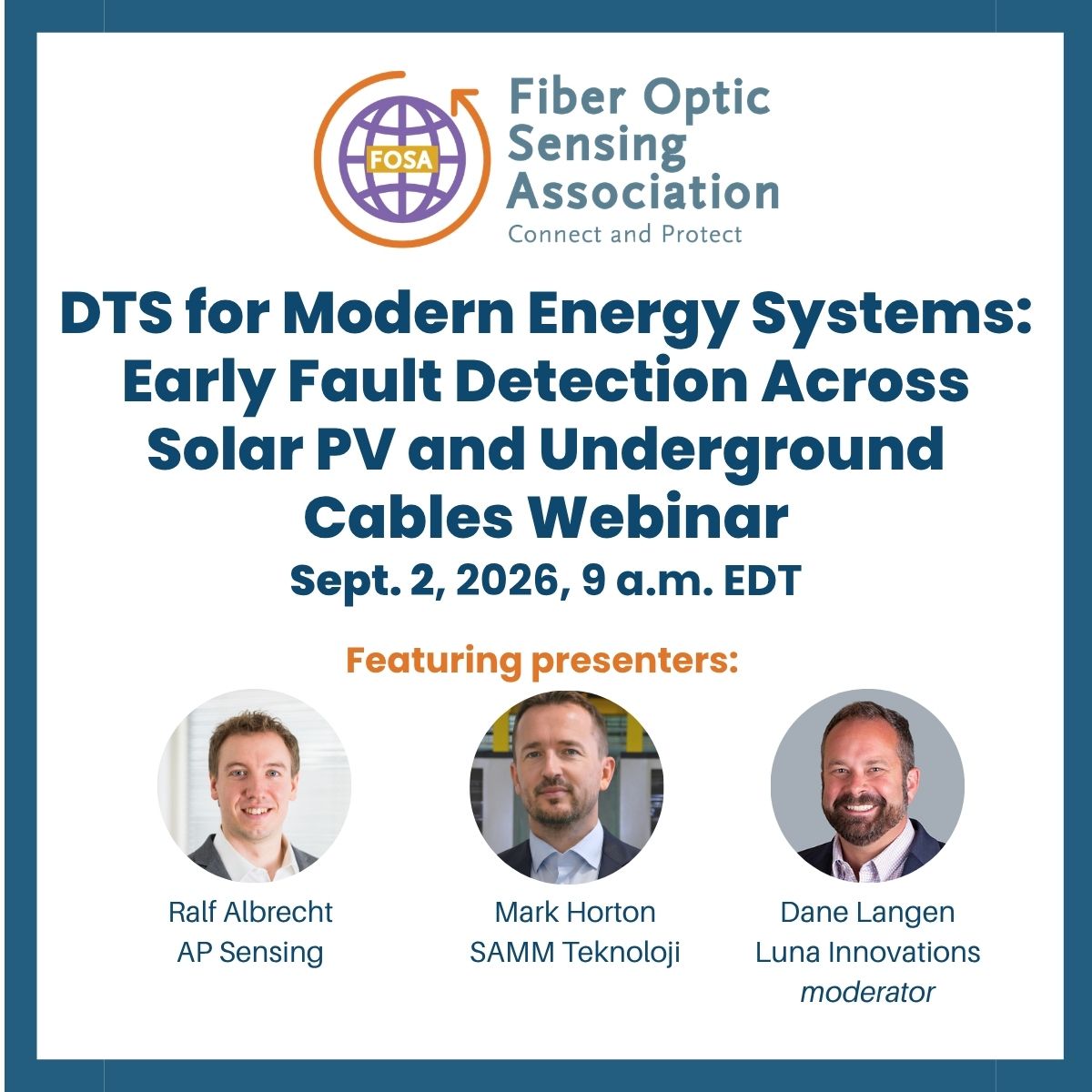
The full recording of this webinar is now available: watch it in full on FOSA’s YouTube channel.
Leave a Reply