Category: Fiber Optic Sensing

  • DTS Is Becoming an Operational Tool, Not Just a Monitoring One — Lessons From FOSA’s Latest Webinar

    DTS Is Becoming an Operational Tool, Not Just a Monitoring One — Lessons From FOSA’s Latest Webinar

    A September 2 webinar hosted by the Fiber Optic Sensing Association (FOSA) put a spotlight on a shift already underway in how Distributed Temperature Sensing (DTS) is used across energy infrastructure: from a technology that simply reports temperature to one that feeds directly into decisions about capacity, maintenance, and risk.

    Titled “DTS for Modern Energy Systems: Early Fault Detection Across Solar PV and Underground Cables,” the session paired two speakers working on opposite ends of the power system. Ralf Albrecht of AP Sensing covered underground transmission and distribution cables, focusing on how DTS data can support dynamic cable ratings. Mark Horton, International Operations Director at SAMM Technology, addressed solar PV and battery energy storage systems (BESS), where the priority is catching abnormal heating before it becomes a fire or an outage. Dane Langen of Luna Innovations moderated on FOSA’s behalf.

    This is a distinct, post-event technical recap of the session; readers looking for the original participation announcement can see SectechMedia’s earlier piece, FOSA Webinar to Explore DTS for Early Fault Detection in Solar PV and Underground Cables.

    Why the Grid Needs a Different Kind of Monitoring

    The premise both speakers returned to: the energy transition isn’t just adding renewable capacity, it’s changing how that capacity behaves. More solar generation, larger installations, high-capacity underground cable runs, and a growing base of BESS assets all add variability that traditional inspection methods struggle to track continuously.

    Thermal cameras, drone surveys, and periodic site visits remain useful, but each one captures a single moment in time. A loosening connector or a slowly warming cable section can develop in the days between inspections and go unnoticed until the next scheduled check.

    DTS addresses that gap differently: instead of a handful of fixed sensors, the optical fiber itself becomes the sensing element along its entire length. Laser pulses sent through the fiber generate backscattered light that, when analyzed, yields a temperature reading roughly every meter, over distances up to about 50 kilometers on a single system. The practical effect is a continuous thermal map of an asset rather than scattered data points.

    Underground Cables: From Fixed Limits to Real-Time Capacity

    Albrecht’s presentation reframed DTS as more than a fault-detection tool for buried cables — it’s also a lever for getting more usable capacity out of existing infrastructure.

    Cable operators set maximum current limits based on conductor temperature, since excess heat accelerates insulation aging and raises failure risk. The issue, as Albrecht explained, is that standard Static Cable Rating calculations tend to assume worst-case conditions — high soil thermal resistivity and similar conservative inputs — baked in at the design stage. Real operating conditions are frequently better than those assumptions, meaning a cable’s actual safe capacity can exceed its official rating.

    Real-Time Thermal Rating (RTTR), also called Dynamic Cable Rating (DCR), replaces some of those fixed assumptions with live data. DTS temperature readings are combined with current electrical load, soil conditions, and thermal models built on IEC and CIGRE methodologies to estimate actual conductor temperature — not just the temperature around the cable — and from that, how much current it can carry safely right now. Albrecht described systems that go a step further, projecting dynamic or emergency ratings 24, 48, or 72 hours out.

    That turns a static design question (“what was this cable rated for?”) into an operational one (“what can it carry today?”) — a distinction Albrecht suggested matters more as renewable-driven load patterns become less predictable. In some cases, unlocking that extra headroom on existing cable routes could reduce or delay the need for new transmission builds.

    One technical wrinkle Albrecht flagged: the sensing fiber isn’t always physically adjacent to the conductor. It may sit within the cable structure, be strapped to it, or run through a nearby duct, and heat takes time to travel from the conductor to wherever the fiber actually measures. He pointed to field examples — including 33 kV double-circuit installations with fiber positioned at varying distances from the cable — to illustrate why DCR systems need thermal modeling layered on top of raw DTS readings, rather than treating the fiber’s temperature as a direct stand-in for the conductor’s.

    Albrecht also touched on overhead lines, where wind cooling — not soil conditions — governs safe current limits. Fiber inside an Optical Ground Wire (OPGW) can’t read conductor temperature directly, but he noted that Distributed Acoustic Sensing (DAS) can analyze vibration patterns in the same fiber to infer wind conditions relevant to Dynamic Line Rating (DLR) calculations — a reminder that DTS and DAS running on infrastructure that already carries fiber can extend well beyond their original design purpose.

    Solar PV: Catching the Problem Before the Fire

    Horton’s presentation shifted the discussion to a different failure mode. In solar PV and BESS installations, the goal isn’t optimizing capacity — it’s catching abnormal heat before it turns into equipment damage, downtime, or fire.

    He listed several common hotspot sources: loose electrical connectors, damaged DC cabling, installation defects, rodent damage, aging components, and rising resistance at connections over time. Left undetected, any of these can escalate from a minor thermal anomaly into a serious failure. The core distinction Horton drew was between detecting a fire and detecting the conditions that lead to one — the earlier the anomaly surfaces, the more room maintenance teams have to intervene.

    Drone thermography, he noted, has real value but the same limitation as underground-cable inspections: it’s a snapshot. A connector that starts failing a week after a drone flight stays invisible until the next flight. Routing sensing fiber across a site — from the backs of modules to combiner boxes, inverters, transformers, AC/DC cabling, BESS units, and grid-connection equipment — turns that into continuous coverage instead. Because fiber doesn’t carry current or pick up electromagnetic interference, it’s also well suited to sitting close to high-voltage equipment.

    Solar sites present their own complication for alarm design: normal temperatures already swing widely with sun angle, ambient conditions, cloud cover, and season, so a single fixed threshold generates excessive false alarms. Horton described layering three approaches instead — absolute maximum-temperature thresholds, rate-of-rise detection for unusually fast heating, and trend/baseline comparisons that flag when a specific asset starts behaving differently from its own historical pattern. That combination is what turns DTS from a long thermometer into an actual condition-monitoring input.

    He also addressed a less glamorous but practical question: fiber survives decades of module swaps, repairs, and maintenance work by being secured behind panels with UV-resistant ties (movable when a module is replaced) and by leaving service loops of spare fiber for future splicing. Depending on a system’s optical budget, a single channel can typically absorb somewhere around 10 to 15 splices before a longer section needs replacing outright — a detail that matters for a sensing system expected to remain functional for the life of the asset.

    Two Problems, One Underlying Shift

    Albrecht and Horton were solving different problems — maximizing safe throughput on kilometers of buried cable versus catching a localized hotspot on a solar module or battery unit — but both talks pointed to the same underlying change: replacing periodic, point-based checks with continuous, distributed measurement.

    The broader theme of the session was that DTS data is increasingly being wired into other systems — thermal models, DCR platforms, SCADA, alarm logic, and maintenance workflows — rather than reviewed in isolation. In cable networks, that can mean determining whether extra transmission capacity is genuinely available. In solar and storage assets, it can mean flagging a developing problem early enough to act on it. Across both applications, the fiber itself is being asked to do more than sense temperature — it’s becoming an input to real operating decisions.

    This article is based on a summary account of FOSA’s September 2, 2026 webinar “DTS for Modern Energy Systems: Early Fault Detection Across Solar PV and Underground Cables,” featuring presentations from Ralf Albrecht (AP Sensing) and Mark Horton (SAMM Technology), moderated by Dane Langen (Luna Innovations). FOSA typically posts recordings of its webinars to its public archive after the fact; readers seeking the full session, including technical Q&A, should check FOSA’s website directly.
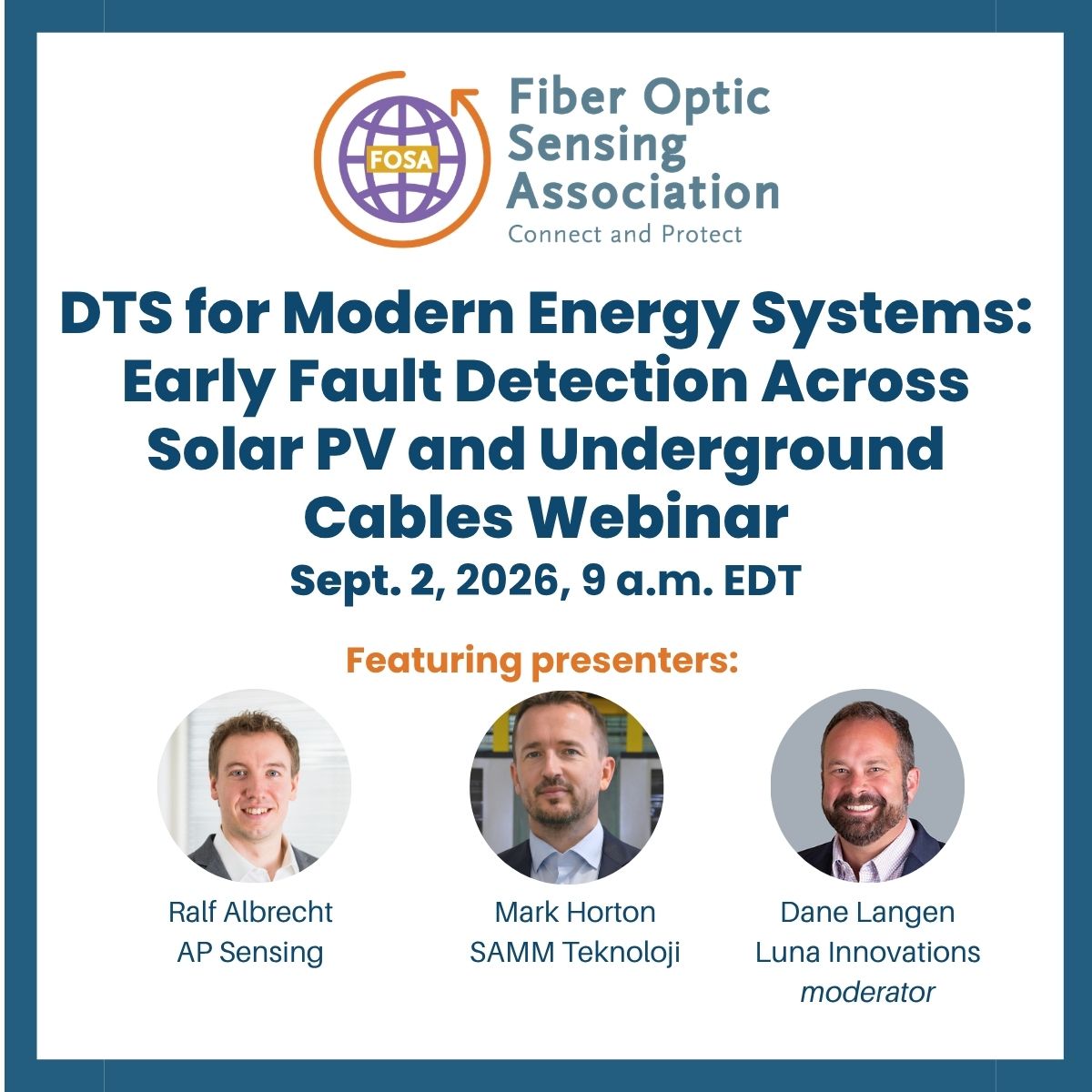
    FOSA's official announcement graphic for the September 2, 2026 webinar "DTS for Modern Energy Systems: Early Fault Detection Across Solar PV and Underground Cables," listing presenters Ralf Albrecht (AP Sensing), Mark Horton (SAMM Teknoloji), and moderator Dane Langen (Luna Innovations)
    FOSA’s official event announcement graphic.

    The full recording of this webinar is now available: watch it in full on FOSA’s YouTube channel.
  • FOSA Webinar to Explore DTS for Early Fault Detection in Solar PV and Underground Cables

    FOSA Webinar to Explore DTS for Early Fault Detection in Solar PV and Underground Cables

    SAMM Technology (SAMM Teknoloji İletişim A.Ş.) is taking part in an upcoming webinar hosted by the Fiber Optic Sensing Association (FOSA), addressing how Distributed Temperature Sensing (DTS) can support early fault detection across solar photovoltaic (PV) installations and underground power cable networks.

    The webinar, titled “DTS for Modern Energy Systems: Early Fault Detection Across Solar PV and Underground Cables,” takes place on September 2, 2026, at 9:00 AM EDT (13:00 UTC), hosted online via Zoom by FOSA, the US-based non-profit industry association focused on advancing distributed and quasi-distributed fiber optic sensing technologies.

    SAMM Technology on the Panel

    Representing SAMM Technology, Mark Horton, the company’s International Operations Director, joins the session alongside Ralf Albrecht of AP Sensing, with Dane Langen of Luna Innovations moderating. According to FOSA’s own event announcement, the panel will discuss how DTS technology is being applied to monitor modern energy infrastructure, with a focus on practical approaches to early fault detection in solar PV installations and underground power cable networks.

    In its own announcement of the participation, SAMM Technology said the webinar “provides an excellent opportunity to share knowledge, discuss emerging trends, and demonstrate how innovative monitoring technologies are supporting the future of energy systems,” adding that it was “proud to see Mark Horton representing SAMM Technology on this distinguished panel.”

    Why DTS for Solar PV and Underground Cables

    Distributed Temperature Sensing turns a standard optical fiber into a continuous string of temperature sensors along its full length, without the need for external power at the sensing points. For underground and solar PV power infrastructure, that capability is particularly relevant: temperature anomalies along a cable route or within a PV installation can be early indicators of developing faults, hotspots, or degrading connections — issues that are otherwise difficult to catch before they cause an outage or safety incident. Panel discussions on this topic typically cover how real-time DTS monitoring data feeds into asset reliability programs, operational efficiency, and system safety practices for energy operators.

    How to Attend

    The FOSA webinar is scheduled for September 2, 2026, 9:00 AM EDT (13:00 UTC), and will be held online via Zoom. Registration details are available through FOSA’s website.

    This article is based on SAMM Technology’s own announcement of its webinar participation (dated August 5, 2026) and FOSA’s official event promotional graphic and public webinar listing.

  • How to Evaluate a DAS or DTS Vendor: A Buyer’s Guide

    How to Evaluate a DAS or DTS Vendor: A Buyer’s Guide

    Choosing a distributed fiber sensing platform requires more than comparing maximum range and brochure specifications. Performance depends on interrogator design, fiber installation, algorithms, integration and the vendor’s ability to support commissioning and long-term tuning.

    Start with the use case

    Pipeline security, rail monitoring, power-cable temperature sensing and perimeter protection require different performance priorities. Define the events, distances, response times and operational outputs before comparing products.

    Look beyond maximum range

    Range without useful signal quality is not enough. Spatial resolution, sampling, dynamic range, localization accuracy, temperature accuracy and environmental tolerance should be evaluated against the real site.

    Evaluate analytics

    For DAS, classification quality and false-alarm control can matter more than raw sensing sensitivity. Ask how models are trained, adapted and validated for the deployment environment.

    Integration and APIs

    The platform should connect cleanly with VMS, PSIM, SCADA, GIS or command-center software. Open APIs and exportable event data reduce long-term lock-in.

    Pilot before scale

    A representative pilot is essential. Test the actual fiber, installation method, noise environment and operator workflow. The best vendor is the one that can demonstrate repeatable performance on the buyer’s infrastructure, not merely on a laboratory specification sheet.

    Conclusion

    How to Evaluate a DAS or DTS Vendor: A Buyer’s Guide should be evaluated as part of a broader operational architecture. The strongest deployments combine suitable sensing technology, resilient communications, clear procedures and measurable performance rather than relying on a single device or headline specification.

    For further technology context, see FOTAS distributed fiber sensing and SAMM.

  • Integrated DAS and DTS: Combining Acoustic and Thermal Intelligence

    Integrated DAS and DTS: Combining Acoustic and Thermal Intelligence

    DAS and DTS observe different physical phenomena, but together they can provide a richer view of critical infrastructure. Acoustic events may indicate movement or mechanical activity while temperature changes reveal thermal stress, fire or abnormal operating conditions.

    Complementary sensing

    DAS detects vibration and acoustic signatures; DTS measures distributed temperature. Combining both allows the same corridor to be monitored for security events and asset-condition changes.

    Power and cable networks

    DTS can identify thermal loading while DAS detects nearby digging, disturbance or unusual vibration. The combination supports both reliability and physical protection.

    Pipeline corridors

    DAS can classify activity and acoustic events while DTS contributes thermal context where product temperature or leak-related effects are relevant.

    Unified analytics

    The challenge is turning two large data streams into usable alarms. Edge processing, event correlation and GIS visualization can help operators focus on meaningful anomalies.

    Procurement implications

    Buyers should evaluate integration at the data and workflow level, not simply whether two interrogators can be installed in the same cabinet. Shared timing, location mapping, APIs and alarm management are central to real operational value.

    Conclusion

    Integrated DAS and DTS for Critical Infrastructure Monitoring should be evaluated as part of a broader operational architecture. The strongest deployments combine suitable sensing technology, resilient communications, clear procedures and measurable performance rather than relying on a single device or headline specification.

  • DTS for Tunnels, Cable Routes and Linear Fire Detection

    DTS for Tunnels, Cable Routes and Linear Fire Detection

    Distributed Temperature Sensing provides continuous temperature measurements along optical fiber, making it useful where heat must be monitored over long or difficult-to-access routes.

    How DTS differs from point detection

    Traditional temperature sensors measure specific locations. DTS creates thousands of measurement points along one fiber and can show how heat develops spatially over time.

    Tunnel applications

    In road and rail tunnels, DTS can support linear heat detection and help operators identify the approximate location and development of abnormal temperature conditions.

    Power cables

    High-voltage cables can develop hotspots that limit loading or indicate deteriorating conditions. DTS provides a thermal profile along the route and supports dynamic operational decisions.

    Industrial routes

    Conveyors, cable trays, pipelines and storage areas can benefit from continuous thermal monitoring where point sensors leave gaps.

    Design considerations

    Response time, spatial resolution, fiber type, installation geometry, calibration and integration with the fire or SCADA system should be evaluated together. DTS is strongest when operators can convert temperature data into clear actions.

    Conclusion

    DTS for Tunnels, Cable Routes and Linear Fire Detection should be evaluated as part of a broader operational architecture. The strongest deployments combine suitable sensing technology, resilient communications, clear procedures and measurable performance rather than relying on a single device or headline specification.

  • DAS for Border and Long-Perimeter Monitoring

    DAS for Border and Long-Perimeter Monitoring

    Long boundaries are difficult to secure with point sensors alone. Distributed Acoustic Sensing can turn fiber installed along a route into a continuous detection layer, providing location-aware vibration and acoustic information over many kilometres.

    Why DAS fits long perimeters

    A single interrogator can monitor a long fiber path, reducing the need for powered electronics at every detection point. This is attractive for remote fences, pipelines, rail corridors and large critical-infrastructure boundaries.

    Event classification

    The main challenge is not detecting vibration but identifying what created it. Machine-learning models can help distinguish footsteps, vehicles, digging, fence interaction, weather and background activity.

    Sensor fusion

    DAS becomes far more useful when alarms cue cameras, thermal imagers or radar. Fiber provides location; optical sensors provide visual confirmation.

    Deployment factors

    Cable installation method, soil type, fence coupling, fiber route and local noise strongly affect performance. Calibration must therefore be site-specific.

    Operational value

    The strongest use case is persistent awareness over distance. DAS should be treated as part of a layered system rather than a standalone answer to every perimeter-security problem.

    Conclusion

    DAS for Border and Long-Perimeter Monitoring should be evaluated as part of a broader operational architecture. The strongest deployments combine suitable sensing technology, resilient communications, clear procedures and measurable performance rather than relying on a single device or headline specification.

  • Fiber Optic Sensing Market 2026: Where DAS and DTS Are Expanding

    Fiber Optic Sensing Market 2026: Where DAS and DTS Are Expanding

    Distributed fiber sensing is moving beyond a small group of specialist applications. Infrastructure owners are increasingly evaluating existing fiber as a sensing asset capable of monitoring vibration, temperature and physical events over long distances.

    Pipeline and energy

    Pipelines remain a major DAS application because one fiber can monitor long corridors for digging, intrusion and characteristic acoustic events. DTS adds thermal monitoring in power-cable and industrial environments.

    Rail and transport

    Rail operators are exploring DAS for train tracking, trackside activity and infrastructure condition awareness. The value is strongest where continuous linear monitoring complements conventional signaling and CCTV.

    Telecom infrastructure

    Existing telecom fiber is becoming strategically important because it can sometimes support sensing without installing a separate sensor every few metres. This opens opportunities in urban infrastructure and route protection.

    Subsea and coastal applications

    Subsea cables can act as distributed sensing paths for vessel activity, seismic events and cable-zone awareness when combined with other maritime data sources.

    The market direction

    The key shift is from single-purpose sensing toward multi-application infrastructure intelligence, with AI classification and edge processing becoming increasingly important to control data volume and false alarms.

    Conclusion

    Fiber Optic Sensing Market 2026: Where DAS and DTS Are Expanding should be evaluated as part of a broader operational architecture. The strongest deployments combine suitable sensing technology, resilient communications, clear procedures and measurable performance rather than relying on a single device or headline specification.

    For further technology context, see FOTAS distributed fiber sensing and SAMM.

  • Pipeline Security Architecture: Sensors, Fiber, Cameras and Control Centers

    Pipeline Security Architecture: Sensors, Fiber, Cameras and Control Centers

    Pipelines cross long distances, remote terrain and multiple jurisdictions. Protecting them requires more than cameras at a few stations. Modern pipeline security combines distributed sensing, process data, imaging and centralized command-and-control.

    The Linear Challenge

    A pipeline can extend hundreds or thousands of kilometers. Conventional point sensors leave large gaps, while continuous patrol is expensive. Distributed Acoustic Sensing can use fiber installed along the route to identify excavation, digging, vehicle movement and other vibration events. In some applications, acoustic signatures may also contribute to leak-related monitoring.

    Process Monitoring

    Security data should be combined with pressure, flow and valve information. A suspicious vibration event near the route becomes more important if process data simultaneously shows an abnormal change. This correlation reduces the time required to understand what is happening.

    Video Verification

    Cameras and thermal imagers are most useful at high-risk locations such as block-valve stations, terminals, crossings and urban interfaces. On long remote routes, mobile cameras, drones or PTZ systems can be tasked after another sensor identifies a specific location.

    Perimeter Protection at Facilities

    Compressor stations, pump stations and terminals require conventional layered security: fencing, access control, radar, thermal imaging, intrusion detection and vehicle management. These fixed sites should feed the same operational picture as the linear pipeline sensors.

    Command and Control

    A central platform should correlate fiber alarms, SCADA events, video, GIS coordinates and maintenance information. Operators need a map-based view showing where an event occurred, what nearby assets are present and which verification resources are available.

    Cyber-Physical Risk

    Pipelines are cyber-physical systems. Security architecture must protect both field assets and the networks connecting sensors, cameras and control systems. Segmentation, authentication and secure remote access are essential.

    Conclusion

    The most effective pipeline-security model is layered and data-driven. Distributed fiber sensing provides continuous awareness along the route, while cameras, process systems and control centers add verification and context. The objective is not more alarms; it is faster, more reliable understanding of events affecting the pipeline.

  • The Future of Distributed Fiber Optic Sensing

    The Future of Distributed Fiber Optic Sensing

    Distributed fiber-optic sensing is moving beyond isolated alarm applications. DAS, DTS and distributed strain technologies are increasingly being combined with AI, edge computing, digital twins and operational platforms to create continuous infrastructure intelligence.

    From Single-Purpose Sensors to Multi-Parameter Monitoring

    Early deployments often focused on one problem: intrusion detection, temperature monitoring or leak awareness. The emerging model combines multiple sensing modes with asset data. A power cable can be monitored for temperature, vibration and strain; a pipeline corridor can combine DAS events with pressure, flow and video; a railway can integrate fiber sensing with signaling and maintenance data.

    AI Changes the Value of the Data

    The volume of distributed sensing data is too large for manual interpretation. Machine learning is therefore becoming central to event classification, anomaly detection and long-term trend analysis. Edge processing can make immediate decisions near the interrogator, while central systems compare patterns across sites.

    Existing Fiber Becomes Strategic

    Another major trend is the use of telecom and utility fiber already installed in the ground. If compatible fiber can support both communications and sensing, the economics of large-scale monitoring change dramatically. Cities, utilities and transport operators may gain sensing coverage without building a completely separate physical network.

    Integration Will Define the Winners

    Hardware performance remains important, but future value will increasingly depend on software, APIs, visualization, model management and integration with SCADA, VMS, GIS, digital twins and maintenance systems. Operators do not need more isolated alarms; they need prioritized, contextual information.

    Conclusion

    The long-term future of distributed fiber-optic sensing is not simply better interrogators. It is the transformation of optical fiber into a continuous data layer for critical infrastructure. When sensing, AI and operational systems are combined, fiber can evolve from a passive communications medium into a distributed nervous system for the physical world.

  • DAS and DTS for Telecom Manhole and Network Condition Monitoring

    DAS and DTS for Telecom Manhole and Network Condition Monitoring

    Telecom infrastructure contains thousands of manholes, ducts and underground routes that are difficult to inspect continuously. Distributed Acoustic Sensing and Distributed Temperature Sensing can add a new layer of visibility by using optical fiber itself as a distributed monitoring medium.

    What DAS Can Detect

    DAS measures vibration and dynamic strain along fiber. In a telecom network, this can help identify excavation activity, repeated impacts, vehicle-related vibration, unauthorized access around manholes and other mechanical disturbances. Because the event can be located along the fiber route, operators can focus inspection on the relevant section.

    What DTS Adds

    DTS provides a temperature profile rather than vibration information. Abnormal heating, environmental changes or local thermal anomalies may indicate conditions that deserve investigation. When DAS and DTS are combined, operators gain two independent physical measurements from the same corridor.

    Mapping Is Essential

    The sensing system reports distance along fiber, so accurate route mapping is critical. Splice points, loops, manholes and changes in cable routing must be documented so optical distance can be translated into a real physical location.

    Operational Value

    The goal is not to replace network-management systems. Optical performance monitoring tells operators about communications quality; distributed sensing provides information about the physical environment around the cable. Combining these views can improve maintenance prioritization and infrastructure security.

    Conclusion

    DAS and DTS can turn telecom fiber routes into sources of physical-condition data. For large underground networks, this creates the possibility of moving from periodic inspection toward continuous infrastructure awareness.