
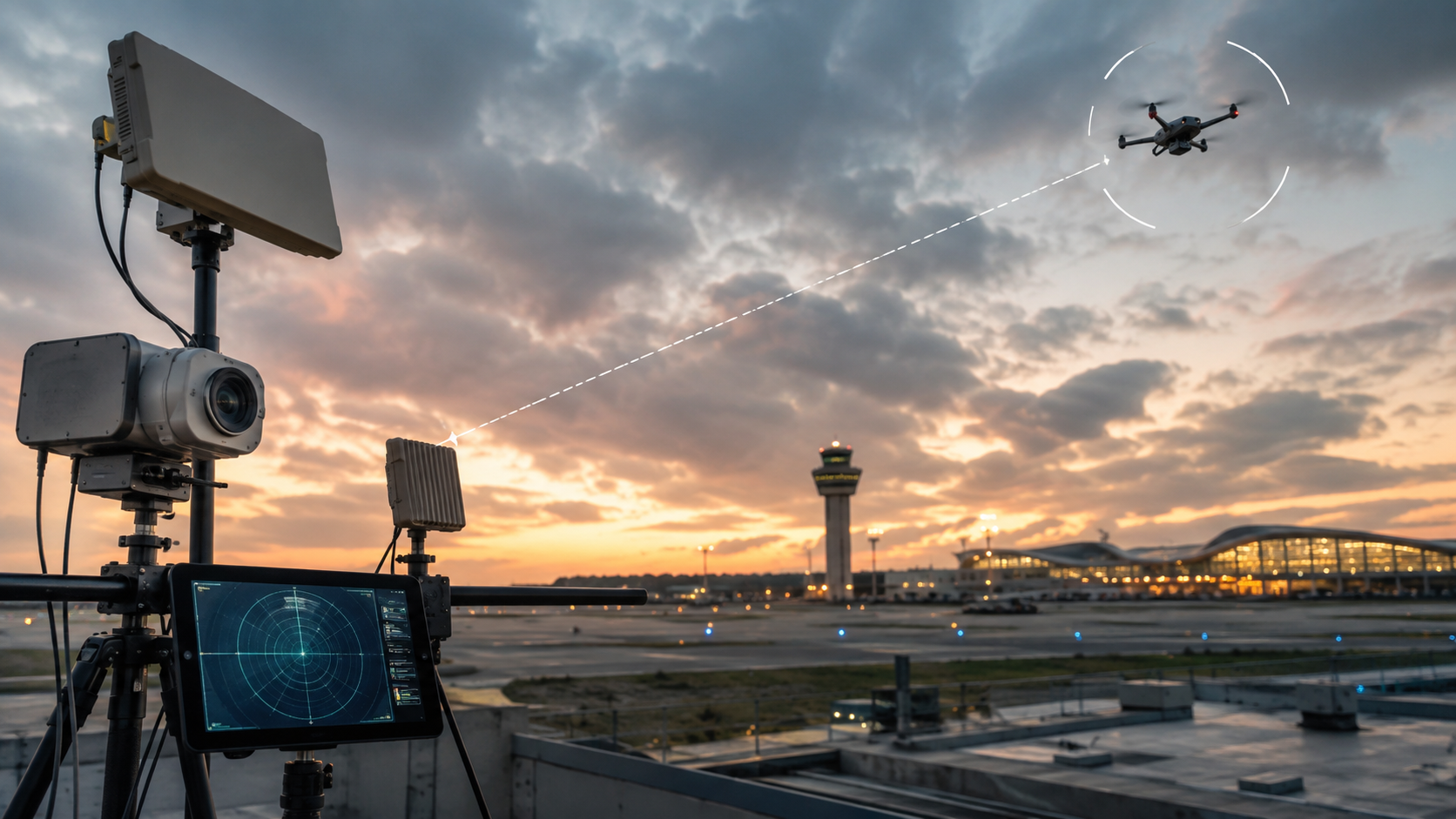
Most public discussion of counter-UAS technology focuses on detection — radar, radio-frequency sensing, acoustic arrays — and on active countermeasures like RF jamming or interceptor drones. A quieter category of counter-drone technology works through purely physical means: netting and barrier systems designed to entangle or block small unmanned aircraft without emitting any signal at all.
Net-Capture Systems
Net-capture counter-UAS systems deploy a net, either fired from a ground-based or drone-mounted launcher, to physically entangle a target drone’s rotors, typically causing it to lose lift and fall, often with a tethered or parachute recovery mechanism to control where it lands. Because these systems rely on physical contact rather than radio-frequency emissions, they can be used in electromagnetically sensitive environments — near airports, hospitals, or facilities where RF jamming would create unacceptable interference risk.
Fixed Netting and Overhead Barriers
A more passive approach uses fixed netting or mesh barriers installed over vulnerable areas — exercise yards at correctional facilities, stadium seating bowls, or sensitive outdoor equipment at critical infrastructure sites — to physically prevent a drone from entering the protected airspace or delivering a payload, regardless of whether the drone has even been detected. This approach trades flexibility for reliability: a fixed net does not require detection, classification, or an operator decision to act, but it also only protects the specific area it physically covers.
Where Physical Countermeasures Fit
Physical counter-UAS methods are generally positioned as a complement to, not a replacement for, detection and RF-based systems. Detection remains necessary to know a threat exists and to cue a response; net-capture systems typically still require a human decision to fire on a specific, confirmed target rather than acting autonomously. Fixed netting, by contrast, requires no real-time decision but only protects a defined footprint.
Legal and Regulatory Considerations
Any counter-drone response, physical or electronic, operates in a legal environment that varies significantly by jurisdiction. In many countries, authority to bring down or interfere with an aircraft — including a small UAS — is restricted to specific government agencies, and private operators of net-capture systems may face legal exposure without proper authorization. Site operators evaluating counter-UAS technology should treat the regulatory and authorization question as a prerequisite, not an afterthought, alongside the technical deployment.
Conclusion
As small drones become a more routine security concern for stadiums, correctional facilities, airports and critical infrastructure, physical countermeasures like net-capture systems and fixed netting offer a non-electronic option that avoids the interference risks of RF jamming. Their real-world value depends heavily on pairing them with reliable detection and on navigating the legal authority questions that govern any active counter-drone response.
Leave a Reply