
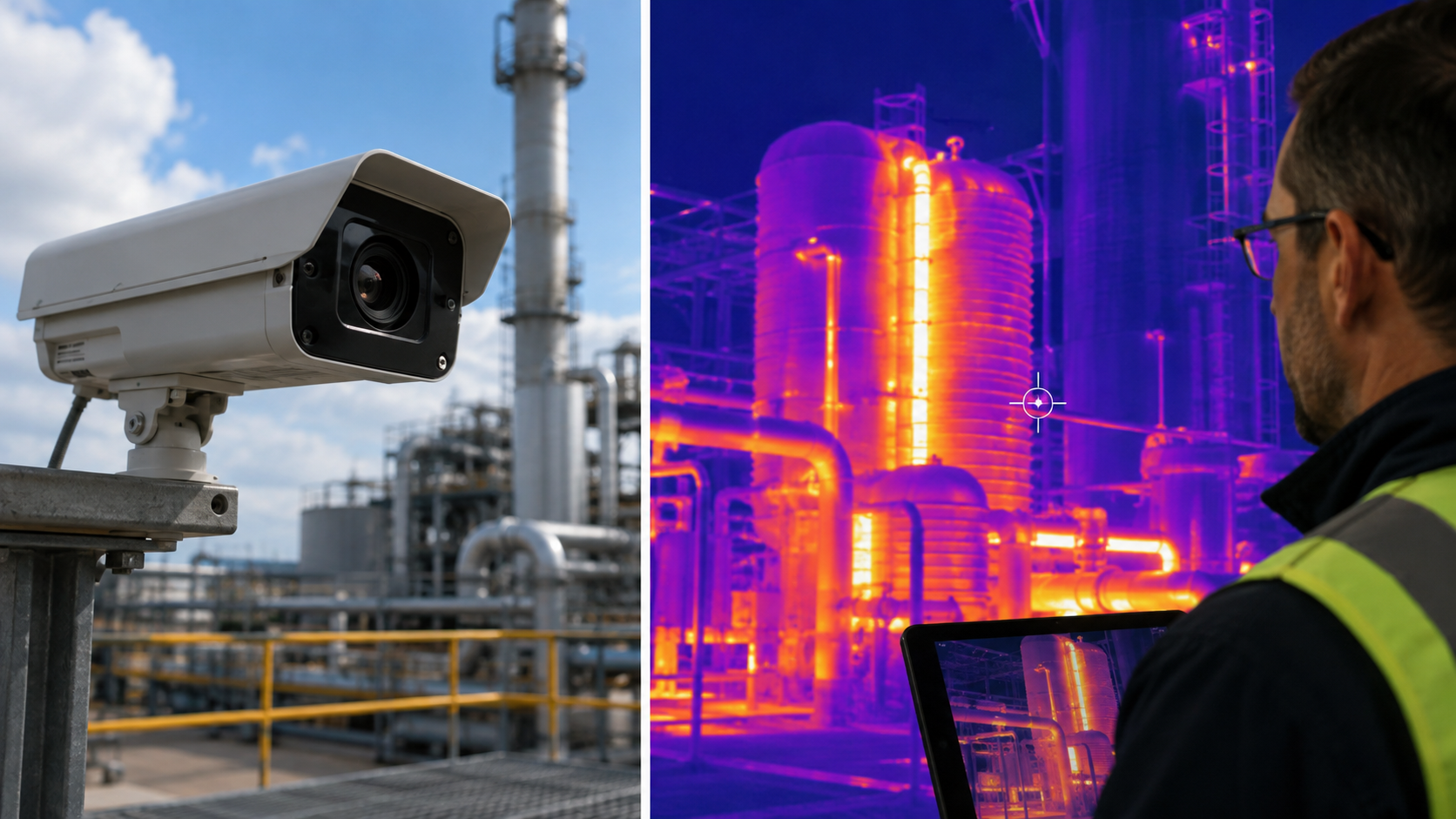
Thermal cameras detect infrared radiation emitted by objects. Because they do not rely on visible illumination, they can detect people, vehicles and equipment in darkness and many difficult lighting conditions. Their strongest role is as part of a layered detection and verification architecture.
Perimeter security
Thermal imaging is especially valuable for perimeter detection. A person may appear as a clear heat contrast when a conventional camera sees only darkness. When paired with properly configured analytics, thermal cameras can classify targets and generate alarms for operator verification.
Industrial monitoring
Thermal cameras are also used to monitor electrical equipment, batteries, process machinery and storage areas for abnormal heat. In these applications, the same sensing platform can contribute to both safety and security operations. Temperature-related conclusions require equipment designed and configured for measurement, not merely thermal video.
Performance in smoke, haze and low contrast
Thermal imaging can sometimes provide useful visibility through light smoke, haze or difficult backlighting where visible cameras struggle. Performance still depends on atmospheric conditions, target contrast, wavelength and the characteristics of the scene.
Advantages of thermal imaging
- Operation without visible illumination
- Strong contrast for many warm targets
- Useful detection capability across large or remote areas
- Potential privacy advantages where facial detail is unnecessary
Important limitations
Thermal cameras do not see through walls and cannot always identify a person. Glass may reflect or block thermal radiation depending on wavelength. Heavy rain, high humidity and extreme ambient temperatures can reduce effective detection performance. Thermal imagery also requires different interpretation from visible video.
Radiometric and non-radiometric systems
Some thermal cameras estimate temperature values, while others are intended only for imaging and detection. Temperature-measurement applications require suitable radiometric equipment, calibration, emissivity settings and environmental compensation. A non-radiometric security camera should not be treated as a precision temperature instrument.
Analytics and seasonal testing
Analytics can detect people or vehicles in thermal scenes, but training data and scene configuration matter. A system should be tested under representative seasonal and weather conditions because temperature contrast changes throughout the year.
Integration with other sensors
A common architecture uses thermal cameras for detection and visible PTZ cameras for verification. Radar can add tracking and range information. Combining complementary sensors can provide stronger situational awareness than relying on any single technology.
Choosing a thermal camera
Selection should begin with the required detection task, field of view, target distance, environmental conditions and integration workflow. Resolution, lens focal length, thermal sensitivity and environmental rating matter, but no single specification determines real-world performance.
Conclusion
Thermal imaging is a powerful specialized tool for physical security and industrial monitoring, but it is not a universal replacement for visible cameras. The best results come from risk-based design, realistic acceptance testing and integration with verification and response procedures.
Leave a Reply