
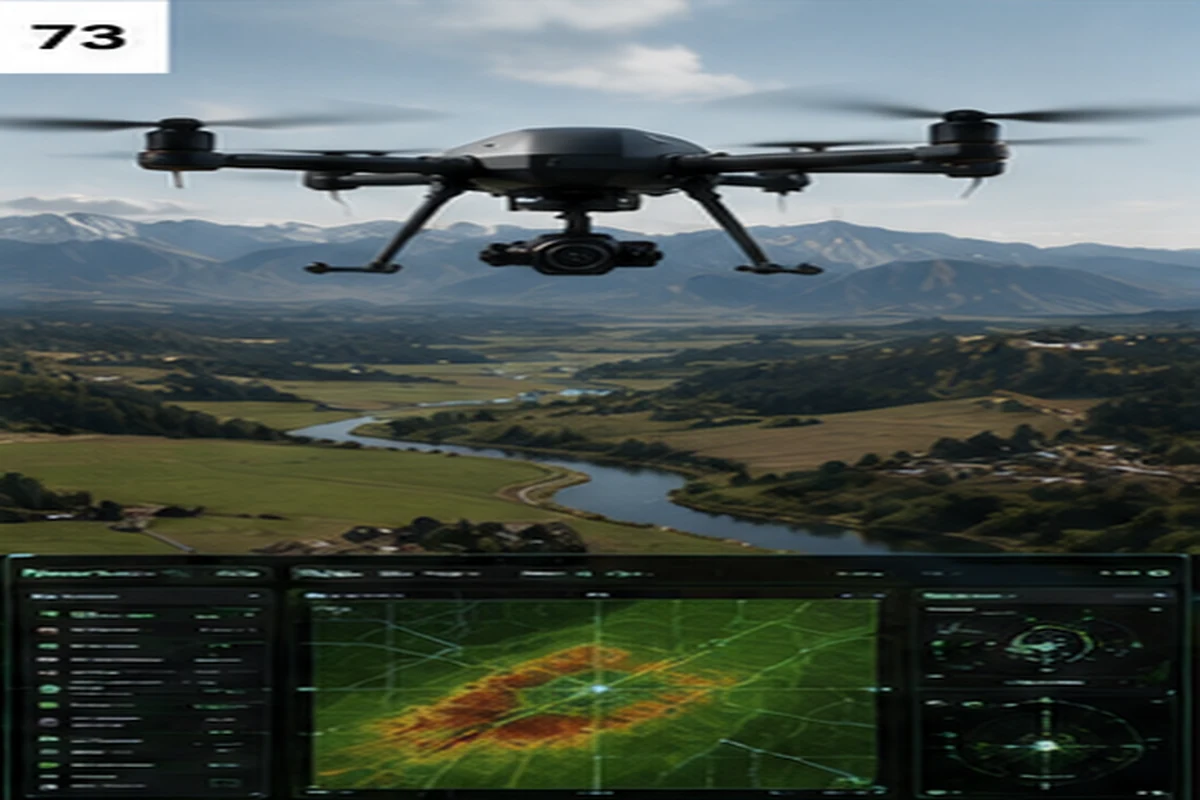
Consumer and commercial drones have become cheap, capable and easy to fly, and that combination has turned unauthorized small unmanned aircraft into a real risk for airports, stadiums, prisons, power plants and other sensitive sites. Counter-UAS (C-UAS) technology is the set of systems built to detect, track, identify and — where legally authorized — mitigate that threat. This guide explains how the major detection layers work, why no single sensor is enough on its own, and what to weigh before deploying a system.
What counter-UAS technology actually does
A counter-UAS deployment is usually described as a four-stage pipeline: detect that an unmanned aircraft is present, track its position and movement over time, identify what kind of drone it is and whether it represents a threat, and — only where the operator is legally authorized to act — mitigate it. Most commercial and critical-infrastructure deployments stop at detect/track/identify; active mitigation such as jamming or physical interception is heavily restricted and, in many jurisdictions, reserved for military, law enforcement or specifically authorized government operators.
The four main detection layers
Real-world counter-UAS systems combine more than one sensor type, because each has a different blind spot.
Radio frequency (RF) detection passively listens for the control and video-link signals between a drone and its operator. It is often the first layer deployed because it is passive, relatively low cost, and can identify a drone’s make and model — and sometimes locate the operator — from its known RF signature. Its limitation is structural: a drone flying a pre-programmed autonomous route with no active control link, or one that is RF-silent by design, will not appear on an RF-only system.
Radar actively illuminates the airspace and detects the reflection, so it finds drones regardless of whether they are transmitting. It can track multiple targets simultaneously, which matters for swarm scenarios, but small consumer drones have a much smaller radar cross-section than aircraft, so effective range for that target class is typically much shorter than a radar’s rated range for larger objects.
Electro-optical and infrared (EO/IR) cameras provide visual or thermal confirmation of a detected track. In most architectures EO/IR is a “slew-to-cue” layer — pointed at a target after RF or radar has already found it — rather than a primary wide-area search sensor, because scanning a full sky visually is slow and unreliable compared with RF or radar detection.
Acoustic sensors use microphone arrays to recognize the sound signature of rotors and propellers. They are passive and comparatively inexpensive, and can work in some non-line-of-sight and low-light conditions, but they are short-ranged and lose reliability near traffic, generators or crowd noise.
Why layered, fused sensing is the standard
No single sensor type covers every scenario, so credible counter-UAS architectures fuse two or more layers rather than relying on one “magic” detector: RF for early warning and identification, radar for RF-silent and autonomous drones, EO/IR for visual verification, and sometimes acoustic sensing as a supplementary layer in quiet environments. A command-and-control platform then fuses detections from each sensor into a single track — without fusion, the same drone can appear as several separate, unconnected alerts, which confuses operators and inflates the apparent scale of a threat.
Mitigation: the heavily regulated final layer
Once a drone is detected, tracked and identified as a genuine threat, mitigation options include RF jamming of the control link, GPS spoofing, high-power microwave devices, physical interceptors such as nets, and — at the most restrictive end — kinetic or directed-energy countermeasures. In most countries these active measures are tightly controlled by aviation and telecommunications law, because jamming or disabling an aircraft can also affect nearby legitimate air traffic and communications. Any organization evaluating counter-UAS technology should confirm what it is legally permitted to do at its specific site before assuming a detection system also gives it the right to act.
Where counter-UAS technology is deployed
Typical deployment sites include airports (where unauthorized drones can force runway closures), stadiums and large public events, correctional facilities (where drones have been used to smuggle contraband), critical infrastructure such as power plants and data centers, and government or military installations. The right sensor mix depends heavily on the site: an airport needs detection that will not generate false alarms from its own radar clutter and air traffic, while a rural substation may prioritize long-range RF and acoustic coverage over a wide, low-traffic perimeter.
What to check before choosing a system
Vendor-quoted detection ranges are typically measured in flat, dry, radio-quiet test conditions. Real-world range at a specific site is reduced by urban RF noise, terrain masking and antenna or mast height, so it is worth asking for performance figures at a comparable site profile rather than a datasheet maximum. It is also worth asking how a vendor maintains its RF and radar signature library, since new consumer drone models are released constantly and a detection library that is not actively updated will miss them. Finally, confirm the legal authorization required for any mitigation capability before including it in a procurement — detection and identification are usually far less regulated than active response.
FAQ
Is RF detection alone enough? No. RF detection misses autonomous or pre-programmed drones that are not actively transmitting to a controller, which is why radar or EO/IR coverage is normally paired with it.
Can a business legally jam or shoot down a drone? In most jurisdictions, no — active mitigation is restricted to authorized government, military or law-enforcement operators. Commercial sites typically deploy detection, tracking and identification, then hand off to authorities for response.
What is the single most important design decision? Matching the sensor mix to the site’s terrain, RF environment and threat profile, rather than deploying one sensor type everywhere. A layered, fused approach consistently outperforms any single technology.
Verification note: This guide describes counter-UAS technology at a general, technology level. It does not cite specific vendor products, performance claims or deployment case studies, since those figures vary by manufacturer and require independent verification before publication.
Leave a Reply