Author: Osiris

  • Cyberattack on Manchester Airports Group Exposes Data of 8.7 Million Customers

    Cyberattack on Manchester Airports Group Exposes Data of 8.7 Million Customers

    Manchester Airports Group, which operates Manchester, London Stansted and East Midlands airports in England, said on August 27, 2026 that it was hit by a cyberattack exposing data belonging to roughly 8.7 million customers, according to the company’s public notice and reporting by The Record and the Yorkshire Post. An unauthorized third party accessed customer data tied to car park, lounge and Fast Track bookings, as well as in-airport Wi-Fi sign-ups.

    The compromised information includes email addresses, phone numbers, vehicle registrations and postcodes; the company said neither it nor the affected system stores payment card or banking details, and that no financial data was exposed. MAG said it was alerted to the incident on a Tuesday and believes attackers first accessed the data a few days before discovery. The company has restricted access to the affected systems, engaged outside cybersecurity specialists, notified relevant authorities and temporarily suspended its online Manage My Booking service as a precaution.

    MAG said passenger safety and aviation security systems were not affected and that flights, airport operations and parking continue to operate normally; the three airports handled more than 65 million passengers last year. The incident illustrates a distinction increasingly emphasized by airport operators: a breach of customer-facing IT and booking systems does not necessarily indicate any compromise of the physical security, screening or airside operational systems that are typically segmented onto separate networks.

  • ATF Confirms Cyberattack on Standalone System Containing Investigation Targets, Calls It a Major Incident

    ATF Confirms Cyberattack on Standalone System Containing Investigation Targets, Calls It a Major Incident

    The Bureau of Alcohol, Tobacco, Firearms and Explosives confirmed on August 27, 2026 that a standalone computer system containing information about targets of ATF investigations was breached, designating the incident a “major incident” under federal guidelines, according to an agency statement and reporting by Recorded Future News. The Justice Department component had appeared on the leak site of the Qilin ransomware gang earlier in the week, though the group did not publish samples of stolen data.

    An ATF spokesperson said the affected system “was not connected to any other ATF systems, including any case management systems, laboratory systems, or eForms systems,” and that it was shut down as soon as the breach was discovered. The agency said its investigative and operational missions were not disrupted, and that the Justice Department is investigating the incident. Qilin has been among the most active ransomware operations of the past two years, with previously claimed attacks on Kuala Lumpur International Airport, beverage maker Asahi, a Texas municipal government and several U.S. power cooperatives.

    The incident adds to a run of cyberattacks affecting Justice Department components in recent years, including earlier breaches involving the U.S. Marshals Service and the federal courts’ docketing system. For law enforcement and government facilities, the case underscores a recurring theme in ransomware incidents: segmenting sensitive investigative systems from broader case-management and operational networks can limit the blast radius of an attack even when a breach cannot be entirely prevented.

  • White House Bans Foreign-Made Bulk-Power System Equipment Over Cyber Backdoor Concerns

    White House Bans Foreign-Made Bulk-Power System Equipment Over Cyber Backdoor Concerns

    President Trump signed an executive order on August 26, 2026 declaring a national emergency over the security of the U.S. bulk-power system and banning the acquisition or installation of foreign-made equipment used to manage electricity transmission and generation, according to the order published by the White House and reporting by The Record. The order covers technology tied to transmission lines rated at 69,000 volts or higher, along with substations, control rooms, power generating stations and reactors, as well as associated software and firmware that could be remotely accessed or updated by foreign governments.

    The administration said the action responds to a pattern of foreign actors “creating and exploiting vulnerabilities” in bulk-power system technology that could enable remote access or supply-chain disruptions. The order directs the Departments of Defense, Commerce and Energy to review transactions involving bulk-power equipment and calls for a published list of pre-qualified vendors and components that federal agencies and utilities can rely on going forward.

    The order follows a string of confirmed intrusions into critical infrastructure operators this year, including cyberattacks affecting water utilities in multiple U.S. states and a reported multi-day shutdown of a small power plant in the United Kingdom, incidents that researchers have variously linked to Iranian, Russian and Chinese-linked hacking groups. For operators of power generation and transmission facilities, the order effectively elevates supply-chain vetting of grid control and monitoring equipment to the same priority long applied to physical perimeter security and access control systems protecting the same sites.

  • CISA Adds Six Vulnerabilities to Known Exploited Vulnerabilities Catalog, Including Citrix NetScaler Flaw

    CISA Adds Six Vulnerabilities to Known Exploited Vulnerabilities Catalog, Including Citrix NetScaler Flaw

    The Cybersecurity and Infrastructure Security Agency (CISA) added six vulnerabilities to its Known Exploited Vulnerabilities (KEV) Catalog on August 26, 2026, based on confirmed evidence of active exploitation. The catalog is the authoritative federal list of vulnerabilities that malicious actors are actively using in real-world attacks.

    The newly added entries are:

    • CVE-2026-8452 — Citrix NetScaler ADC and NetScaler Gateway improper restriction of operations within the bounds of a memory buffer vulnerability
    • CVE-2022-0995 — Linux Kernel out-of-bounds write vulnerability
    • CVE-2021-23758 — Ajax.NET Professional deserialization of untrusted data vulnerability
    • CVE-2019-1068 — Microsoft SQL Server remote code execution vulnerability
    • CVE-2015-5287 — Red Hat Automatic Bug Reporting Tool (ABRT) privilege escalation vulnerability
    • CVE-2015-3246 — Red Hat Libuser race condition vulnerability

    The mix illustrates a pattern CISA has flagged repeatedly this year: threat actors continue to exploit vulnerabilities dating back a decade alongside newly disclosed flaws, particularly where organizations have failed to retire legacy systems or apply available patches. The Citrix NetScaler entry is the most recent disclosure in the group and affects widely deployed application delivery and remote access infrastructure, making it an attractive target for initial network access.

    Federal Remediation Requirements

    Binding Operational Directive (BOD) 26-04, Prioritizing Security Updates Based on Risk, requires Federal Civilian Executive Branch (FCEB) agencies to remediate catalog vulnerabilities by CISA-assigned due dates, with particular urgency for flaws that grant an attacker total control of an affected asset post-exploitation. The directive also establishes baseline expectations for agencies to check whether a system was already compromised before a patch was applied.

    While BOD 26-04 formally applies only to FCEB agencies, CISA continues to encourage all organizations — including operators of industrial, commercial, and critical infrastructure systems — to treat KEV Catalog membership as a high-priority signal for patch management, given that every entry reflects confirmed, not merely theoretical, exploitation activity.

  • Lockheed Martin Demonstrates AI-Driven Battle Management Prototype for Guam Missile Defense

    Lockheed Martin Demonstrates AI-Driven Battle Management Prototype for Guam Missile Defense

    Lockheed Martin demonstrated a prototype AI-driven battle management system for the Guam Defense System (GDS) on August 26, 2026, showing how artificial intelligence analytics can compress the time it takes to detect, evaluate, and respond to air and missile threats in a simulated Guam operational environment.

    The prototype, called the GDS Battle Manager Suite, networks data from multiple Integrated Air and Missile Defense (IAMD) systems slated for deployment to Guam, including Aegis Guam and the Integrated Battle Command System (IBCS), into a single tactical picture. Powered by Lockheed Martin’s CommandIQ software, the system applies AI analytics to assess incoming tracks and generate fire-direction recommendations for human operators.

    From Request to Demonstration in Under Two Months

    The U.S. Army issued a call for a GDS Battle Manager Suite solution in June 2026. Lockheed Martin was invited to a Phase 2 evaluation at the Army Tactical Systems Integration Laboratory at Fort Bliss, Texas, where the company said its prototype was integrated and met demonstration requirements within 24 hours of arrival on site.

    Traditional IAMD battle management has relied on operators manually correlating information across documents, voice channels, and text messages — a process that is time-consuming and prone to error under the compressed timelines of a missile engagement. By automating that correlation and applying algorithmic shot selection informed by extensive simulation data, Lockheed Martin says the system is designed to give operators machine-speed decision support while helping preserve high-cost interceptor inventories.

    Part of a Broader Command-and-Control Push

    The Guam prototype follows related software-based command-and-control integration work Lockheed Martin performed during the Valiant Shield 2026 exercise, which the company has cited as evidence that capabilities developed across different programs and vendors can be connected rapidly to meet emerging operational requirements — a recurring theme as the Pentagon pushes for faster, more interoperable air and missile defense architectures across the Indo-Pacific.

    Guam’s defense architecture has been a focus of U.S. missile defense investment for several years given the island’s strategic role as a forward operating location. Layering AI-assisted battle management on top of existing sensor and interceptor networks is intended to help defenders manage a more complex and saturated threat picture without proportionally increasing the number of personnel required to operate it.

  • CISA Warns of Hardcoded Credentials in Johnson Controls TL280 Security Cameras

    CISA Warns of Hardcoded Credentials in Johnson Controls TL280 Security Cameras

    CISA published an Industrial Control Systems advisory on August 6, 2026 (ICSA-26-218-02) warning that Johnson Controls TL280 cameras running firmware versions prior to 5.63 contain hardcoded credentials that could allow an attacker to access sensitive information on the device.

    The vulnerability, tracked as CVE-2026-27871 and rated 4.1 on the CVSS v3 scale, stems from the use of a broken or risky cryptographic algorithm tied to authentication values embedded directly in the device firmware. Because the credentials are fixed at the firmware level rather than generated per device, an attacker who recovers them from one unit could potentially reuse them across other TL280 deployments running the same vulnerable firmware version.

    Johnson Controls, headquartered in Ireland, reports that TL280 units are deployed worldwide across Critical Manufacturing, Commercial Facilities, Government Services and Facilities, Transportation Systems, and Energy sectors — reflecting how widely IP camera platforms from major building-security vendors have been integrated into critical infrastructure environments. As of the advisory’s publication, CISA said it was not aware of public exploitation specifically targeting this vulnerability.

    Recommended Mitigations

    Johnson Controls’ primary recommended fix is to apply firmware update 5.63, which addresses the hardcoded credential weakness directly. CISA and the vendor also recommend layered compensating controls for cameras that cannot be updated immediately:

    • Restrict network access to affected cameras to trusted management VLANs only, and avoid exposing devices directly to the internet or untrusted network segments
    • Monitor device access logs for anomalous authentication activity
    • Rotate any shared or downstream credentials that may have been derived from or associated with the hardcoded values
    • Segment ICS/SCADA and physical-security device networks behind firewalls, isolated from general business networks
    • Use up-to-date VPNs for any required remote access rather than direct internet exposure

    The advisory is a reminder that video surveillance hardware sits at the intersection of physical and cyber risk: a credential weakness in a camera is not just a data-exposure issue but a potential foothold into the broader network segment the camera is connected to, particularly in environments where security devices are deployed on flat, unsegmented networks.

  • Supply Chain and Cargo Security Technology: Protecting Goods in Transit

    Supply Chain and Cargo Security Technology: Protecting Goods in Transit

    Cargo theft and supply chain tampering represent a persistent and, according to industry logistics and insurance publications, growing risk for shippers, carriers and the retailers and manufacturers who depend on predictable delivery of goods. Unlike facility-based physical security, which can rely on a fixed perimeter and stationary sensors, cargo security technology has to protect assets that are constantly moving through a chain of custody spanning warehouses, trucks, rail yards, ports and, in many cases, multiple countries and jurisdictions.

    GPS tracking is the foundational layer, but modern cargo security goes well beyond simple location reporting. Tracking devices installed on trailers, containers or high-value pallets increasingly combine location data with motion sensors, light sensors and door-open detection, so that a monitoring system can distinguish a truck making a scheduled stop from a trailer being diverted from its planned route or opened at an unscheduled location. Geofencing, which triggers an alert when a shipment deviates from an approved route corridor or dwells outside an authorized stop for longer than a defined threshold, is one of the most widely deployed capabilities because it converts raw location data into an actionable alert rather than requiring a human to continuously monitor a map.

    Seal integrity monitoring addresses the specific risk of container or trailer tampering during transit. Traditional mechanical seals only reveal tampering after the fact, when a receiving facility inspects the seal and finds it broken or replaced. Electronic seals, which report their status to a monitoring platform in near real time, close that gap by alerting a monitoring center the moment a seal is opened or its circuit is broken, regardless of where in the journey that occurs, giving carriers and shippers the ability to respond during transit rather than discovering a loss only at delivery.

    Video and sensor technology at cargo handling facilities, including ports, rail yards and cross-dock warehouses, has increasingly incorporated automated license plate and container number recognition to reconcile physical cargo movement against shipping manifests automatically, flagging discrepancies between what a system expects to see and what cameras actually capture at a gate or loading dock. This automated reconciliation reduces reliance on manual gate-log entry, which remains a common point of both error and, in cases of insider-facilitated theft, deliberate manipulation.

    Driver and facility access verification is a frequently underweighted layer of cargo security. A significant share of cargo theft, according to logistics security industry reporting, involves some degree of insider knowledge or facilitation, whether through compromised load information, fraudulent pickup credentials, or collusion with facility personnel. Technology responses include multi-factor verification of drivers and carriers at pickup, digital credentialing tied to a specific scheduled load rather than a general facility access badge, and audit trails that log which personnel accessed load and routing information ahead of a theft, supporting investigation after an incident occurs.

    Data integration across these layers, tracking devices, electronic seals, gate cameras and transportation management systems, is what separates a mature cargo security program from a collection of disconnected point solutions. Organizations increasingly centralize this data into a single monitoring capability, whether an in-house logistics security operations function or a third-party cargo security monitoring service, so that an anomaly detected by one system, such as a route deviation flagged by GPS tracking, can be immediately cross-referenced against seal status and the load’s risk classification to determine whether the deviation warrants an automated alert, a phone call to the driver, or immediate law enforcement notification.

  • Global Security Operations Center (GSOC) Design: People, Process and Technology

    Global Security Operations Center (GSOC) Design: People, Process and Technology

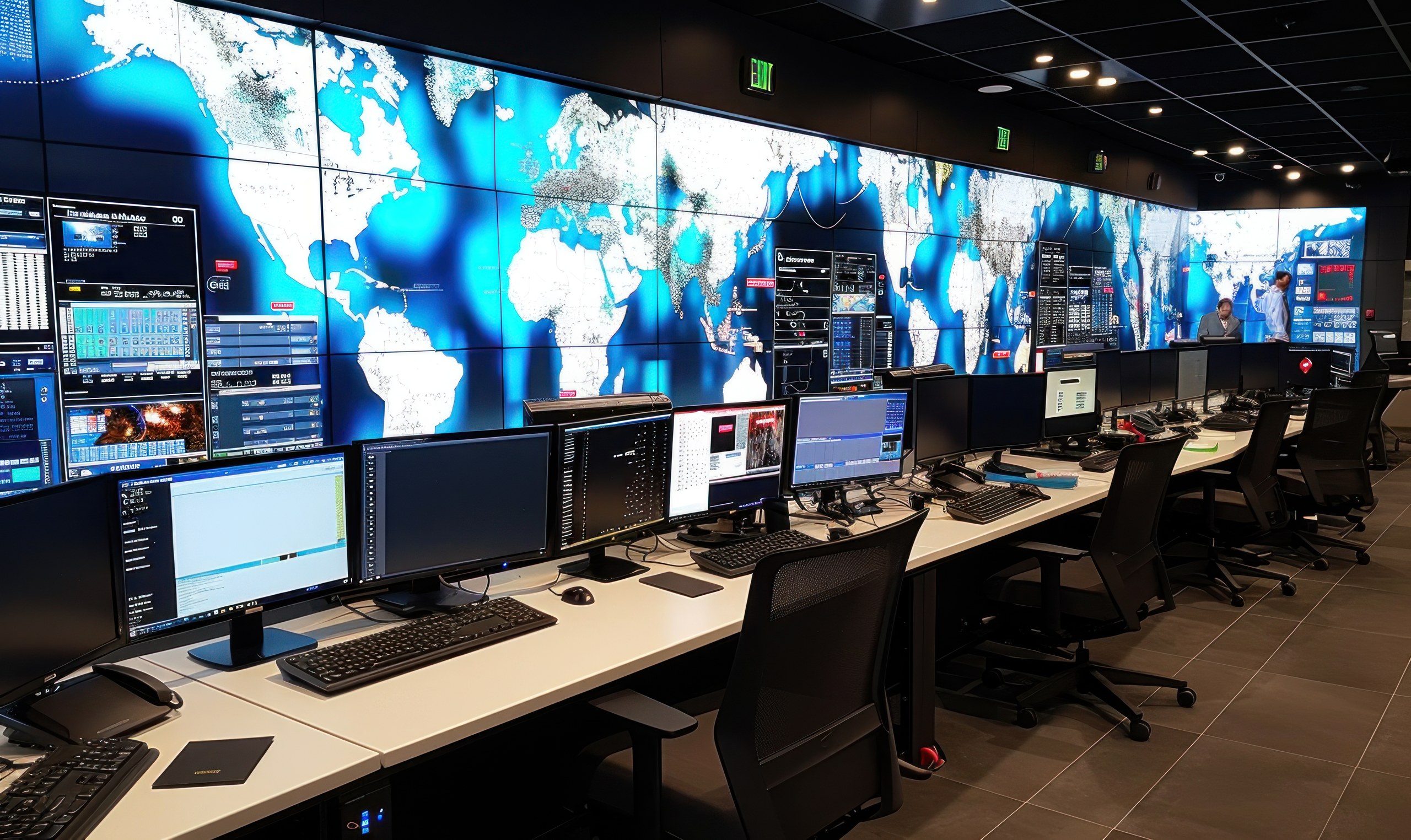
    A Global Security Operations Center, or GSOC, centralizes monitoring and incident response for organizations with security operations spread across multiple facilities, regions or time zones. Unlike a single-site guard station monitoring local cameras and alarms, a GSOC is built to aggregate video, access control, intrusion detection, travel risk intelligence and often cybersecurity alerting from dozens or hundreds of locations into a unified operating picture, with staff trained to triage and coordinate response regardless of where an incident originates.

    The technology layer that makes this possible is a physical security information management (PSIM) platform, or increasingly a unified security platform that combines video management, access control and analytics natively rather than through a separate integration layer. The core function of this software is normalization: translating alerts and video feeds from potentially dozens of different camera manufacturers, access control panels and alarm systems, often installed at different times by different integrators, into a consistent interface that a GSOC operator can act on without needing to learn each underlying vendor system individually.

    Staffing model and shift structure are as important to GSOC effectiveness as the underlying software. A GSOC covering global operations typically requires 24/7 staffing organized around a “follow the sun” model, with regional teams handing off situational awareness at shift boundaries, or a single centralized team working rotating shifts. The choice affects language coverage, familiarity with regional regulatory and cultural context, and response time to incidents occurring outside a centralized team’s typical working hours; organizations with major operations concentrated in a small number of regions often favor a hybrid model with a smaller follow-the-sun core team supplemented by on-call regional specialists.

    Alert prioritization and workflow design determine whether a GSOC scales effectively as the number of monitored sites grows. Without a structured triage process, a GSOC ingesting alerts from hundreds of facilities can quickly become overwhelmed by nuisance alarms, such as motion-triggered alerts from wildlife or weather rather than genuine intrusions. Mature GSOCs implement tiered alert classification, often informed by analytics that pre-filter video-based alerts before they reach a human operator, and maintain documented standard operating procedures that specify escalation paths, notification requirements and decision authority for different incident categories, from a minor access control malfunction to an active threat requiring law enforcement coordination.

    Integration with business continuity and crisis management functions is increasingly a defining feature of higher-maturity GSOCs. Rather than operating purely as a security monitoring function, many organizations now position their GSOC as the initial point of situational awareness for a broader range of business-impacting events, including severe weather affecting a facility, civil unrest near a location with traveling employees, or a supply chain disruption at a manufacturing site, feeding that awareness into the organization’s broader crisis management and business continuity processes rather than treating physical security monitoring as an isolated function.

    Facility design for a physical GSOC space itself follows established principles: redundant power and network connectivity, video walls sized and positioned for extended-shift ergonomics, and physical security controls for the GSOC space that reflect its role as a high-value target in its own right, since an incident that disables or compromises the GSOC’s own operations removes situational awareness across the entire organization at the moment it may be needed most. Organizations building or upgrading a GSOC increasingly plan for a geographically redundant backup facility or cloud-hosted failover capability, so that a single site outage, whether from a power failure, natural disaster or targeted attack, does not eliminate centralized monitoring capability entirely.

  • AI-Based Concealed Weapons Detection: How Walkthrough Systems Work

    AI-Based Concealed Weapons Detection: How Walkthrough Systems Work

    A newer category of weapons detection has emerged over the past several years alongside traditional metal detectors and X-ray screening: walkthrough systems that use sensor fusion and machine learning to flag concealed firearms and large blades without requiring visitors to empty pockets, remove belts, or stop and be individually wanded. These systems are increasingly deployed at venues, schools, stadiums, hospitals and corporate campuses seeking higher throughput than conventional metal detection allows while still screening for weapons rather than general metal content.

    The underlying sensing approaches vary by vendor but generally fall into two categories: active electromagnetic field sensing, which detects disturbances in a low-power magnetic field as a person walks through a portal, and millimeter-wave or other RF-based imaging, which can detect the physical shape and material properties of concealed objects at a distance. Both approaches feed raw sensor data into a machine-learning classification model trained to distinguish the electromagnetic or material signature of firearms and large blades from the signatures of common personal items such as laptops, keys, belt buckles and phones.

    The core technical challenge is the same one that affects any binary detection system: the trade-off between false negatives (missed weapons) and false positives (alarms on benign items). Vendors in this category generally tune their classification models toward minimizing false negatives given the severity of a missed detection, which means false alarm rates on common metal objects remain a genuine operational consideration; venues deploying these systems typically pair them with a secondary visual or manual check process for anyone who triggers an alert, rather than treating the AI classification as a final determination on its own.

    Throughput is the primary operational advantage these systems offer over traditional walk-through metal detectors paired with bag search and wanding. Because visitors do not need to remove metal objects from pockets or empty bags for the primary screening pass, venues can process significantly higher visitor volumes per lane during peak entry periods such as event doors opening or shift changes at a large facility. This throughput advantage is a major driver of adoption at large venues, though it depends on adequate staffing for the secondary screening process that handles alerts, since a system that generates alerts faster than staff can resolve them simply creates a new bottleneck at the secondary screening point.

    Placement and environmental tuning matter significantly to real-world performance. Systems using electromagnetic field sensing can be affected by nearby metal structures, electronic equipment, or other portals placed too close together, requiring careful site surveys and calibration during installation. Integrators typically conduct a threat testing and calibration process specific to each installation site rather than relying solely on factory default settings, and ongoing recalibration is generally required as a venue’s surrounding infrastructure or foot traffic patterns change.

    Privacy and civil liberties considerations differ from those raised by facial recognition or license plate reading, since these systems generally are not designed to identify individuals, but questions remain about how alert data, video capture at detection points, and any biometric-adjacent data are stored and for how long. Procurement teams evaluating this category should request clarity on data retention practices, false alarm rate testing under realistic conditions rather than only controlled test environments, and integration requirements with existing access control and video management systems, since standalone weapons detection lanes that are not integrated with a venue’s broader security operations center reduce the speed at which an alert can be escalated to a coordinated response.

  • Executive and Dignitary Protection Technology: GPS, Panic Alerts and Travel Risk Intelligence

    Executive and Dignitary Protection Technology: GPS, Panic Alerts and Travel Risk Intelligence

    Executive protection has historically relied on trained personnel: close protection officers, advance teams and drivers who assess a principal’s environment in real time. Technology has not replaced that human judgment, but it has meaningfully extended what a protection team can see and how quickly it can respond, particularly for organizations that need to protect executives, board members or high-profile individuals across frequent, often international, travel.

    Location awareness is the foundational layer. Modern executive protection programs typically issue principals a discreet tracking device, or rely on a mobile application with background location services, that reports position to a monitoring center on a continuous or interval basis. The technical trade-off is between battery life and update frequency: continuous high-frequency GPS reporting drains battery quickly and can be detected by device-scanning tools, while longer reporting intervals conserve power but reduce situational awareness during a fast-moving incident. Many programs address this by combining a low-frequency background trace with an on-demand “check-in” or panic function that triggers high-frequency reporting the moment it is activated.

    Panic and duress alerting has moved well beyond a single button. Contemporary systems support silent activation methods, including a specific sequence of button presses on a smartphone, a wearable device with a discreet trigger, or voice-activated duress phrases that can be spoken into a phone call without alerting a nearby threat actor that an alert has been raised. When triggered, these systems typically push the principal’s live location, a pre-recorded audio or video stream if available, and relevant medical and emergency contact information simultaneously to a monitoring center, local protection team members, and in some deployments directly to a pre-coordinated local emergency response contact.

    Travel risk intelligence is the layer that operates before a trip begins rather than during an incident. Dedicated travel risk management platforms aggregate data from government travel advisories, regional threat intelligence feeds, health and disease surveillance sources, and civil unrest monitoring services, then map that data against a principal’s planned itinerary to flag elevated-risk destinations, routes or dates. Advance teams use this intelligence to adjust routing, lodging selection and local security staffing, and increasingly to pre-position emergency evacuation plans and medical assistance contracts specific to the destination.

    Communication redundancy is a design principle that runs through all of these systems. A protection program that depends entirely on a principal’s personal smartphone and cellular connectivity has a single point of failure in exactly the scenarios, such as civil unrest or infrastructure disruption, where reliable communication matters most. Mature programs layer satellite communication devices, encrypted messaging applications that can operate over degraded connectivity, and pre-briefed rally points and communication windows that do not depend on any single technology working correctly.

    Integration with corporate security operations centers is increasingly common for organizations with dedicated executive protection functions, allowing a principal’s location and duress status to appear alongside broader corporate security monitoring rather than in an isolated protection-team-only system. This integration raises the same governance questions found in other converged security programs: who has visibility into an executive’s real-time location, how long location history is retained, and what separation exists between legitimate protective monitoring and inappropriate surveillance of a senior executive’s personal movements.