
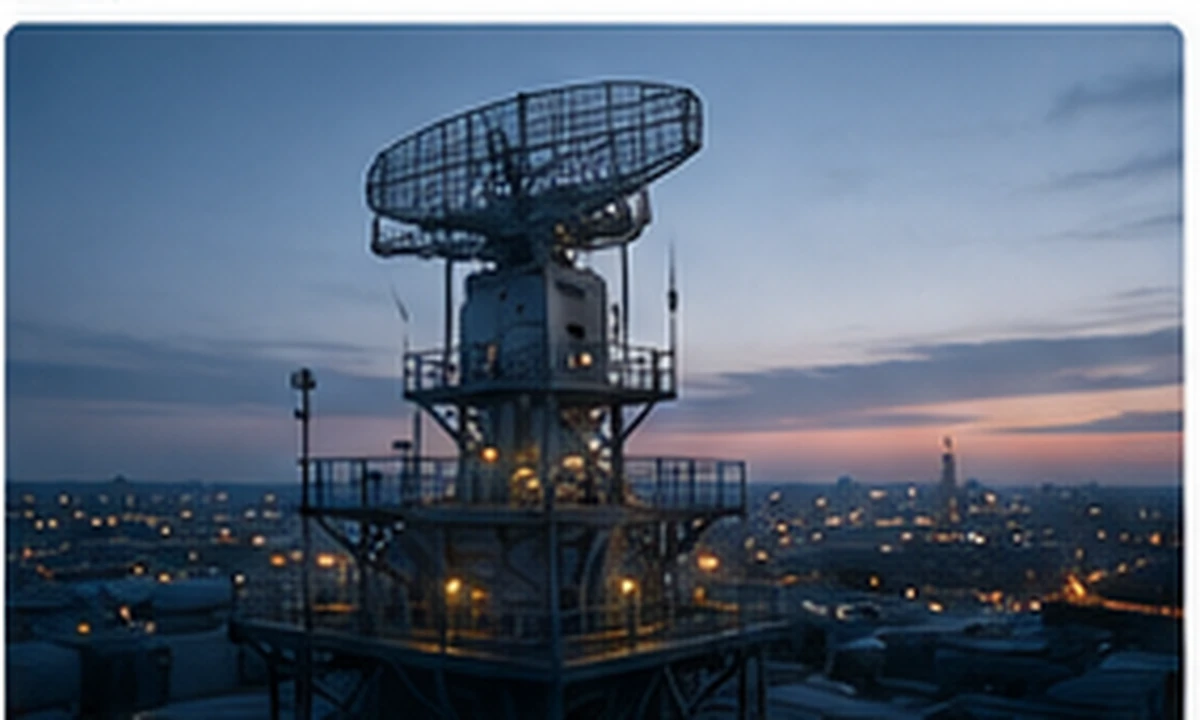
Radar has quietly become one of the more important sensor types in commercial perimeter security, moving well beyond its traditional home in aviation and military applications. For sites that need reliable detection across large open areas and in poor visibility, radar increasingly sits alongside cameras and fence-line sensors rather than as a niche add-on.
Why Radar Fits Perimeter Detection
Radar works by emitting radio waves and measuring how they reflect off objects, calculating range, speed and direction of movement independent of light or weather conditions. That makes it fundamentally different from video-based detection, which depends on adequate lighting and a clear line of sight, and from fence-mounted or buried sensors, which only detect activity at the point of intrusion rather than approach. A radar unit can detect a person or vehicle approaching a perimeter well before they reach it, in complete darkness, heavy rain, fog or blowing dust that would defeat most cameras.
From Military-Grade to Commercially Practical
Early security radar systems were adapted from military and airport surveillance technology, which made them expensive and often overly sensitive for typical commercial use. The current generation of ground surveillance radar is purpose-built for perimeter security, with solid-state designs, lower price points, and detection logic tuned to classify people and vehicles rather than simply flagging any movement, which has driven down the false-alarm rates that limited earlier radar deployments.
Where Radar Is Being Deployed
Radar has found a particular niche protecting large, open sites where fence-line sensors or camera coverage alone would be impractical or prohibitively expensive: solar farms, substations, ports, logistics yards, construction sites and data center campuses. In these environments, a small number of radar units can cover distances that would require dozens of cameras, and the radar’s output can then cue nearby pan-tilt-zoom cameras to automatically point at and record a detected target, combining radar’s long-range detection with video’s ability to visually confirm and identify a threat.
Radar as Part of a Layered System
Security professionals generally treat radar as one layer in a broader detection strategy rather than a standalone solution. Radar excels at early, long-range detection across open ground but provides limited ability to identify what it has detected, which is why it is typically paired with video analytics for classification and verification, and sometimes with thermal cameras for confirmation in total darkness. This sensor-fusion approach, combining radar’s reach with the identification strengths of video and thermal imaging, has become a common design pattern for protecting critical infrastructure and other large perimeters.
FAQ
Does radar replace cameras in perimeter security? No. Radar is generally used to detect and track objects across an open area, then hand off to cameras for visual verification and identification, rather than replacing video entirely.
Can radar work in bad weather? Yes, this is one of radar’s core advantages. Because it uses radio waves rather than visible light, radar performance is largely unaffected by darkness, fog, rain, dust and similar conditions that degrade camera performance.
Is security radar expensive to deploy? Costs have fallen significantly compared with early military-derived systems, and because a single radar unit can cover a large area, overall system cost per square foot of coverage is often lower than achieving equivalent coverage with cameras alone.
Leave a Reply