
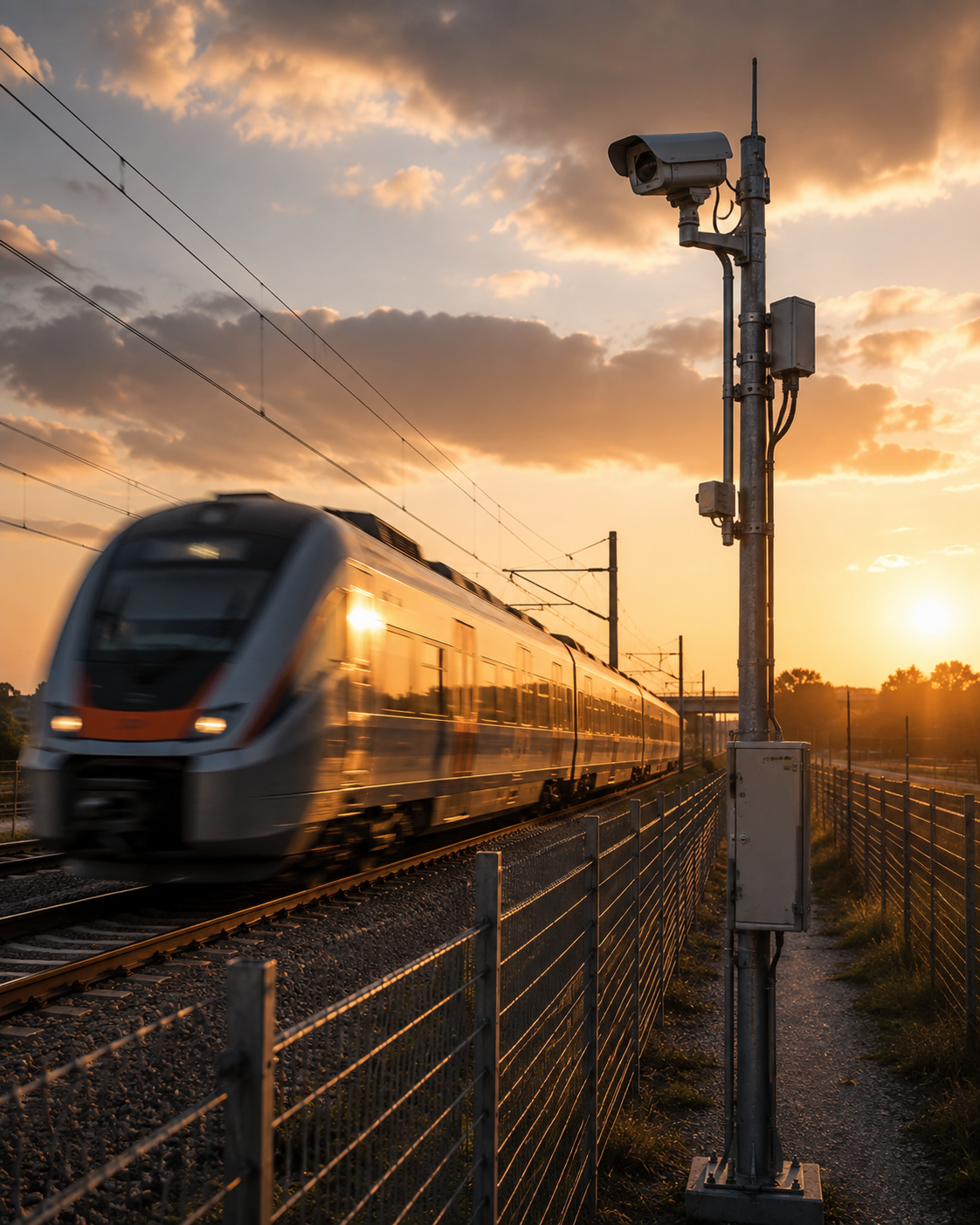
Rail networks extend across long corridors that are difficult to monitor continuously with cameras and point sensors. Distributed Acoustic Sensing can use a fiber running beside the track to observe vibration along many kilometers from a single interrogator.
Train detection and tracking A moving train generates a strong and characteristic vibration signature. DAS analytics can estimate its position, direction and speed as the signal moves along the fiber. This creates a distributed view of traffic even where no conventional trackside detector is installed.
Trackside intrusion Footsteps, vehicles and activity near the railway can produce distinct patterns. A DAS system may help identify trespass, unauthorized maintenance activity or movement in protected areas. The exact detection performance depends on fiber placement, ground coupling and background vibration.
Infrastructure condition awareness Changes in vibration patterns can also provide clues about track, wheel or infrastructure condition. Repeated measurements can be compared over time to identify unusual behavior. DAS should not be treated as a replacement for certified railway condition-monitoring systems, but it can add a valuable continuous data layer.
Rockfall and environmental events In suitable installations, distributed sensing can identify ground vibration associated with rockfall, landslides or other events near the track. Combining DAS with weather, geotechnical and camera data can improve situational awareness on vulnerable routes.
Existing telecom fiber Railways often already have optical fiber installed for signaling and communications. In some cases, spare fibers—or even fibers in existing cable routes—can be used for sensing. This can make large-scale pilots practical without building a new powered sensor network along the entire line.
Analytics are essential Rail environments contain complex vibration from trains, road crossings, machinery and nearby communities. Event classification must be trained and validated against real local conditions. Alarm thresholds that work on one section of track may not be appropriate elsewhere.
The broader opportunity is to transform railway fiber from a communications asset into a sensing infrastructure. With the right analytics and integration, the same corridor can support train awareness, intrusion detection, environmental monitoring and condition intelligence over distances that are difficult to cover with conventional sensors alone.
Leave a Reply