
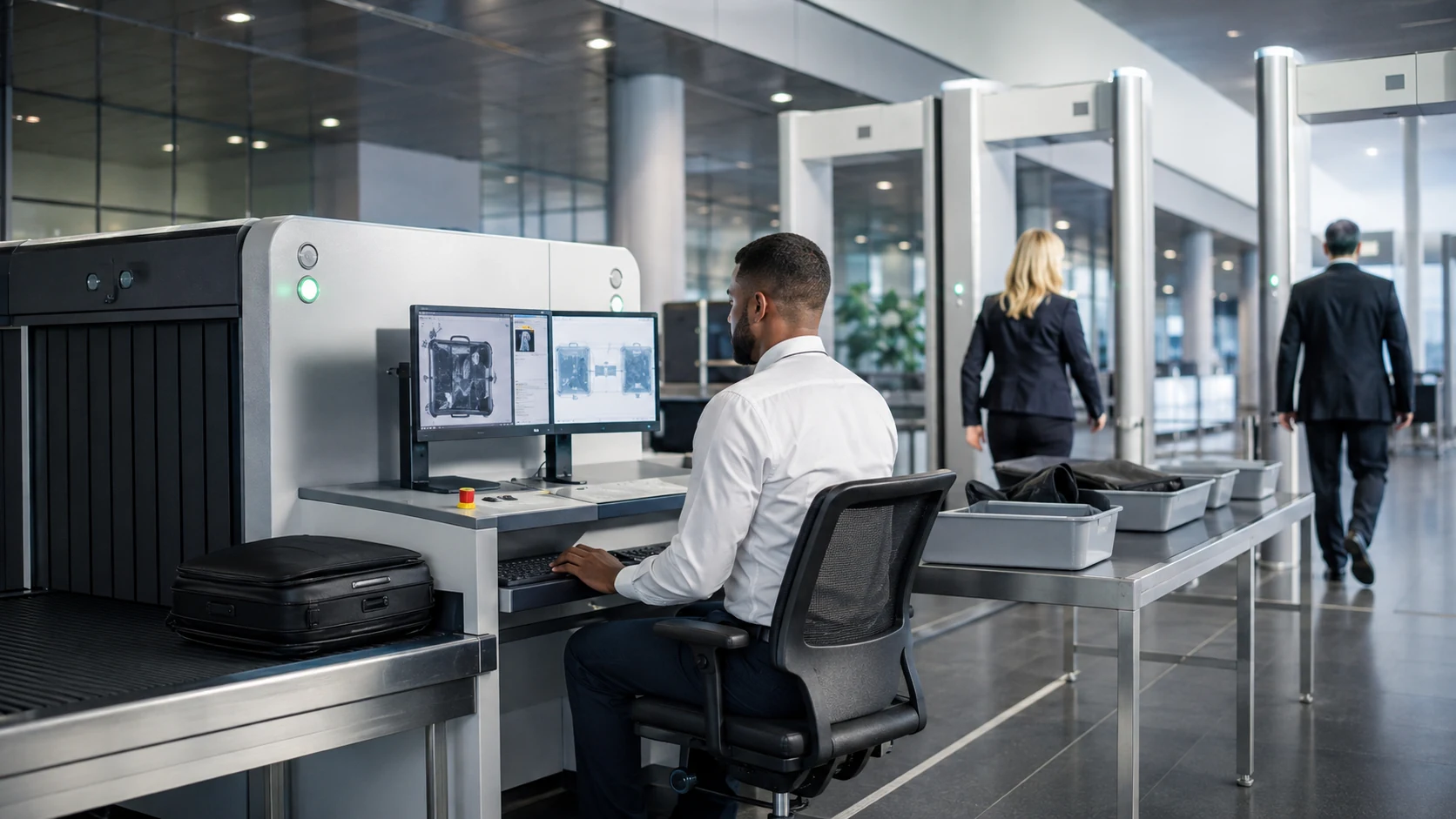
Learn how X-ray, CT, metal detection, explosive trace detection, radiation detection and vehicle screening technologies are used in security checkpoints.
Security screening is about finding prohibited or dangerous items without turning every checkpoint into a manual search. That sounds straightforward, but different threats interact with matter in different ways. A metal detector is useful for conductive metal objects; an X-ray system reveals differences in material density and composition; explosive trace detection looks for microscopic chemical residues. There is no single screening technology that reliably answers every threat question.
X-ray screening
Conventional X-ray systems send radiation through an object and measure how materials attenuate the beam. Operators interpret the resulting image, often with software that highlights material groups or suspicious regions. X-ray is widely used for baggage, parcels, cargo and mail because it allows inspection without opening every item.
Image quality depends on generator geometry, detector performance, object density and viewing angle. Dense objects can obscure material behind them, which is why dual-view and multi-view architectures can improve assessment. Automated detection algorithms can assist operators, but final performance still depends on threat libraries, system configuration and human interpretation.
Computed tomography
CT screening takes multiple X-ray projections and reconstructs a three-dimensional representation of an object. That gives screening software more information about shape and density than a single projection. TSA has deployed CT equipment at passenger checkpoints and has described it as advanced checkpoint screening technology. The value is not simply a prettier image: 3D reconstruction can support automated threat recognition and allow operators to rotate or inspect virtual slices of a bag.
Walk-through and handheld metal detection
Metal detectors create an electromagnetic field and sense disturbances caused by conductive objects. Walk-through systems are suited to high-throughput personnel screening, while handheld detectors are used for secondary inspection and localization.
Sensitivity is a trade-off. A system tuned aggressively may detect smaller objects but create more alarms from harmless personal items. Screening policy, threat model and expected throughput need to be considered together.
Explosive trace detection
ETD systems analyze tiny residues collected from surfaces, bags or hands. The technology is useful because it looks for chemical evidence that may not be visually obvious. It is typically a secondary method rather than a universal replacement for imaging. Sampling technique, contamination control and environmental conditions can influence results.
Radiation and nuclear detection
Radiation portal monitors and handheld instruments detect ionizing radiation associated with radioactive materials. These technologies are important at borders, ports, critical facilities and special events, but the screening problem is complex because legitimate medical or industrial sources can also produce radiation. Detection must therefore be linked to identification and response procedures.
Vehicle and cargo inspection
Large-scale X-ray or gamma-based systems can inspect vehicles, trucks and cargo containers. Under-vehicle inspection systems use cameras or scanners to inspect vehicle undersides for anomalies. Automatic number-plate recognition can add identity and movement history, but it is not itself a contraband detector.
Why layered screening matters
Checkpoint design should combine technologies based on the threat. A high-security facility may use identity verification, walk-through metal detection, bag X-ray, trace detection and secondary manual inspection. An airport may apply different screening to passengers, checked baggage, cargo and staff.
The goal is not to maximize the number of machines. It is to create a sequence in which one technology compensates for another’s blind spots while keeping throughput acceptable.
FAQ
Is CT better than X-ray? CT provides richer 3D information, but “better” depends on the screening application, throughput, cost and detection requirements.
Can a metal detector find explosives? It detects metal, not explosive chemistry. Explosive threats may require imaging, trace detection or other methods.
Can AI replace screening operators? Automated detection can assist, but operational procedures, secondary screening and trained human judgment remain important.
Verification note
Detection probabilities and false-alarm figures must come from validated test programs for specific devices; figures in this article avoid vendor performance claims and general industry description only.
Leave a Reply