Category: Detection & Screening

X-ray, CT, metal detection and trace-detection technologies used to screen people, baggage and cargo.

  • Gunshot Detection and Acoustic Sensors: How Sound-Based Security Systems Work

    Gunshot Detection and Acoustic Sensors: How Sound-Based Security Systems Work

    Not every security event announces itself on camera first. Acoustic detection technology — gunshot detection systems and glass-break sensors chief among them — is built on the premise that certain security events have a distinctive sound signature that can be identified and acted on faster than a human reviewing video footage.

    How Gunshot Detection Works

    Gunshot detection systems use arrays of acoustic sensors, sometimes combined with infrared muzzle-flash detection, to identify the specific acoustic signature of a gunshot: a sharp, high-amplitude transient with a characteristic frequency profile that differs from a slammed door, a firework, or a vehicle backfire. Multi-sensor arrays can triangulate the approximate location of the shot using the small time differences in when the sound reaches each sensor.

    These systems are most established in outdoor, wide-area deployments — originally developed for city-wide law-enforcement use — and have increasingly been adapted for indoor use in schools, hospitals, and corporate campuses, where the acoustic environment (reverberation, HVAC noise, multiple rooms) presents different tuning challenges than an open outdoor space.

    Glass-Break Detection

    Glass-break sensors work on a related but distinct principle: they listen for the specific frequency signature produced when glass fractures, which differs from the sound of glass being tapped or a window being closed forcefully. Acoustic glass-break sensors are typically mounted on a wall or ceiling within a room, and rely on line-of-sound rather than line-of-sight, so a single sensor can often cover multiple windows in the same space.

    Some systems use shock sensors mounted directly on the glass or frame instead of, or in addition to, acoustic detection, trading broader room coverage for a more direct mechanical confirmation that a specific pane has been struck.

    The False-Alarm Problem

    Acoustic detection’s core engineering challenge is the same one facing every alarm technology: separating a real event from an acoustically similar but harmless one. Early gunshot-detection deployments were criticized for false positives triggered by fireworks, construction noise, and vehicle backfires. Modern systems address this primarily through sensor fusion — combining acoustic signature analysis with other data such as muzzle-flash detection, sensor-array triangulation consistency, and in some deployments, correlation with nearby camera analytics — rather than relying on audio alone.

    Integration With Response Systems

    The operational value of acoustic detection comes from what happens after a valid detection: automatic lockdown triggers, mass notification alerts, and direct routing of location data to responding security personnel or law enforcement. A detection that takes seconds to identify a threat but minutes to reach a human decision-maker loses much of its advantage over conventional alarm response.

    Conclusion

    Acoustic detection systems fill a specific gap that video-based analytics cannot: identifying threat events by sound signature, often faster than a visual confirmation would be possible, and in areas without camera coverage. Their effectiveness depends less on the underlying acoustic science, which is well established, and more on tuning for the specific environment and on tight integration with the response workflow that follows a detection.
  • K9 Detection Teams vs. Technology: Explosives and Narcotics Screening Compared

    K9 Detection Teams vs. Technology: Explosives and Narcotics Screening Compared

    Despite decades of advances in trace-detection and chemical-sensing technology, trained detection dogs remain a benchmark that many automated screening systems are still measured against, particularly for explosives and narcotics detection in environments where speed and mobility matter as much as raw sensitivity.

    What Detection Dogs Do Well

    A trained detection dog can screen a moving crowd, a parked vehicle, or a large open area far faster than most stationary technology, since the dog and handler simply walk through the space rather than requiring each person or item to pass through a fixed checkpoint. Dogs are also highly mobile and adaptable, able to work in outdoor environments, uneven terrain, and situations where setting up fixed equipment isn’t practical, and their sensitivity to airborne trace odors in real-world, unpredictable environments has proven difficult for technology to fully replicate.

    What Technology Does Well

    Trace-detection technology, which analyzes a physical swab or air sample for chemical signatures of explosives or narcotics, produces a documented, repeatable result that does not depend on a living animal’s health, mood or fatigue on a given day. Technology-based screening can also run continuously without rest breaks, doesn’t require years of specialized training and ongoing recertification the way a working dog and handler team does, and produces a data trail that can be logged and audited, which matters in regulated environments like aviation security.

    Cost, Availability and Deployment Speed

    Training a detection dog and handler team is a significant, multi-year investment, and the supply of qualified teams is limited relative to demand, particularly for high-profile events or emergency deployments where trained teams may need to travel from elsewhere. Fixed technology installations require significant upfront capital and site preparation but, once deployed, scale more predictably: a facility can install additional trace-detection lanes far more easily than it can recruit and train additional canine teams on short notice.

    Most Security Programs Use Both

    Rather than treating dogs and technology as competing options, most serious security programs deploy them as complementary layers: technology handles high-volume, repeatable screening at fixed checkpoints, while detection dogs provide rapid, mobile screening for large crowds, vehicles, and situations technology cannot easily reach, such as searching a stadium concourse before an event or sweeping a vehicle in a parking structure. Security planners generally select the mix based on the specific threat environment, available budget, and how quickly a space needs to be screened.

    FAQ

    Are detection dogs more accurate than technology? Both approaches have strengths and limitations; dogs excel at real-world, mobile screening of large or irregular spaces, while technology offers documented, repeatable results better suited to fixed, high-volume checkpoints. Neither is universally more accurate across all scenarios.

    How long does it take to train a detection dog? Training a working detection dog and handler team typically takes many months to over a year, followed by ongoing recertification and continued training throughout the dog’s working life.

    Can technology fully replace detection dogs? Not currently for most large-scale or mobile screening scenarios; most security programs use technology and detection dogs as complementary layers rather than substitutes for one another.

  • Under-Vehicle Surveillance Systems: How UVSS Technology Works

    Under-Vehicle Surveillance Systems: How UVSS Technology Works

    The underside of a vehicle is one of the few spaces that conventional security cameras, guards and X-ray baggage scanners simply cannot see, which is why under-vehicle surveillance systems (UVSS) have become a standard checkpoint technology at facilities where vehicle-borne threats are a serious concern, including government buildings, ports, prisons, data centers, and major event venues.

    How a UVSS Scan Actually Works

    A typical UVSS installation embeds a line-scan camera, or an array of cameras, in a low-profile housing set into or on top of the road surface at a checkpoint. As a vehicle drives over the unit at low speed, the camera captures a continuous image strip of the undercarriage, which imaging software then stitches together into a single flattened, readable image of the entire underside, similar in concept to how a flatbed scanner builds an image line by line. The resulting image lets an operator, or increasingly an automated analytics system, inspect the chassis, fuel tank, wheel wells and other undercarriage components for anything that looks out of place.

    Fixed, Portable and Drive-Through Configurations

    Fixed UVSS units are permanently installed at a checkpoint lane and offer the most consistent image quality, since the scanning geometry and lighting are controlled and calibrated for that specific location. Portable UVSS units, often mounted on a wheeled pallet or ramp, trade some image consistency for the ability to be moved between checkpoints or deployed temporarily for a specific event. Both configurations are generally designed for vehicles to drive over slowly rather than stop, keeping traffic moving through a checkpoint rather than creating a bottleneck.

    From Manual Review to Automated Threat Detection

    Early UVSS deployments relied entirely on a human operator visually reviewing each scanned image for anomalies, a process that works but depends heavily on operator attention and experience. Newer systems increasingly pair the scan with automated image analysis that compares the captured undercarriage against a reference image of the same vehicle model, or flags common anomaly patterns, to help operators catch changes they might otherwise miss during a high-volume shift, while still leaving the final determination to a trained person.

    FAQ

    Do vehicles need to stop for a UVSS scan? No, most systems are designed to scan a vehicle driving over the unit at low speed, though some very high-resolution or high-security deployments may require a brief stop or reduced speed for optimal image quality.

    Can UVSS detect explosives directly? UVSS provides a visual image of the undercarriage for anomaly detection; it does not chemically detect explosives the way a trace-detection or canine screening does, which is why it is often paired with other screening methods at the highest-security checkpoints.

    Where are under-vehicle surveillance systems most commonly deployed? Government and military facility entrances, ports and border crossings, prisons and correctional facilities, data centers, and major stadium or event venues are among the most common deployment locations.

  • Lawsuit Tests Whether AI Gun-Detection Vendors Can Be Held Liable When Systems Miss a Threat

    Lawsuit Tests Whether AI Gun-Detection Vendors Can Be Held Liable When Systems Miss a Threat

    A legal analysis published by SecurityInfoWatch examines a lawsuit, filed May 1, 2026, by a survivor of the January 2025 shooting at Antioch High School in Nashville against AI weapons-detection vendor Omnilert and installer System Integrations. The suit alleges the AI gun-detection system deployed at the school failed to flag the shooter’s weapon.

    The SIW analysis frames the case as an early test of whether weapons-detection vendors can be held legally liable when a system’s marketed detection capabilities do not perform as claimed in a real-world incident — a question the physical security industry has largely not had to confront in court until now.

    Why it matters: As AI-based weapons detection is adopted more widely in schools and other public facilities, this case and others like it will likely shape how vendors market detection-accuracy claims, how procurement contracts allocate liability, and how buyers evaluate performance guarantees — regardless of the case’s eventual outcome.

    Source: SecurityInfoWatch.com, September 10, 2026.

  • Security Screening Technologies Explained: X-Ray, CT and AI Detection Systems

    Security Screening Technologies Explained: X-Ray, CT and AI Detection Systems

    Security screening sits at the entry point of airports, courthouses, stadiums, schools and corporate campuses, tasked with finding weapons, explosives and other prohibited items before they reach a protected space. The technology behind that job has moved well beyond the single-view X-ray machine, now combining several imaging and detection methods, often stitched together with AI-based image analysis.

    X-Ray Imaging: The Foundation

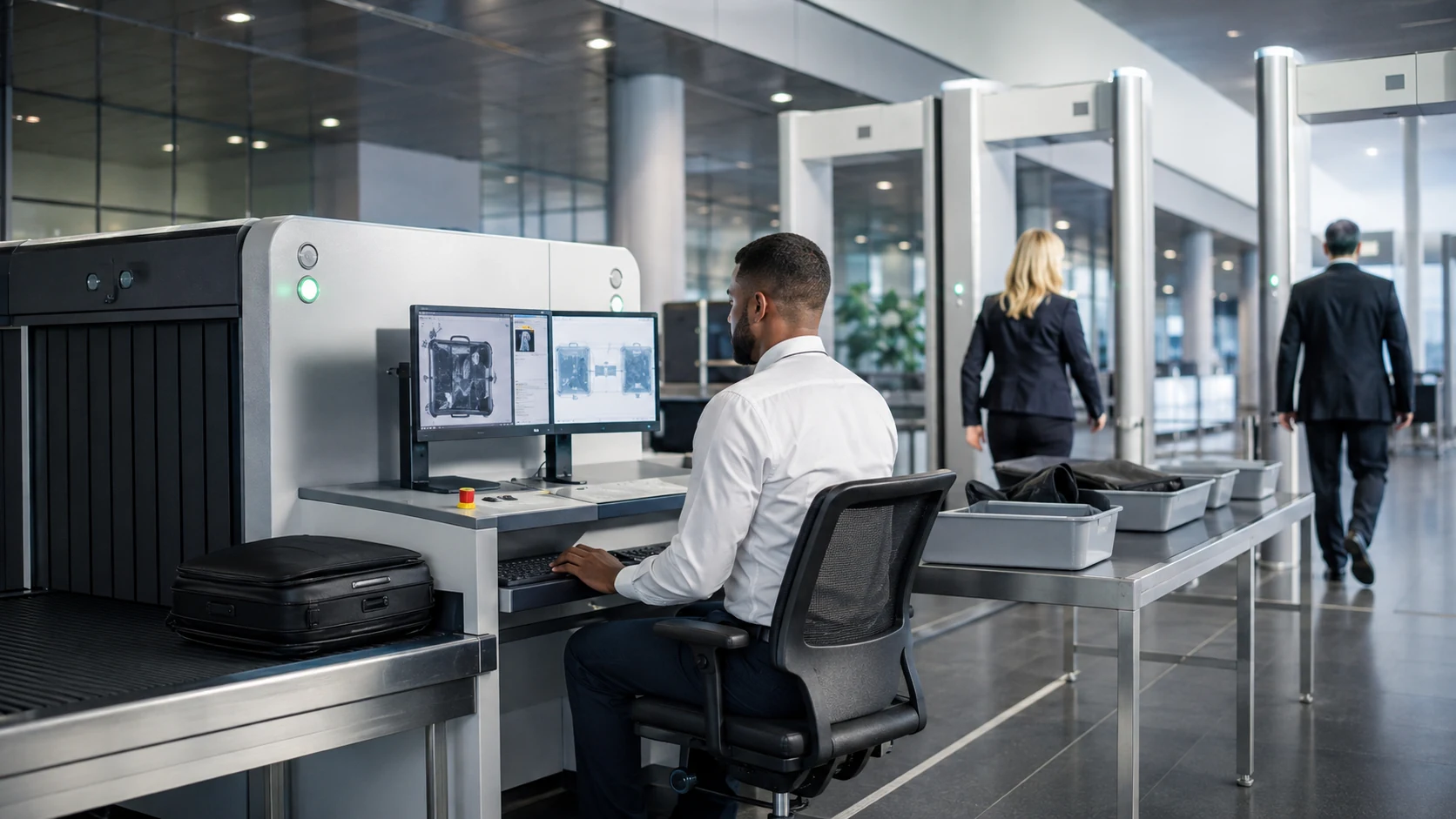
    Conventional X-ray screening remains the backbone of checkpoint security for bags and parcels. Dual-energy X-ray systems distinguish organic materials, such as explosives, from inorganic ones, such as metal, by measuring how differently two X-ray energy levels are absorbed by an object. Operators view color-coded images where organic, inorganic and mixed materials appear in different hues, helping them spot items that warrant a closer look.

    Computed Tomography Adds a Third Dimension

    Computed tomography (CT) scanning, long used in medical imaging, has moved into checkpoint security because it captures a full 3D image of a bag’s contents rather than a flat 2D projection. A CT scanner rotates an X-ray source and detector array around the object, reconstructing a volumetric image that can be rotated and examined from any angle. This additional depth of information is a major reason aviation security programs in the United States, the European Union and elsewhere have pushed to replace older 2D X-ray checkpoint lanes with CT-based lanes, since 3D imaging makes it easier to isolate the shape and density of a suspicious item without the operator needing to ask a traveler to remove it from the bag.

    Millimeter Wave and Body Scanning

    For screening people rather than bags, millimeter wave scanners have become the standard alternative to metal detectors at many checkpoints. These scanners bounce low-energy electromagnetic waves off the body and surrounding clothing, building an image that can reveal non-metallic items, such as ceramic weapons or plastic explosives, that a traditional walk-through metal detector would miss. Automated target recognition software increasingly processes that image directly, flagging areas of concern on a generic body outline rather than displaying a detailed image of the person, which addresses a long-standing privacy objection to earlier body-scanning technology.

    Where AI Fits Into Screening

    Artificial intelligence has entered checkpoint screening primarily as an assistant to human operators rather than a replacement for them. AI-based automatic threat recognition software, trained on large libraries of scanned images, highlights or outlines items in an X-ray or CT image that match the visual signature of prohibited items, such as firearms or explosive shapes. Vendors and regulators generally frame this as a way to reduce operator fatigue and inconsistency across long shifts, rather than as a fully autonomous decision system; a human screener typically still makes the final call on whether a flagged bag needs secondary inspection.

    Trace Detection and Complementary Methods

    Screening programs typically layer imaging technologies with trace detection, which identifies microscopic particles of explosive residue on a swab taken from a bag, laptop or hand. Some checkpoints also use chemical vapor detection to sample the air around a bag or person. These methods do not replace imaging but add a second, independent detection layer that can catch threats an X-ray or CT image alone might not clearly reveal, such as explosive residue on the outside of an otherwise unremarkable item.

    FAQ

    Is CT screening only used in aviation? No. While aviation checkpoints have driven much of the recent investment in CT-based screening, similar imaging systems are used in courthouses, government buildings, correctional facilities and some large venues.

    Does AI screening replace human operators? Not currently. AI automatic threat recognition tools are generally deployed to flag likely threats for a human operator to review, rather than to make autonomous accept/reject decisions.

    Are millimeter wave scanners safe? Millimeter wave technology uses non-ionizing radio frequency energy at power levels regulators consider safe for repeated screening, unlike ionizing technologies such as X-ray, which is why walk-through millimeter wave scanners are used directly on people while X-ray and CT are reserved for bags and cargo.

  • TSA Unveils Horizon 25 Strategy to Modernize Checkpoints and Expand Counter-Drone Capabilities

    TSA Unveils Horizon 25 Strategy to Modernize Checkpoints and Expand Counter-Drone Capabilities

    The Transportation Security Administration launched a new strategic plan called Horizon 25 on August 24, 2026, timed to the agency’s 25th anniversary, outlining three priorities: modernizing checkpoint technology, improving the traveler experience, and hardening security across multiple transportation modes, according to TSA’s own press release and reporting from International Airport Review and Federal News Network.

    TSA Administrator David P. Cummins said the plan is intended to streamline how the agency acquires new screening technology, including next-generation scanners and biometric identity-verification systems, as well as expand TSA’s capability to detect and respond to unmanned aircraft near airports and other transportation facilities. The agency has been steadily rolling out Credential Authentication Technology 2 units, which pair document scanning with live facial comparison, as part of a broader $781 million technology-modernization program already underway.

    Gold+ Program to Be Replaced

    As part of Horizon 25, TSA said it will retire its existing Gold+ program and replace it with an evolved Screening Partnership Program, expanding the role private security contractors play in airport checkpoint operations under federal oversight. The agency framed the changes as part of a longer-term effort to reduce checkpoint friction for low-risk travelers while concentrating resources on higher-risk threats, including the small-drone threat vector that has drawn increasing federal attention this year.

    TSA said further implementation details will be worked out with field and headquarters staff in September, with the counter-UAS and technology-acquisition components expected to roll out in phases rather than all at once.

  • AI-Based Concealed Weapons Detection: How Walkthrough Systems Work

    AI-Based Concealed Weapons Detection: How Walkthrough Systems Work

    A newer category of weapons detection has emerged over the past several years alongside traditional metal detectors and X-ray screening: walkthrough systems that use sensor fusion and machine learning to flag concealed firearms and large blades without requiring visitors to empty pockets, remove belts, or stop and be individually wanded. These systems are increasingly deployed at venues, schools, stadiums, hospitals and corporate campuses seeking higher throughput than conventional metal detection allows while still screening for weapons rather than general metal content.

    The underlying sensing approaches vary by vendor but generally fall into two categories: active electromagnetic field sensing, which detects disturbances in a low-power magnetic field as a person walks through a portal, and millimeter-wave or other RF-based imaging, which can detect the physical shape and material properties of concealed objects at a distance. Both approaches feed raw sensor data into a machine-learning classification model trained to distinguish the electromagnetic or material signature of firearms and large blades from the signatures of common personal items such as laptops, keys, belt buckles and phones.

    The core technical challenge is the same one that affects any binary detection system: the trade-off between false negatives (missed weapons) and false positives (alarms on benign items). Vendors in this category generally tune their classification models toward minimizing false negatives given the severity of a missed detection, which means false alarm rates on common metal objects remain a genuine operational consideration; venues deploying these systems typically pair them with a secondary visual or manual check process for anyone who triggers an alert, rather than treating the AI classification as a final determination on its own.

    Throughput is the primary operational advantage these systems offer over traditional walk-through metal detectors paired with bag search and wanding. Because visitors do not need to remove metal objects from pockets or empty bags for the primary screening pass, venues can process significantly higher visitor volumes per lane during peak entry periods such as event doors opening or shift changes at a large facility. This throughput advantage is a major driver of adoption at large venues, though it depends on adequate staffing for the secondary screening process that handles alerts, since a system that generates alerts faster than staff can resolve them simply creates a new bottleneck at the secondary screening point.

    Placement and environmental tuning matter significantly to real-world performance. Systems using electromagnetic field sensing can be affected by nearby metal structures, electronic equipment, or other portals placed too close together, requiring careful site surveys and calibration during installation. Integrators typically conduct a threat testing and calibration process specific to each installation site rather than relying solely on factory default settings, and ongoing recalibration is generally required as a venue’s surrounding infrastructure or foot traffic patterns change.

    Privacy and civil liberties considerations differ from those raised by facial recognition or license plate reading, since these systems generally are not designed to identify individuals, but questions remain about how alert data, video capture at detection points, and any biometric-adjacent data are stored and for how long. Procurement teams evaluating this category should request clarity on data retention practices, false alarm rate testing under realistic conditions rather than only controlled test environments, and integration requirements with existing access control and video management systems, since standalone weapons detection lanes that are not integrated with a venue’s broader security operations center reduce the speed at which an alert can be escalated to a coordinated response.

  • Security Screening Technologies Explained: X-Ray, CT, Metal and Trace Detection

    Security Screening Technologies Explained: X-Ray, CT, Metal and Trace Detection

    Learn how X-ray, CT, metal detection, explosive trace detection, radiation detection and vehicle screening technologies are used in security checkpoints.

    Security screening is about finding prohibited or dangerous items without turning every checkpoint into a manual search. That sounds straightforward, but different threats interact with matter in different ways. A metal detector is useful for conductive metal objects; an X-ray system reveals differences in material density and composition; explosive trace detection looks for microscopic chemical residues. There is no single screening technology that reliably answers every threat question.

    X-ray screening

    Conventional X-ray systems send radiation through an object and measure how materials attenuate the beam. Operators interpret the resulting image, often with software that highlights material groups or suspicious regions. X-ray is widely used for baggage, parcels, cargo and mail because it allows inspection without opening every item.

    Image quality depends on generator geometry, detector performance, object density and viewing angle. Dense objects can obscure material behind them, which is why dual-view and multi-view architectures can improve assessment. Automated detection algorithms can assist operators, but final performance still depends on threat libraries, system configuration and human interpretation.

    Computed tomography

    CT screening takes multiple X-ray projections and reconstructs a three-dimensional representation of an object. That gives screening software more information about shape and density than a single projection. TSA has deployed CT equipment at passenger checkpoints and has described it as advanced checkpoint screening technology. The value is not simply a prettier image: 3D reconstruction can support automated threat recognition and allow operators to rotate or inspect virtual slices of a bag.

    Walk-through and handheld metal detection

    Metal detectors create an electromagnetic field and sense disturbances caused by conductive objects. Walk-through systems are suited to high-throughput personnel screening, while handheld detectors are used for secondary inspection and localization.

    Sensitivity is a trade-off. A system tuned aggressively may detect smaller objects but create more alarms from harmless personal items. Screening policy, threat model and expected throughput need to be considered together.

    Explosive trace detection

    ETD systems analyze tiny residues collected from surfaces, bags or hands. The technology is useful because it looks for chemical evidence that may not be visually obvious. It is typically a secondary method rather than a universal replacement for imaging. Sampling technique, contamination control and environmental conditions can influence results.

    Radiation and nuclear detection

    Radiation portal monitors and handheld instruments detect ionizing radiation associated with radioactive materials. These technologies are important at borders, ports, critical facilities and special events, but the screening problem is complex because legitimate medical or industrial sources can also produce radiation. Detection must therefore be linked to identification and response procedures.

    Vehicle and cargo inspection

    Large-scale X-ray or gamma-based systems can inspect vehicles, trucks and cargo containers. Under-vehicle inspection systems use cameras or scanners to inspect vehicle undersides for anomalies. Automatic number-plate recognition can add identity and movement history, but it is not itself a contraband detector.

    Why layered screening matters

    Checkpoint design should combine technologies based on the threat. A high-security facility may use identity verification, walk-through metal detection, bag X-ray, trace detection and secondary manual inspection. An airport may apply different screening to passengers, checked baggage, cargo and staff.

    The goal is not to maximize the number of machines. It is to create a sequence in which one technology compensates for another’s blind spots while keeping throughput acceptable.

    FAQ

    Is CT better than X-ray? CT provides richer 3D information, but “better” depends on the screening application, throughput, cost and detection requirements.

    Can a metal detector find explosives? It detects metal, not explosive chemistry. Explosive threats may require imaging, trace detection or other methods.

    Can AI replace screening operators? Automated detection can assist, but operational procedures, secondary screening and trained human judgment remain important.

    Verification note

    Detection probabilities and false-alarm figures must come from validated test programs for specific devices; figures in this article avoid vendor performance claims and general industry description only.

  • Goessel USD 411 Deploys ZeroEyes AI Gun Detection Across Kansas School District

    Goessel USD 411 Deploys ZeroEyes AI Gun Detection Across Kansas School District

    Goessel USD 411, a two-campus school district in Kansas, has deployed ZeroEyes’ AI gun detection and intelligent situational awareness platform, funded through the Kansas Safe and Secure Firearm Detection Grant Program administered by the Office of the Kansas Attorney General, the company announced.

    What’s New

    ZeroEyes’ software layers onto the district’s existing digital security cameras, using computer vision to identify visible firearms in real time. Detections are verified by trained analysts in the company’s Operations Center before alerts are dispatched to designated school personnel and law enforcement. The district secured grant funding following coordination with local law enforcement and community leaders who identified AI gun detection as a safety priority.

    Why It Matters

    “The ability to accurately detect and identify a handgun from a distance exceeded our expectations and gave us added confidence in the technology’s role in helping keep our schools safe,” said Scott Boden, Superintendent of Goessel USD 411. The deployment adds to a growing list of Kansas and Midwest school districts using state firearm-detection grant programs to fund AI-based weapon detection as part of a broader national expansion of K-12 gun-detection deployments.