
Correctional facilities operate under security requirements that differ from almost any other building type: the population inside is confined rather than free to leave, staff safety and inmate safety must both be protected, and a security failure can have immediate, serious consequences.
Perimeter detection
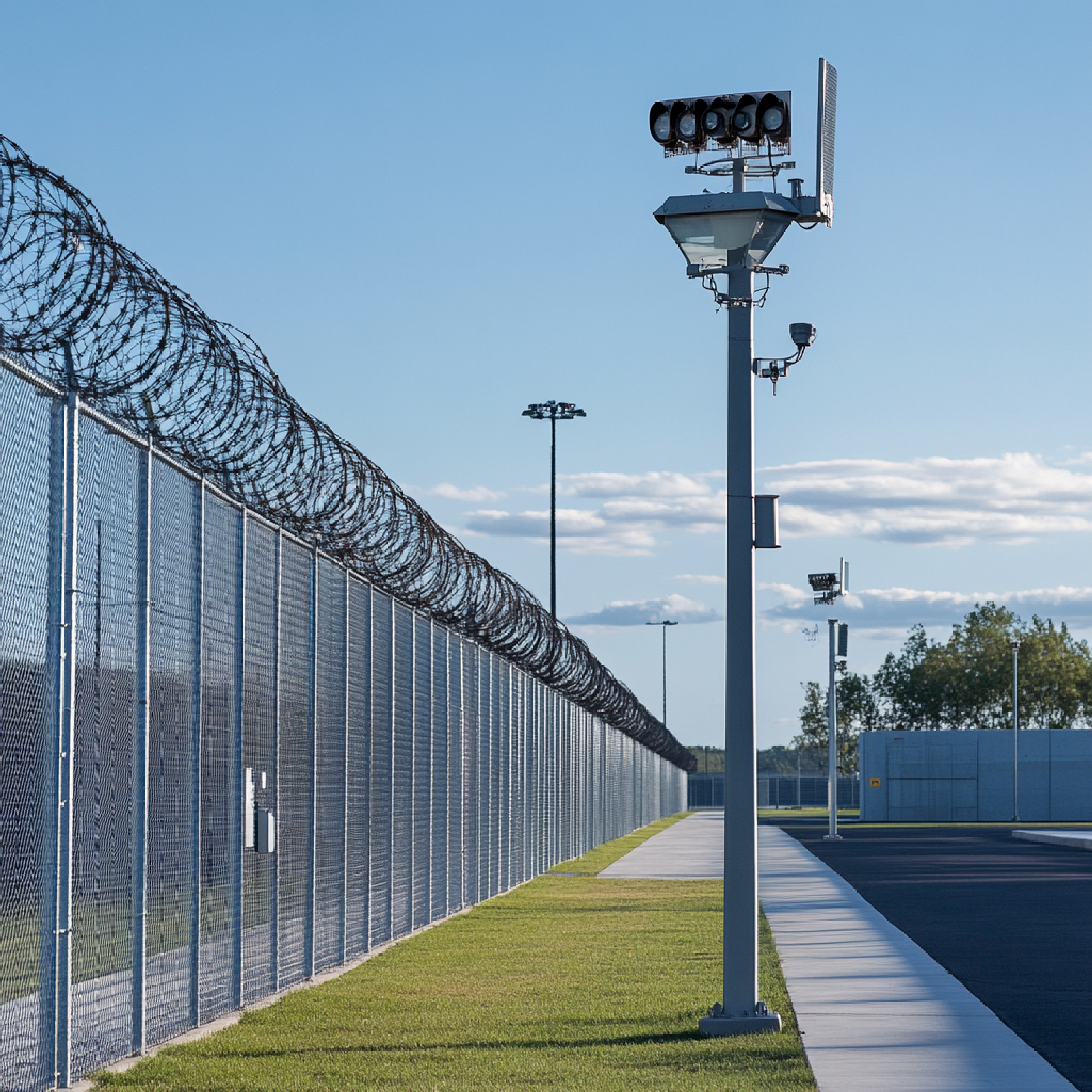
Correctional perimeters typically combine physical barriers such as double fencing, razor wire and clear zones with electronic detection, including fence-mounted sensors, buried cable systems, microwave or radar detection, and camera coverage. Layered detection is intended to give staff advance warning of an escape attempt or unauthorized approach before a physical breach occurs.
Video surveillance across a closed environment
Comprehensive camera coverage of housing units, corridors, yards, visitation areas and perimeter zones supports both incident investigation and day-to-day supervision. Because correctional facilities operate continuously, video systems are typically designed for extended retention and rapid search, since incidents may not be reported or discovered until well after they occur.
Access control and movement management
Correctional access control governs not just entry to the facility but internal movement between housing units, program areas and secure zones. Interlocking door systems, sally ports and centrally controlled locking are common design features intended to prevent an inmate or unauthorized individual from moving freely between security zones.
Contraband and weapons detection
Screening technology at entry points, including walkthrough and handheld metal detectors, body scanners and mail-screening systems, is used to reduce the introduction of weapons, drugs and unauthorized devices such as cell phones. Contraband detection is an ongoing operational challenge for correctional agencies, and facilities generally combine technology with staff search procedures rather than relying on any single method.
Duress alarms and staff safety
Personal duress alarms that allow staff to summon help discreetly, combined with fixed panic buttons in high-risk areas, are a standard feature of correctional security design. Rapid, reliable location information is particularly important in a correctional setting given the potential for an incident to escalate quickly.
Command and control integration
Correctional security operations centers typically integrate video, access control, intercom and alarm systems into a single monitoring environment, allowing control-room staff to observe and respond across the facility rather than managing separate systems independently.
Conclusion
Correctional facility security depends on layered perimeter detection, comprehensive video coverage, tightly controlled internal movement, contraband screening and reliable staff duress capability, integrated through a command-and-control environment built for continuous, high-consequence operation.
Leave a Reply