
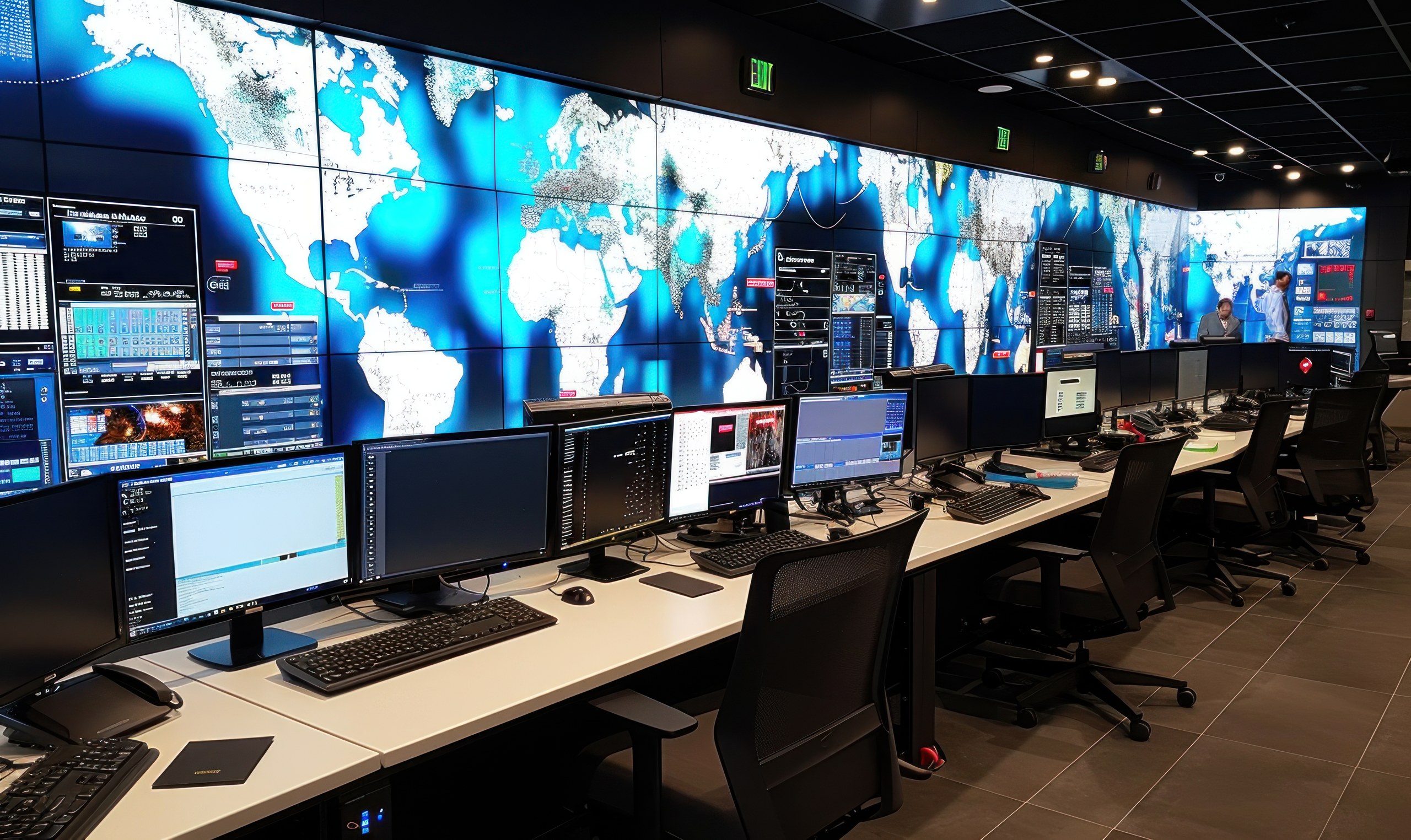
A Global Security Operations Center, or GSOC, centralizes monitoring and incident response for organizations with security operations spread across multiple facilities, regions or time zones. Unlike a single-site guard station monitoring local cameras and alarms, a GSOC is built to aggregate video, access control, intrusion detection, travel risk intelligence and often cybersecurity alerting from dozens or hundreds of locations into a unified operating picture, with staff trained to triage and coordinate response regardless of where an incident originates.
The technology layer that makes this possible is a physical security information management (PSIM) platform, or increasingly a unified security platform that combines video management, access control and analytics natively rather than through a separate integration layer. The core function of this software is normalization: translating alerts and video feeds from potentially dozens of different camera manufacturers, access control panels and alarm systems, often installed at different times by different integrators, into a consistent interface that a GSOC operator can act on without needing to learn each underlying vendor system individually.
Staffing model and shift structure are as important to GSOC effectiveness as the underlying software. A GSOC covering global operations typically requires 24/7 staffing organized around a “follow the sun” model, with regional teams handing off situational awareness at shift boundaries, or a single centralized team working rotating shifts. The choice affects language coverage, familiarity with regional regulatory and cultural context, and response time to incidents occurring outside a centralized team’s typical working hours; organizations with major operations concentrated in a small number of regions often favor a hybrid model with a smaller follow-the-sun core team supplemented by on-call regional specialists.
Alert prioritization and workflow design determine whether a GSOC scales effectively as the number of monitored sites grows. Without a structured triage process, a GSOC ingesting alerts from hundreds of facilities can quickly become overwhelmed by nuisance alarms, such as motion-triggered alerts from wildlife or weather rather than genuine intrusions. Mature GSOCs implement tiered alert classification, often informed by analytics that pre-filter video-based alerts before they reach a human operator, and maintain documented standard operating procedures that specify escalation paths, notification requirements and decision authority for different incident categories, from a minor access control malfunction to an active threat requiring law enforcement coordination.
Integration with business continuity and crisis management functions is increasingly a defining feature of higher-maturity GSOCs. Rather than operating purely as a security monitoring function, many organizations now position their GSOC as the initial point of situational awareness for a broader range of business-impacting events, including severe weather affecting a facility, civil unrest near a location with traveling employees, or a supply chain disruption at a manufacturing site, feeding that awareness into the organization’s broader crisis management and business continuity processes rather than treating physical security monitoring as an isolated function.
Facility design for a physical GSOC space itself follows established principles: redundant power and network connectivity, video walls sized and positioned for extended-shift ergonomics, and physical security controls for the GSOC space that reflect its role as a high-value target in its own right, since an incident that disables or compromises the GSOC’s own operations removes situational awareness across the entire organization at the moment it may be needed most. Organizations building or upgrading a GSOC increasingly plan for a geographically redundant backup facility or cloud-hosted failover capability, so that a single site outage, whether from a power failure, natural disaster or targeted attack, does not eliminate centralized monitoring capability entirely.
Leave a Reply