German video security specialist Geutebrück is entering a new corporate phase after receiving a majority investment from IBEX Wachstumspartner, alongside European AI group Merantix Momentum, according to Security Info Watch and confirmed by law firm Schmitz Knoth, which advised Geutebrück’s shareholders on the transaction. The deal closed on August 31, 2026.
New Leadership and International Ambitions
As part of the transition, Tobias Huemmerich will take over management of the company, with plans to further internationalize the business and expand its customer offering, according to Security Middle East. Geutebrück has operated in the video security market for more than 55 years and has built a reputation as a provider of video management software and hardware for public-sector and highly critical infrastructure clients.
Merantix Momentum Brings AI Expertise
Merantix Momentum, described as Europe’s leading AI group, is joining the investment specifically to help Geutebrück develop new AI-based applications, according to the companies. Geutebrück has said it sees opportunities to extend its video management platform beyond traditional security use cases, including the potential use of anonymized video data to identify workflow efficiencies and improve occupational safety.
Part of a Broader Consolidation Trend
The investment adds to a string of ownership changes across the video surveillance sector as manufacturers seek capital and AI expertise to keep pace with larger competitors. IBEX Wachstumspartner, an owner-managed investment firm focused on succession situations at German medium-sized businesses, said the deal reflects its strategy of pairing growth capital with digitalization expertise for established technology companies entering a generational transition.
OpenAI is committing $1 billion to subsidize access to its cyber-capable AI models for critical infrastructure defenders and launching a center to train security professionals in the U.S. public sector, as part of an expansion of its Daybreak program, the company said.
What’s New
The Daybreak Defense Network will provide subsidized AI cyber capabilities, training and technical assistance, though OpenAI has disclosed few details about specific costs or eligibility criteria. The company has selected HackerOne as one of a limited group of cybersecurity vendors with early access to its frontier cyber capabilities through the network. OpenAI co-founder Greg Brockman has separately published a blog post describing the use of AI agents to find and fix security vulnerabilities.
Why It Matters
“There are a large amount of people and organizations that want to uplevel their security, but they don’t know how,” Brockman said, adding that without broader adoption of AI-assisted defense, “it’s possible we can expect critical infrastructure outages as part of normal life.” The pledge follows a separate letter signed by OpenAI, Anthropic, Google, Microsoft and more than 100 other companies calling for coordinated industry defense against AI-driven cyber threats, and reflects a wider push by frontier AI labs to position their models as tools for under-resourced defenders in sectors like water, energy and healthcare.
September 4, 2026 — NAPCO Security Technologies has released Prima v8, a redesigned mobile app for its Prima self-contained smart security systems. The update adds revised security controls, biometric authentication, expanded notification settings and an Apple Watch companion app.
What Changed in Prima v8
The new version reorganizes navigation and rebuilds core workflows for arming, device control and account management. Security screens provide clearer entry and exit countdowns, alarm details and sensor status information. Users can also manage connected lights, locks, garage doors, water valves and thermostats from the app.
NAPCO says existing users can install the update without creating a new account or re-pairing their system devices. Credentials, configurations and device pairings are intended to carry over. The Apple Watch companion app supports arming and disarming from the watch, while revised settings give users more control over push, email and SMS notifications.
Why It Matters
Residential and small-commercial security platforms increasingly combine alarm status, connected-device control and account administration in one mobile interface. A clearer workflow can reduce routine friction for users and installers, but app convenience does not replace professional system design, reliable communications or an appropriate alarm-response plan.
The release follows the wider shift toward software-led management of intrusion and connected-building systems. For background on the underlying sensors and control architecture, see SectechMedia’s guide to intrusion detection and alarm systems.
A September 2 webinar hosted by the Fiber Optic Sensing Association (FOSA) put a spotlight on a shift already underway in how Distributed Temperature Sensing (DTS) is used across energy infrastructure: from a technology that simply reports temperature to one that feeds directly into decisions about capacity, maintenance, and risk.
Titled “DTS for Modern Energy Systems: Early Fault Detection Across Solar PV and Underground Cables,” the session paired two speakers working on opposite ends of the power system. Ralf Albrecht of AP Sensing covered underground transmission and distribution cables, focusing on how DTS data can support dynamic cable ratings. Mark Horton, International Operations Director at SAMM Technology, addressed solar PV and battery energy storage systems (BESS), where the priority is catching abnormal heating before it becomes a fire or an outage. Dane Langen of Luna Innovations moderated on FOSA’s behalf.
The premise both speakers returned to: the energy transition isn’t just adding renewable capacity, it’s changing how that capacity behaves. More solar generation, larger installations, high-capacity underground cable runs, and a growing base of BESS assets all add variability that traditional inspection methods struggle to track continuously.
Thermal cameras, drone surveys, and periodic site visits remain useful, but each one captures a single moment in time. A loosening connector or a slowly warming cable section can develop in the days between inspections and go unnoticed until the next scheduled check.
DTS addresses that gap differently: instead of a handful of fixed sensors, the optical fiber itself becomes the sensing element along its entire length. Laser pulses sent through the fiber generate backscattered light that, when analyzed, yields a temperature reading roughly every meter, over distances up to about 50 kilometers on a single system. The practical effect is a continuous thermal map of an asset rather than scattered data points.
Underground Cables: From Fixed Limits to Real-Time Capacity
Albrecht’s presentation reframed DTS as more than a fault-detection tool for buried cables — it’s also a lever for getting more usable capacity out of existing infrastructure.
Cable operators set maximum current limits based on conductor temperature, since excess heat accelerates insulation aging and raises failure risk. The issue, as Albrecht explained, is that standard Static Cable Rating calculations tend to assume worst-case conditions — high soil thermal resistivity and similar conservative inputs — baked in at the design stage. Real operating conditions are frequently better than those assumptions, meaning a cable’s actual safe capacity can exceed its official rating.
Real-Time Thermal Rating (RTTR), also called Dynamic Cable Rating (DCR), replaces some of those fixed assumptions with live data. DTS temperature readings are combined with current electrical load, soil conditions, and thermal models built on IEC and CIGRE methodologies to estimate actual conductor temperature — not just the temperature around the cable — and from that, how much current it can carry safely right now. Albrecht described systems that go a step further, projecting dynamic or emergency ratings 24, 48, or 72 hours out.
That turns a static design question (“what was this cable rated for?”) into an operational one (“what can it carry today?”) — a distinction Albrecht suggested matters more as renewable-driven load patterns become less predictable. In some cases, unlocking that extra headroom on existing cable routes could reduce or delay the need for new transmission builds.
One technical wrinkle Albrecht flagged: the sensing fiber isn’t always physically adjacent to the conductor. It may sit within the cable structure, be strapped to it, or run through a nearby duct, and heat takes time to travel from the conductor to wherever the fiber actually measures. He pointed to field examples — including 33 kV double-circuit installations with fiber positioned at varying distances from the cable — to illustrate why DCR systems need thermal modeling layered on top of raw DTS readings, rather than treating the fiber’s temperature as a direct stand-in for the conductor’s.
Albrecht also touched on overhead lines, where wind cooling — not soil conditions — governs safe current limits. Fiber inside an Optical Ground Wire (OPGW) can’t read conductor temperature directly, but he noted that Distributed Acoustic Sensing (DAS) can analyze vibration patterns in the same fiber to infer wind conditions relevant to Dynamic Line Rating (DLR) calculations — a reminder that DTS and DAS running on infrastructure that already carries fiber can extend well beyond their original design purpose.
Solar PV: Catching the Problem Before the Fire
Horton’s presentation shifted the discussion to a different failure mode. In solar PV and BESS installations, the goal isn’t optimizing capacity — it’s catching abnormal heat before it turns into equipment damage, downtime, or fire.
He listed several common hotspot sources: loose electrical connectors, damaged DC cabling, installation defects, rodent damage, aging components, and rising resistance at connections over time. Left undetected, any of these can escalate from a minor thermal anomaly into a serious failure. The core distinction Horton drew was between detecting a fire and detecting the conditions that lead to one — the earlier the anomaly surfaces, the more room maintenance teams have to intervene.
Drone thermography, he noted, has real value but the same limitation as underground-cable inspections: it’s a snapshot. A connector that starts failing a week after a drone flight stays invisible until the next flight. Routing sensing fiber across a site — from the backs of modules to combiner boxes, inverters, transformers, AC/DC cabling, BESS units, and grid-connection equipment — turns that into continuous coverage instead. Because fiber doesn’t carry current or pick up electromagnetic interference, it’s also well suited to sitting close to high-voltage equipment.
Solar sites present their own complication for alarm design: normal temperatures already swing widely with sun angle, ambient conditions, cloud cover, and season, so a single fixed threshold generates excessive false alarms. Horton described layering three approaches instead — absolute maximum-temperature thresholds, rate-of-rise detection for unusually fast heating, and trend/baseline comparisons that flag when a specific asset starts behaving differently from its own historical pattern. That combination is what turns DTS from a long thermometer into an actual condition-monitoring input.
He also addressed a less glamorous but practical question: fiber survives decades of module swaps, repairs, and maintenance work by being secured behind panels with UV-resistant ties (movable when a module is replaced) and by leaving service loops of spare fiber for future splicing. Depending on a system’s optical budget, a single channel can typically absorb somewhere around 10 to 15 splices before a longer section needs replacing outright — a detail that matters for a sensing system expected to remain functional for the life of the asset.
Two Problems, One Underlying Shift
Albrecht and Horton were solving different problems — maximizing safe throughput on kilometers of buried cable versus catching a localized hotspot on a solar module or battery unit — but both talks pointed to the same underlying change: replacing periodic, point-based checks with continuous, distributed measurement.
The broader theme of the session was that DTS data is increasingly being wired into other systems — thermal models, DCR platforms, SCADA, alarm logic, and maintenance workflows — rather than reviewed in isolation. In cable networks, that can mean determining whether extra transmission capacity is genuinely available. In solar and storage assets, it can mean flagging a developing problem early enough to act on it. Across both applications, the fiber itself is being asked to do more than sense temperature — it’s becoming an input to real operating decisions.
This article is based on a summary account of FOSA’s September 2, 2026 webinar “DTS for Modern Energy Systems: Early Fault Detection Across Solar PV and Underground Cables,” featuring presentations from Ralf Albrecht (AP Sensing) and Mark Horton (SAMM Technology), moderated by Dane Langen (Luna Innovations). FOSA typically posts recordings of its webinars to its public archive after the fact; readers seeking the full session, including technical Q&A, should check FOSA’s website directly.
SAMM Technology (SAMM Teknoloji İletişim A.Ş.) is taking part in an upcoming webinar hosted by the Fiber Optic Sensing Association (FOSA), addressing how Distributed Temperature Sensing (DTS) can support early fault detection across solar photovoltaic (PV) installations and underground power cable networks.
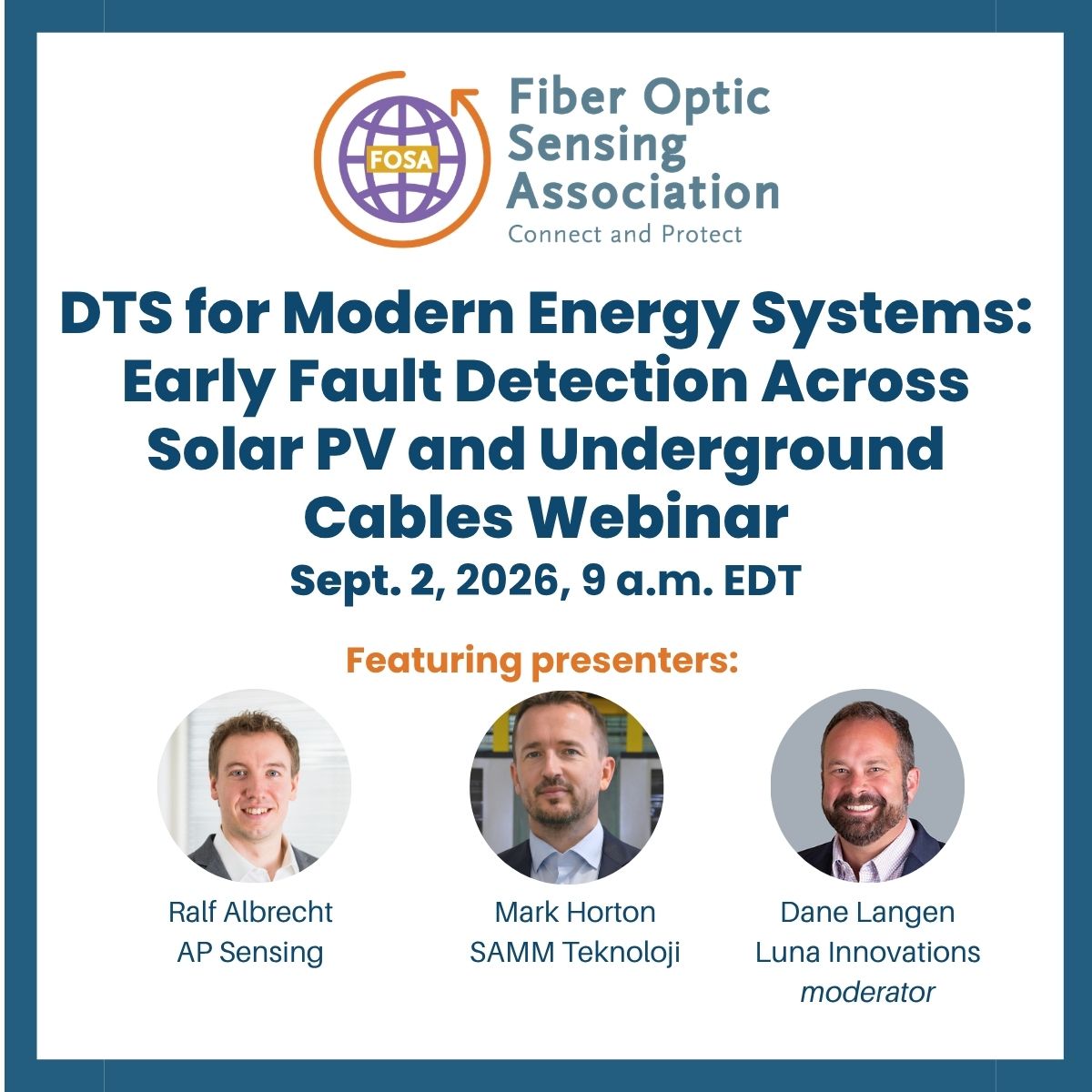
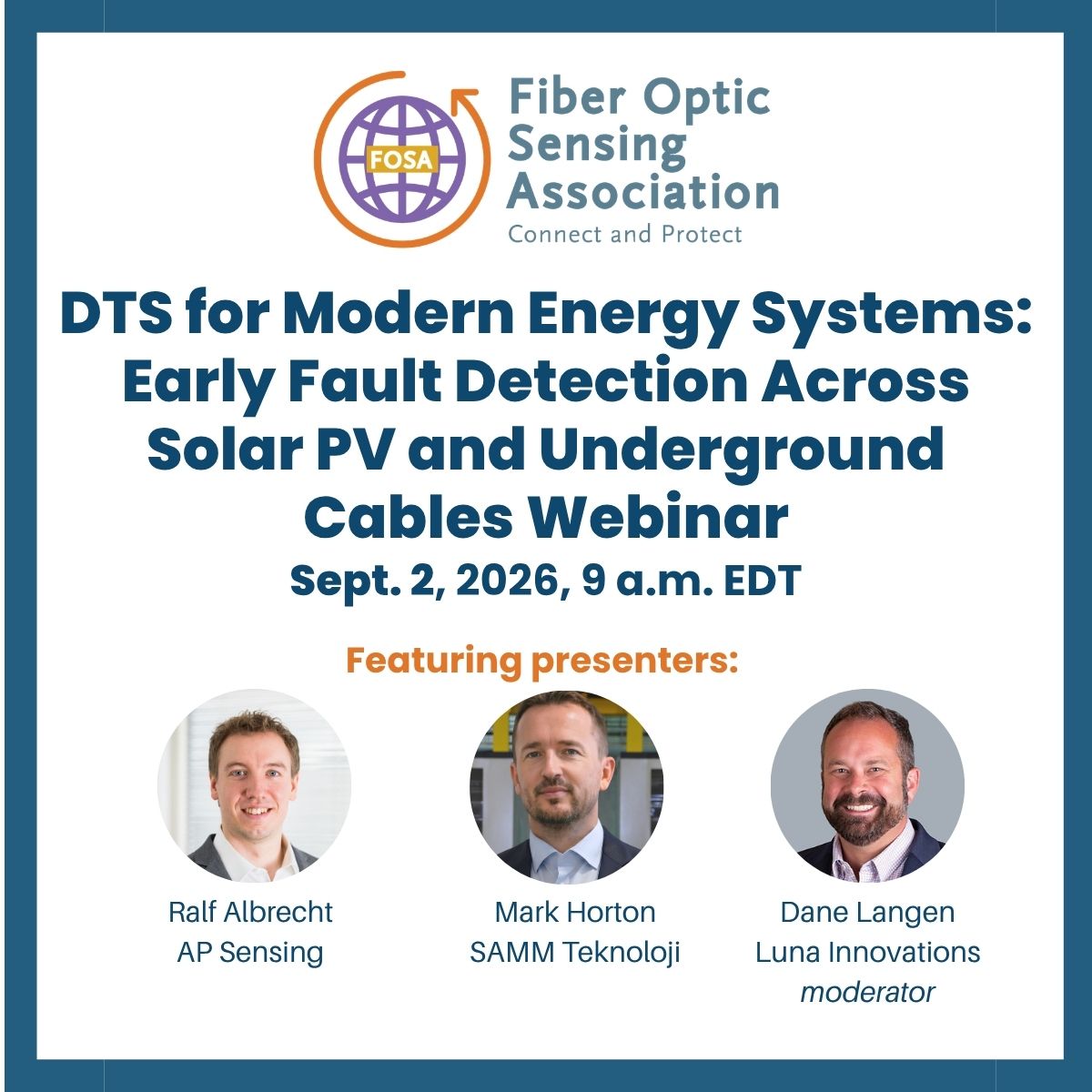
The webinar, titled “DTS for Modern Energy Systems: Early Fault Detection Across Solar PV and Underground Cables,” takes place on September 2, 2026, at 9:00 AM EDT (13:00 UTC), hosted online via Zoom by FOSA, the US-based non-profit industry association focused on advancing distributed and quasi-distributed fiber optic sensing technologies.
SAMM Technology on the Panel
Representing SAMM Technology, Mark Horton, the company’s International Operations Director, joins the session alongside Ralf Albrecht of AP Sensing, with Dane Langen of Luna Innovations moderating. According to FOSA’s own event announcement, the panel will discuss how DTS technology is being applied to monitor modern energy infrastructure, with a focus on practical approaches to early fault detection in solar PV installations and underground power cable networks.
In its own announcement of the participation, SAMM Technology said the webinar “provides an excellent opportunity to share knowledge, discuss emerging trends, and demonstrate how innovative monitoring technologies are supporting the future of energy systems,” adding that it was “proud to see Mark Horton representing SAMM Technology on this distinguished panel.”
Why DTS for Solar PV and Underground Cables
Distributed Temperature Sensing turns a standard optical fiber into a continuous string of temperature sensors along its full length, without the need for external power at the sensing points. For underground and solar PV power infrastructure, that capability is particularly relevant: temperature anomalies along a cable route or within a PV installation can be early indicators of developing faults, hotspots, or degrading connections — issues that are otherwise difficult to catch before they cause an outage or safety incident. Panel discussions on this topic typically cover how real-time DTS monitoring data feeds into asset reliability programs, operational efficiency, and system safety practices for energy operators.
How to Attend
The FOSA webinar is scheduled for September 2, 2026, 9:00 AM EDT (13:00 UTC), and will be held online via Zoom. Registration details are available through FOSA’s website.
This article is based on SAMM Technology’s own announcement of its webinar participation (dated August 5, 2026) and FOSA’s official event promotional graphic and public webinar listing.
Meta is piloting robots from three vendors, Watney Robotics, Kinova and ABB, to handle physical maintenance tasks inside its data centers, including swapping network cables, power-cycling servers, reseating components and inspecting equipment, according to an August 31, 2026 report from WIRED based on current and former employees familiar with the trials.
What the Robots Are Doing
At Meta’s Altoona, Iowa campus, a pair of dual-armed Watney robots has been tested on cabling work since June 2025, supervised by human operators and still slower than a person, per the report. At the Prometheus campus in New Albany, Ohio, four-wheel ABB robots equipped with a scissor-lift riser and a six-axis arm are being used to reseat hardware components, and Meta is separately evaluating a Kinova Gen3 robotic arm for power-cycling servers. Meta has also deployed simpler robots that remotely restart devices by physically pressing power buttons. Kinova and ABB declined to comment to WIRED, and Watney did not respond to the outlet’s requests for comment.
Why It Matters
One Meta data-center worker told WIRED that a working cable-swapping system could eventually take on as much as 80% of some technicians’ current workload, though that figure is an employee estimate rather than a company-published target, and the robots still struggle with dense cabling, tight corners and tasks that require sustained autonomy. As AI-driven data center buildouts accelerate, the trials point to facility operations and physical security converging with the same automation trends reshaping server hardware itself.
A new report from rf IDEAS and Wavelynx has found that most security leaders believe their organizations are more advanced than industry peers on authentication, even though barely a quarter describe their systems as largely modernized, according to the 2026 State of Authentication Modernization Report published August 31, 2026.
Key Findings
The survey of 500 IT and security leaders at mid-sized to enterprise organizations found 93% believe their authentication and security maturity outpaces their industry peers, yet only 24% said their systems are largely modernized and 53% have not significantly updated authentication systems in at least three years. While 78% called modernization a high priority for the next 12 months, only 72% of managers closer to day-to-day execution agreed it was a high priority, and 27% cited unclear return on investment as a barrier. Among organizations that do prioritize the work, 55% plan to allocate at least $500,000 to it, but credential and authentication upgrades ranked eighth among security initiatives overall, behind higher-profile priorities.
Why It Matters
Forty percent of respondents estimated that a breach involving unauthorized access would cost their organization less than $1 million, well below the $4.4 million global average cost of a data breach reported for 2025. rf IDEAS and Wavelynx said the gap between confidence and readiness underscores the need to treat physical and logical access control as a single modernization effort rather than two separate budgets.
LastPass rolled out a series of product updates on August 31, 2026 aimed at credential and access management, including what the company describes as the industry’s first Mobile Smart Scanner and expanded SaaS Monitoring capabilities for its Business Max customers, according to the company’s announcement carried by Security Info Watch.
What’s New
The Mobile Smart Scanner lets users scan passwords from printed lists, screenshots and handwritten notes through the LastPass Mobile app and convert them into encrypted, autofill-ready credentials. Persistent Monitoring, now fully released across all browser extensions, keeps SaaS visibility active through a permanent browser-extension connection even when a user is signed out of LastPass, and administrators can now set more granular SaaS Protect usage rules for specific users or groups. LastPass also completed its move from a Legacy Admin Console to a single Unified Admin Console, introduced a company-wide sign-up link for Teams, Business and Business Max customers, and is shifting Dark Web Monitoring for consumer accounts to automatic enrollment. The company said it passed independent SOC 2 and ISO 27001/27701 audits with zero findings for a second consecutive year.
Why It Matters
LastPass tied the updates to IBM’s 2026 Cost of a Data Breach Report, which found AI-driven attacks rose 56% year over year and added roughly $1 million to average breach costs, with 92% of organizations hit by AI-related breaches lacking adequate AI access controls. The emphasis on visibility and credential hygiene mirrors a broader push across the industry to close the kind of access gaps that groups exploit in AI-assisted phishing and credential-theft campaigns.
The Department of Defense has suspended Cybersecurity Maturity Model Certification (CMMC) Phase II requirements that were scheduled to take effect November 10, 2026, while a reform task force reviews the program, according to an August 31, 2026 report from Security Info Watch. Phase I self-assessments and current NIST SP 800-171 Revision 2 obligations remain in effect for defense contractors.
What’s Paused, What Isn’t
Level 1 self-assessments covering 15 safeguarding requirements from FAR clause 52.204-21 continue on their annual cycle, and Level 2 self-assessments against the 110 security requirements in NIST SP 800-171 Rev. 2 continue every three years with annual affirmation, with results still required in the Supplier Performance Risk System (SPRS). For contracts under DFARS clause 252.204-7012, contracting officers must still verify a current SPRS assessment score before certain awards, extensions or option exercises. Only the timing of third-party CMMC Phase II assessments has changed, not the underlying obligation to safeguard Controlled Unclassified Information, Bill Osborne, vice president of Defense Sector Services at Magna5, told the publication.
Why It Matters
The pause gives contractors more time to fix gaps in scope, documentation and System Security Plans before a Third-Party Assessment Organization is engaged, rather than a reason to slow readiness work altogether. Compliance requirements of this kind sit alongside physical protections for critical infrastructure and defense-linked targets that state-linked threat actors continue to probe.
Keenfinity Group is separating its former Intrusion & Access portfolio into two dedicated subsidiaries effective September 1, 2026, with Radionix taking over intrusion alarm systems and MiCOS concentrating exclusively on access control, the company confirmed to Security Info Watch on August 31, 2026.
New Leadership Structure
Phil Dutoy, who joined Keenfinity in 2025 and previously worked on the company’s transformation strategy following its carve-out from Bosch, becomes CEO of Radionix. Gregor Schlechtriem, who had led the combined Intrusion & Access business through the Radionix brand launch, moves to lead MiCOS exclusively. Both companies remain wholly owned Keenfinity subsidiaries pursuing separate go-to-market strategies, and Keenfinity said the change will not alter existing product lines: Radionix continues to build on Bosch intrusion technology, while Bosch-branded access control products continue under the same development and support teams.
Two Legacy Brands, Two Focused Businesses
Radionix, formally launched at GSX 2025, builds on nearly six decades of intrusion-system heritage and includes the G Series platform that integrates intrusion detection, access control and fire alarm functions. MiCOS revives a brand with more than four decades of access control history and will operate out of Eindhoven, Netherlands, with a development center in Aachen, Germany. Keenfinity became an independent company on July 1, 2025, after Triton completed its acquisition of Bosch’s security and communications technology business.
Why It Matters
The split gives each business room to compete more directly in increasingly specialized markets, following a broader industry pattern of vendors separating access control strategy from intrusion detection as buyers demand deeper feature depth in each category rather than a single generalist product line.