Author: Osiris

  • Supply Chain and Cargo Security Technology: Protecting Goods in Transit

    Supply Chain and Cargo Security Technology: Protecting Goods in Transit

    Cargo theft and supply chain tampering represent a persistent and, according to industry logistics and insurance publications, growing risk for shippers, carriers and the retailers and manufacturers who depend on predictable delivery of goods. Unlike facility-based physical security, which can rely on a fixed perimeter and stationary sensors, cargo security technology has to protect assets that are constantly moving through a chain of custody spanning warehouses, trucks, rail yards, ports and, in many cases, multiple countries and jurisdictions.

    GPS tracking is the foundational layer, but modern cargo security goes well beyond simple location reporting. Tracking devices installed on trailers, containers or high-value pallets increasingly combine location data with motion sensors, light sensors and door-open detection, so that a monitoring system can distinguish a truck making a scheduled stop from a trailer being diverted from its planned route or opened at an unscheduled location. Geofencing, which triggers an alert when a shipment deviates from an approved route corridor or dwells outside an authorized stop for longer than a defined threshold, is one of the most widely deployed capabilities because it converts raw location data into an actionable alert rather than requiring a human to continuously monitor a map.

    Seal integrity monitoring addresses the specific risk of container or trailer tampering during transit. Traditional mechanical seals only reveal tampering after the fact, when a receiving facility inspects the seal and finds it broken or replaced. Electronic seals, which report their status to a monitoring platform in near real time, close that gap by alerting a monitoring center the moment a seal is opened or its circuit is broken, regardless of where in the journey that occurs, giving carriers and shippers the ability to respond during transit rather than discovering a loss only at delivery.

    Video and sensor technology at cargo handling facilities, including ports, rail yards and cross-dock warehouses, has increasingly incorporated automated license plate and container number recognition to reconcile physical cargo movement against shipping manifests automatically, flagging discrepancies between what a system expects to see and what cameras actually capture at a gate or loading dock. This automated reconciliation reduces reliance on manual gate-log entry, which remains a common point of both error and, in cases of insider-facilitated theft, deliberate manipulation.

    Driver and facility access verification is a frequently underweighted layer of cargo security. A significant share of cargo theft, according to logistics security industry reporting, involves some degree of insider knowledge or facilitation, whether through compromised load information, fraudulent pickup credentials, or collusion with facility personnel. Technology responses include multi-factor verification of drivers and carriers at pickup, digital credentialing tied to a specific scheduled load rather than a general facility access badge, and audit trails that log which personnel accessed load and routing information ahead of a theft, supporting investigation after an incident occurs.

    Data integration across these layers, tracking devices, electronic seals, gate cameras and transportation management systems, is what separates a mature cargo security program from a collection of disconnected point solutions. Organizations increasingly centralize this data into a single monitoring capability, whether an in-house logistics security operations function or a third-party cargo security monitoring service, so that an anomaly detected by one system, such as a route deviation flagged by GPS tracking, can be immediately cross-referenced against seal status and the load’s risk classification to determine whether the deviation warrants an automated alert, a phone call to the driver, or immediate law enforcement notification.

  • Global Security Operations Center (GSOC) Design: People, Process and Technology

    Global Security Operations Center (GSOC) Design: People, Process and Technology

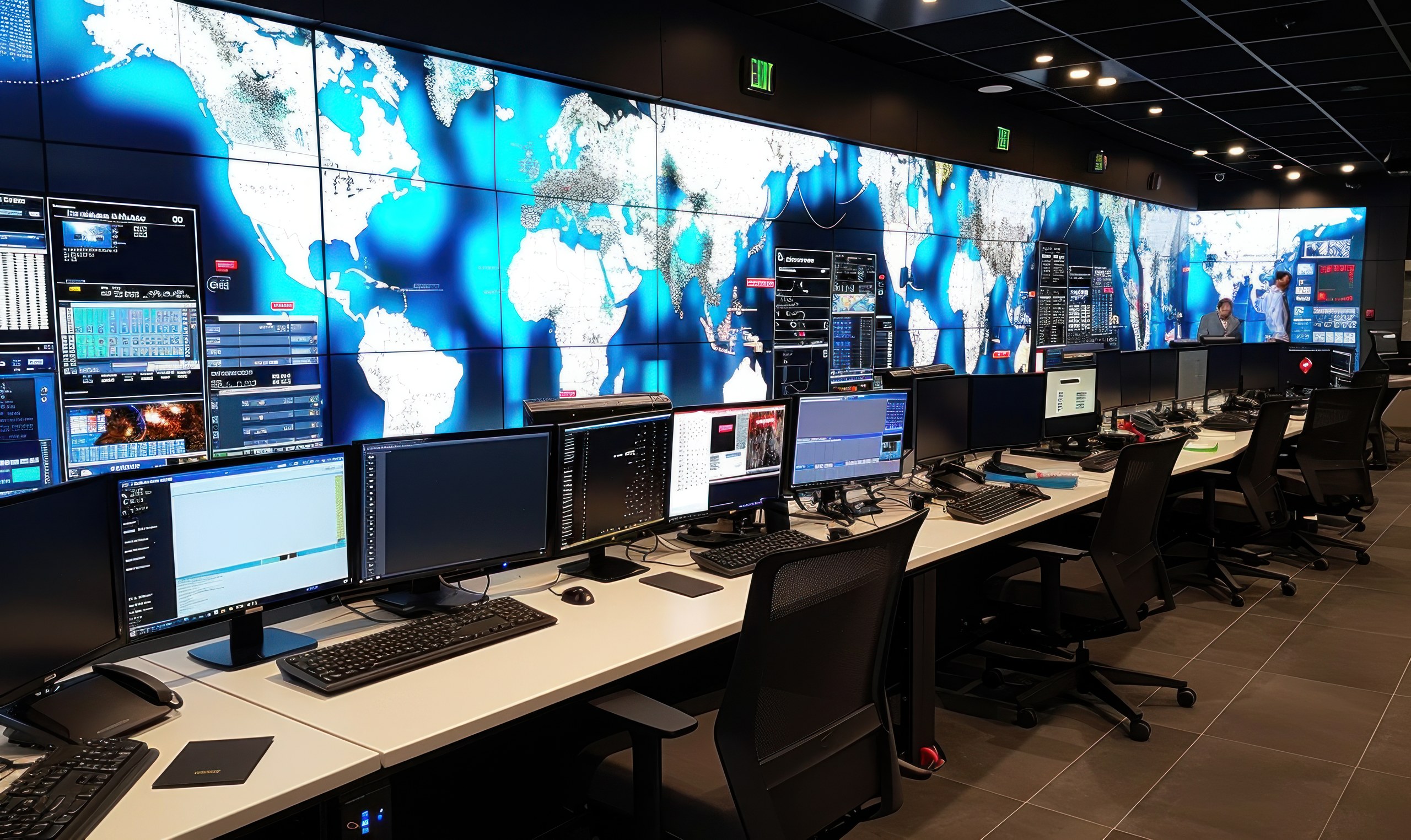
    A Global Security Operations Center, or GSOC, centralizes monitoring and incident response for organizations with security operations spread across multiple facilities, regions or time zones. Unlike a single-site guard station monitoring local cameras and alarms, a GSOC is built to aggregate video, access control, intrusion detection, travel risk intelligence and often cybersecurity alerting from dozens or hundreds of locations into a unified operating picture, with staff trained to triage and coordinate response regardless of where an incident originates.

    The technology layer that makes this possible is a physical security information management (PSIM) platform, or increasingly a unified security platform that combines video management, access control and analytics natively rather than through a separate integration layer. The core function of this software is normalization: translating alerts and video feeds from potentially dozens of different camera manufacturers, access control panels and alarm systems, often installed at different times by different integrators, into a consistent interface that a GSOC operator can act on without needing to learn each underlying vendor system individually.

    Staffing model and shift structure are as important to GSOC effectiveness as the underlying software. A GSOC covering global operations typically requires 24/7 staffing organized around a “follow the sun” model, with regional teams handing off situational awareness at shift boundaries, or a single centralized team working rotating shifts. The choice affects language coverage, familiarity with regional regulatory and cultural context, and response time to incidents occurring outside a centralized team’s typical working hours; organizations with major operations concentrated in a small number of regions often favor a hybrid model with a smaller follow-the-sun core team supplemented by on-call regional specialists.

    Alert prioritization and workflow design determine whether a GSOC scales effectively as the number of monitored sites grows. Without a structured triage process, a GSOC ingesting alerts from hundreds of facilities can quickly become overwhelmed by nuisance alarms, such as motion-triggered alerts from wildlife or weather rather than genuine intrusions. Mature GSOCs implement tiered alert classification, often informed by analytics that pre-filter video-based alerts before they reach a human operator, and maintain documented standard operating procedures that specify escalation paths, notification requirements and decision authority for different incident categories, from a minor access control malfunction to an active threat requiring law enforcement coordination.

    Integration with business continuity and crisis management functions is increasingly a defining feature of higher-maturity GSOCs. Rather than operating purely as a security monitoring function, many organizations now position their GSOC as the initial point of situational awareness for a broader range of business-impacting events, including severe weather affecting a facility, civil unrest near a location with traveling employees, or a supply chain disruption at a manufacturing site, feeding that awareness into the organization’s broader crisis management and business continuity processes rather than treating physical security monitoring as an isolated function.

    Facility design for a physical GSOC space itself follows established principles: redundant power and network connectivity, video walls sized and positioned for extended-shift ergonomics, and physical security controls for the GSOC space that reflect its role as a high-value target in its own right, since an incident that disables or compromises the GSOC’s own operations removes situational awareness across the entire organization at the moment it may be needed most. Organizations building or upgrading a GSOC increasingly plan for a geographically redundant backup facility or cloud-hosted failover capability, so that a single site outage, whether from a power failure, natural disaster or targeted attack, does not eliminate centralized monitoring capability entirely.

  • AI-Based Concealed Weapons Detection: How Walkthrough Systems Work

    AI-Based Concealed Weapons Detection: How Walkthrough Systems Work

    A newer category of weapons detection has emerged over the past several years alongside traditional metal detectors and X-ray screening: walkthrough systems that use sensor fusion and machine learning to flag concealed firearms and large blades without requiring visitors to empty pockets, remove belts, or stop and be individually wanded. These systems are increasingly deployed at venues, schools, stadiums, hospitals and corporate campuses seeking higher throughput than conventional metal detection allows while still screening for weapons rather than general metal content.

    The underlying sensing approaches vary by vendor but generally fall into two categories: active electromagnetic field sensing, which detects disturbances in a low-power magnetic field as a person walks through a portal, and millimeter-wave or other RF-based imaging, which can detect the physical shape and material properties of concealed objects at a distance. Both approaches feed raw sensor data into a machine-learning classification model trained to distinguish the electromagnetic or material signature of firearms and large blades from the signatures of common personal items such as laptops, keys, belt buckles and phones.

    The core technical challenge is the same one that affects any binary detection system: the trade-off between false negatives (missed weapons) and false positives (alarms on benign items). Vendors in this category generally tune their classification models toward minimizing false negatives given the severity of a missed detection, which means false alarm rates on common metal objects remain a genuine operational consideration; venues deploying these systems typically pair them with a secondary visual or manual check process for anyone who triggers an alert, rather than treating the AI classification as a final determination on its own.

    Throughput is the primary operational advantage these systems offer over traditional walk-through metal detectors paired with bag search and wanding. Because visitors do not need to remove metal objects from pockets or empty bags for the primary screening pass, venues can process significantly higher visitor volumes per lane during peak entry periods such as event doors opening or shift changes at a large facility. This throughput advantage is a major driver of adoption at large venues, though it depends on adequate staffing for the secondary screening process that handles alerts, since a system that generates alerts faster than staff can resolve them simply creates a new bottleneck at the secondary screening point.

    Placement and environmental tuning matter significantly to real-world performance. Systems using electromagnetic field sensing can be affected by nearby metal structures, electronic equipment, or other portals placed too close together, requiring careful site surveys and calibration during installation. Integrators typically conduct a threat testing and calibration process specific to each installation site rather than relying solely on factory default settings, and ongoing recalibration is generally required as a venue’s surrounding infrastructure or foot traffic patterns change.

    Privacy and civil liberties considerations differ from those raised by facial recognition or license plate reading, since these systems generally are not designed to identify individuals, but questions remain about how alert data, video capture at detection points, and any biometric-adjacent data are stored and for how long. Procurement teams evaluating this category should request clarity on data retention practices, false alarm rate testing under realistic conditions rather than only controlled test environments, and integration requirements with existing access control and video management systems, since standalone weapons detection lanes that are not integrated with a venue’s broader security operations center reduce the speed at which an alert can be escalated to a coordinated response.

  • Executive and Dignitary Protection Technology: GPS, Panic Alerts and Travel Risk Intelligence

    Executive and Dignitary Protection Technology: GPS, Panic Alerts and Travel Risk Intelligence

    Executive protection has historically relied on trained personnel: close protection officers, advance teams and drivers who assess a principal’s environment in real time. Technology has not replaced that human judgment, but it has meaningfully extended what a protection team can see and how quickly it can respond, particularly for organizations that need to protect executives, board members or high-profile individuals across frequent, often international, travel.

    Location awareness is the foundational layer. Modern executive protection programs typically issue principals a discreet tracking device, or rely on a mobile application with background location services, that reports position to a monitoring center on a continuous or interval basis. The technical trade-off is between battery life and update frequency: continuous high-frequency GPS reporting drains battery quickly and can be detected by device-scanning tools, while longer reporting intervals conserve power but reduce situational awareness during a fast-moving incident. Many programs address this by combining a low-frequency background trace with an on-demand “check-in” or panic function that triggers high-frequency reporting the moment it is activated.

    Panic and duress alerting has moved well beyond a single button. Contemporary systems support silent activation methods, including a specific sequence of button presses on a smartphone, a wearable device with a discreet trigger, or voice-activated duress phrases that can be spoken into a phone call without alerting a nearby threat actor that an alert has been raised. When triggered, these systems typically push the principal’s live location, a pre-recorded audio or video stream if available, and relevant medical and emergency contact information simultaneously to a monitoring center, local protection team members, and in some deployments directly to a pre-coordinated local emergency response contact.

    Travel risk intelligence is the layer that operates before a trip begins rather than during an incident. Dedicated travel risk management platforms aggregate data from government travel advisories, regional threat intelligence feeds, health and disease surveillance sources, and civil unrest monitoring services, then map that data against a principal’s planned itinerary to flag elevated-risk destinations, routes or dates. Advance teams use this intelligence to adjust routing, lodging selection and local security staffing, and increasingly to pre-position emergency evacuation plans and medical assistance contracts specific to the destination.

    Communication redundancy is a design principle that runs through all of these systems. A protection program that depends entirely on a principal’s personal smartphone and cellular connectivity has a single point of failure in exactly the scenarios, such as civil unrest or infrastructure disruption, where reliable communication matters most. Mature programs layer satellite communication devices, encrypted messaging applications that can operate over degraded connectivity, and pre-briefed rally points and communication windows that do not depend on any single technology working correctly.

    Integration with corporate security operations centers is increasingly common for organizations with dedicated executive protection functions, allowing a principal’s location and duress status to appear alongside broader corporate security monitoring rather than in an isolated protection-team-only system. This integration raises the same governance questions found in other converged security programs: who has visibility into an executive’s real-time location, how long location history is retained, and what separation exists between legitimate protective monitoring and inappropriate surveillance of a senior executive’s personal movements.

  • Insider Threat Programs: Merging Physical and Cyber Risk Signals

    Insider Threat Programs: Merging Physical and Cyber Risk Signals

    Insider threat programs have traditionally lived in one of two silos: a physical security team tracking badge swipes, visitor logs and after-hours building access, or a cybersecurity team monitoring data exfiltration, privileged account misuse and anomalous network activity. Neither view alone tells a complete story. An employee who badges into a facility outside normal hours, then downloads an unusually large volume of files from a file share twenty minutes later, is a pattern that only becomes visible when physical access data and IT activity logs are correlated in the same timeline.

    The technical foundation for merging these signals is not exotic. Access control systems already generate structured, timestamped event logs; user and entity behavior analytics (UEBA) platforms already ingest authentication, file access and network telemetry. The harder problem is organizational: physical security, IT security, HR and legal typically operate under different reporting lines, different data retention policies and different thresholds for what counts as suspicious. A mature insider threat program has to establish a cross-functional governance structure before it can meaningfully fuse the underlying data streams, because badge data and endpoint telemetry both carry privacy and labor-law implications that vary significantly by jurisdiction.

    Once governance is in place, the technical architecture generally follows a hub-and-spoke pattern: a central risk-scoring engine ingests event feeds from access control platforms, video management systems, HR systems (departures, role changes, disciplinary actions), and IT security tools (DLP alerts, privileged access management logs, endpoint detection and response), then applies weighted rules or machine-learning models to flag combinations of behavior that individually would not trigger an alert. A single late-night badge entry is unremarkable. A late-night badge entry combined with access to a server room outside an employee’s normal work area, followed by an unusual outbound data transfer, is a materially different risk signal.

    False positives are the central operational challenge. Programs that alert on every anomaly quickly overwhelm the analysts responsible for triage, and organizations that overcorrect by raising thresholds risk missing genuine indicators. Most mature programs address this with tiered alerting: low-confidence signals feed a baseline risk score that adjusts an individual’s overall standing without generating an immediate case, while high-confidence combinations of physical and digital indicators generate a case for human review. This tiering also matters for legal defensibility, since insider threat investigations that lead to termination or law enforcement referral need an evidentiary trail that shows proportionate, policy-driven escalation rather than surveillance triggered by a single ambiguous event.

    Departure workflows are one of the highest-value integration points. Employees who have resigned or been notified of termination represent a statistically elevated period of insider risk, and organizations increasingly automate a coordinated response across systems: access control credentials are scheduled for deactivation at a specific time, video retention policies for the individual’s typical work areas are extended, and IT security tooling temporarily lowers the alert threshold for that user’s accounts. Coordinating this sequence requires access control, HR information systems and IT identity platforms to share a common employee identifier and event bus, which is often the most significant integration project in standing up a converged program.

    Vendor tooling in this space spans several categories: dedicated insider risk management platforms that specialize in behavioral analytics across HR, IT and physical data; broader security information and event management (SIEM) platforms extended with physical access connectors; and unified physical security platforms that have added behavioral analytics modules on top of existing access control and video management functionality. Organizations evaluating these options should weigh not just detection capability but data governance: how long behavioral profiles are retained, who can access risk scores, and what due-process protections exist for employees flagged by an automated system, since insider threat programs that lack clear governance can create legal exposure and erode workforce trust even when the underlying technology performs as intended.

  • Nvidia Posts Blowout Quarterly Results, Guides to Accelerating Growth as Data Center Demand Surges

    Nvidia Posts Blowout Quarterly Results, Guides to Accelerating Growth as Data Center Demand Surges

    Nvidia reported second-quarter fiscal 2027 results after market close on August 26, 2026 that topped Wall Street expectations and sent the stock and broader semiconductor sector higher the following trading day. According to CNBC and The Motley Fool, the company reported quarterly revenue of $96.2 billion, more than double the prior-year period, with adjusted earnings per share of $2.22, both ahead of analyst consensus estimates of roughly $92.1 billion in revenue and $2.09 in adjusted EPS.

    Nvidia’s data center segment, which includes the GPUs and networking hardware powering large-scale AI training and inference clusters, contributed roughly $89 billion of the quarter’s revenue, according to Yahoo Finance’s reporting on the release, ahead of average analyst estimates near $85.8 billion. CNBC reported that CFO Colette Kress guided investors to expect approximately 70% revenue growth in fiscal 2028, sharply above the roughly 44% growth analysts surveyed by LSEG had anticipated, while CEO Jensen Huang said actual demand “is much greater than 70%” but that the company remains constrained by how much product it can manufacture and ship.

    The S&P 500 and Nasdaq Composite both closed higher on August 27 following the results, with semiconductor peers including Broadcom, Micron and SanDisk also gaining in premarket and regular trading as investors read the results as confirmation that hyperscaler AI infrastructure spending remains on an accelerating trajectory rather than plateauing, according to CNBC and StockAnalysis.com market coverage.

    For the security technology sector, sustained data center capital expenditure from hyperscale and enterprise AI infrastructure buyers has direct downstream implications: physical security, fire suppression, and access control specification for new data center campuses typically track the pace of underlying compute buildouts, and integrators serving that vertical have increasingly cited data center project pipelines as a primary growth driver, a dynamic separately highlighted in trade coverage of building-systems suppliers this year.

  • Over 100 Tech Companies Including OpenAI, Anthropic, Google and Microsoft Sign Letter on Defending Against AI-Driven Cyber Threats

    Over 100 Tech Companies Including OpenAI, Anthropic, Google and Microsoft Sign Letter on Defending Against AI-Driven Cyber Threats

    More than 100 technology companies, including OpenAI, Anthropic, Google and Microsoft, signed an open letter published August 27, 2026 urging closer cooperation between the private and public sectors to defend against AI-related cyber threats, according to TechCrunch. The letter calls for coordinated action as increasingly capable AI models are used both to accelerate cyberattacks and, in parallel, to help defenders detect and respond to them faster.

    TechCrunch reported that several of the signatories are, in the same period, continuing to develop more advanced frontier AI models even as they promote defensive programs built on that same technology, including OpenAI’s Daybreak program, Anthropic’s Mythos initiative, and a newly introduced cyber-defense platform from Microsoft called Perception. The report characterized this as a “conflicted position” for labs simultaneously advancing capability and warning about the risks that capability can pose in the hands of attackers.

    The initiative follows a series of disclosures throughout 2026 in which security researchers and AI labs described attackers using large language models to accelerate reconnaissance, vulnerability discovery and exploit development, alongside separate efforts by AI companies to formalize responsible-disclosure and defensive-use programs for their own models. The letter does not, according to the report, set out binding commitments, but frames the current moment as one requiring shared standards and cooperation between AI developers, security vendors, and government agencies as both offensive and defensive uses of AI systems mature.

    For security teams evaluating AI-enabled defensive tools, the emergence of vendor-specific programs from major model developers adds a new category of capability alongside established security operations center analytics platforms, though it also raises procurement questions about how defensive AI programs from foundation model vendors will integrate with, or compete against, existing security information and event management and extended detection and response tooling already deployed across enterprise and critical infrastructure environments.

  • Texas Governor Orders Pause on New Data Center Approvals Amid Grid Interconnection Strain

    Texas Governor Orders Pause on New Data Center Approvals Amid Grid Interconnection Strain

    Texas Governor Greg Abbott has ordered a pause on approvals for new large data center projects seeking to connect to the state’s power grid, a move that Houston Public Media reported on August 27, 2026 could delay roughly 300 large data center projects, though not every planned facility in the state is covered by the pause.

    The order responds to mounting pressure on the Electric Reliability Council of Texas (ERCOT) interconnection queue, as AI-driven data center demand has produced a wave of large-load requests competing for grid capacity and connection timelines. According to the report, Beth Garza, who previously served as ERCOT’s independent market monitor, said the interconnection process could take significantly longer than originally projected, whether because of the governor’s pause or because the initial timeline itself was unrealistic; Garza said she “will be pleasantly surprised” if by April 2027 the industry has a clear picture of which data center loads will ultimately be able to move forward.

    Texas has emerged as one of the largest hubs for hyperscale and AI-focused data center construction in the country, drawing investment from major cloud and AI infrastructure providers seeking access to relatively fast permitting and available land, but also straining grid planning as operators request power commitments that can rival the demand of entire cities. The pause reflects a broader tension states are navigating between courting large-scale data center investment and protecting grid reliability and consumer electricity costs for existing residential and industrial customers.

    For the physical security and critical infrastructure sector, large-scale data center buildouts have significant downstream implications beyond power supply: campus perimeter security, access control, and fire and life-safety systems are typically scoped and budgeted alongside the underlying facility and power infrastructure, meaning delays or restructuring of a project’s grid interconnection timeline can directly affect the pace of associated physical security procurement and installation work tied to new builds.

  • CISA Publishes New Round of ICS Advisories Covering Industrial Test, Fleet and IoT Devices

    CISA Publishes New Round of ICS Advisories Covering Industrial Test, Fleet and IoT Devices

    The Cybersecurity and Infrastructure Security Agency published a new batch of industrial control system advisories on August 27, 2026, covering vulnerabilities in products used across manufacturing, transportation and utility test environments. Among the advisories was one for Rockwell Automation’s OTTO Fleet Manager, tagged to the Critical Manufacturing and Transportation Systems sectors, which CISA said contains a flaw (CVE-2026-75112) that could reduce the computational cost required for an attacker to carry out offline brute-force attacks against stored password hashes in versions up to V2.36.2.

    A separate advisory covered the Applied Systems Engineering ASE2000 V2 Communications Test Set, a tool used to test IEC 60870-5-104 protocol communications common in electric utility SCADA environments. According to the advisory and a technical writeup published by Trout Software, the affected versions (2.25 through 2.37) carry two flaws: a legacy XML external entity issue tied to an outdated bundled Apache log4net library, and an improper certificate validation weakness in the product’s IEC 60870-5-104 TLS client that could allow an attacker to intercept and impersonate a trusted peer during protocol testing. CISA credited researcher Enoch Wang with the report and noted the vendor has released version 2.38 as a fix.

    CISA also published advisories for the Xiiaozet LK100W device, warning that successful exploitation of the flaws it identified could allow an attacker to take control of the device, and for the All-Line Equipment Company Fuel-Boss and Ebyte NA111-M products. As with its standard ICS advisory practice, CISA’s guidance recommends that asset owners minimize network exposure of control system devices, ensure they are not directly reachable from the internet, and place control system networks behind firewalls, isolated from business IT networks.

    The advisories arrive amid a broader pattern industry researchers have flagged this year: security vendor Forescout reported that ICS advisory volume topped 500 for the first time in 2025, with a growing share of vulnerabilities affecting field controllers, remote terminal units and other Purdue Model Level 1 devices that directly interface with physical processes. CISA continues to publish advisories on a rolling weekly basis covering vendors ranging from major industrial automation suppliers to smaller niche device manufacturers used in specific utility and manufacturing test workflows.

  • CISA Adds ownCloud, Linux Kernel and JFrog Artifactory Flaws to Known Exploited Vulnerabilities Catalog

    CISA Adds ownCloud, Linux Kernel and JFrog Artifactory Flaws to Known Exploited Vulnerabilities Catalog

    The Cybersecurity and Infrastructure Security Agency added three vulnerabilities to its Known Exploited Vulnerabilities (KEV) catalog on August 27, 2026, citing evidence of active exploitation. The additions are CVE-2023-49105, an improper authentication vulnerability in ownCloud; CVE-2026-53362, an unspecified vulnerability in the Linux Kernel; and CVE-2026-66384, an improper limitation of a pathname to a restricted directory vulnerability affecting JFrog Artifactory, according to CISA’s alert.

    CISA’s advisory notes that vulnerabilities of this type are “a frequent attack vector for malicious cyber actors” and pose significant risk to federal networks. Under Binding Operational Directive 26-04, Federal Civilian Executive Branch agencies are required to remediate KEV catalog entries within CISA-specified timeframes, though the directive does not legally bind private-sector organizations.

    The JFrog Artifactory path traversal flaw is notable given the platform’s widespread use as a binary and package repository in enterprise software development pipelines; a pathname restriction bypass in that context can potentially allow an attacker to read or write files outside intended directories, a class of vulnerability that has previously been leveraged for both data exfiltration and remote code execution in build and artifact-management systems. The ownCloud authentication flaw, tracked since 2023, affects a self-hosted file-sharing platform used by organizations that manage sensitive document storage internally rather than through commercial cloud providers.

    CISA said it “will continue to add vulnerabilities to the catalog that meet the specified criteria” and encouraged all organizations, not just federal agencies, “to adopt risk-based vulnerability management and prioritize remediation of KEV Catalog vulnerabilities.” The agency’s KEV catalog has become a widely used reference point across the security industry for prioritizing patch management amid a growing volume of disclosed vulnerabilities.