
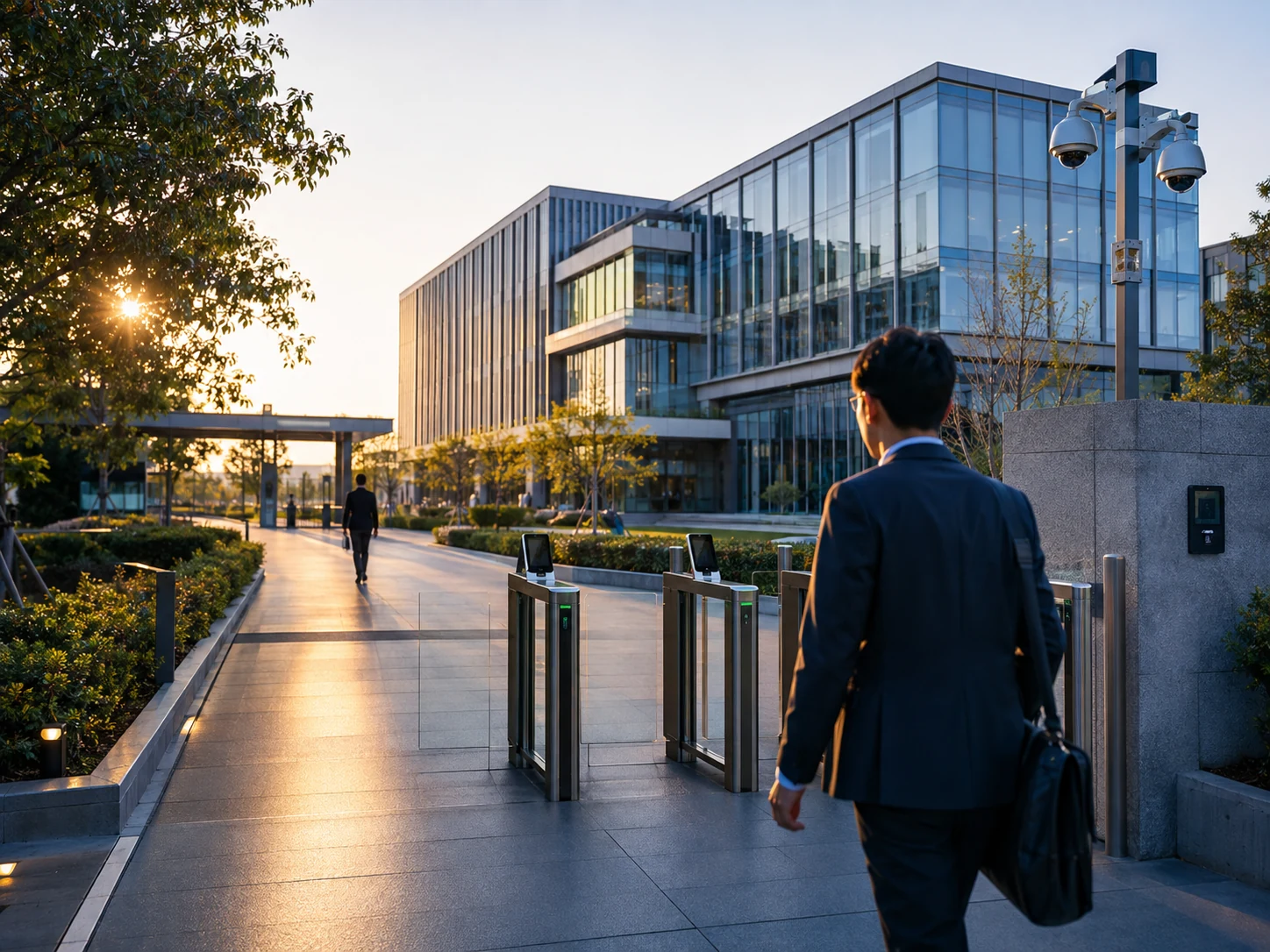
Schools and college campuses share a difficult security profile: they must stay open and welcoming to students, staff, families and visitors, while protecting large populations across buildings that were often not designed with modern security requirements in mind.
Layered access control
Many K-12 campuses now control building entry with electronic locks, visitor check-in systems and single-point-of-entry designs during the school day, while allowing classrooms to be locked from inside in an emergency. University campuses typically layer broader perimeter and building access around more open pedestrian environments, since restricting movement across an entire campus is rarely practical.
Visitor management
Digital visitor-management systems that screen visitors against watchlists, print time-limited badges and log entry and exit have become standard in many districts, replacing paper sign-in sheets. These systems give administrators a real-time record of who is on site, which matters both for day-to-day safety and for emergency accountability.
Weapons detection and screening
Some districts and universities have introduced weapons-detection systems at building entrances, ranging from traditional metal detectors to newer AI-assisted scanning designed to move larger volumes of students through checkpoints with less friction than manual bag checks. Adoption varies widely by district and budget, and the technology is generally deployed as one layer among several rather than a standalone solution.
Video surveillance and analytics
Camera coverage of entrances, hallways, parking areas and building perimeters supports both incident response and day-to-day safety and discipline needs. Some systems add analytics for tasks such as detecting a propped-open door or unusual after-hours activity, which can be more useful on large, multi-building campuses than continuous human monitoring alone.
Mass notification and emergency communication
Rapid, campus-wide communication is central to school security planning. Mass-notification systems typically combine PA announcements, text and email alerts, and integration with local law enforcement, and many districts now tie lockdown procedures to a single trigger that activates locks, notifications and camera views simultaneously.
Balancing security and learning environment
Security leaders in education generally caution against measures that make schools feel like fortified facilities, since that can affect student wellbeing without necessarily improving safety outcomes. Physical security investments are typically paired with threat-assessment programs, staff training and clear procedures, which education-security researchers describe as at least as important as the technology itself.
Conclusion
Effective school and campus security combines layered access control, visitor management, appropriate detection technology, video coverage and fast communication, implemented in a way that fits the culture and openness required of a learning environment rather than working against it.