
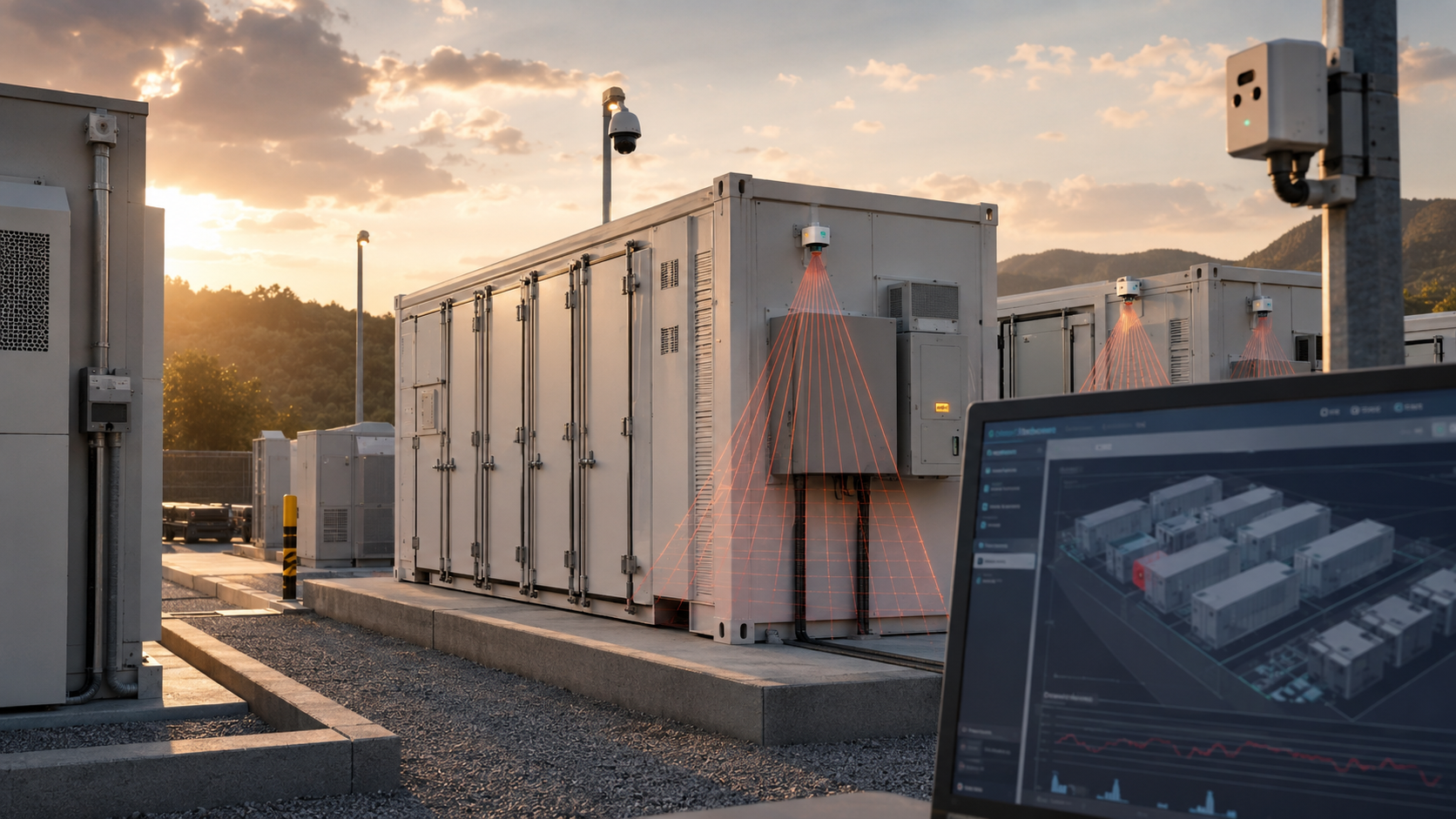
Battery energy storage systems are expanding rapidly because they help stabilize grids, support renewable energy and provide backup power. Their fire-safety challenge is different from that of conventional buildings: lithium-ion cells can fail internally, generate heat and flammable gases, and progress into thermal runaway before visible flames appear.
Why early warning matters A traditional smoke detector may only respond after decomposition has advanced. BESS protection therefore benefits from layered detection. Battery management systems can track abnormal voltage, current and temperature. Gas sensors can identify characteristic off-gassing. Aspirating smoke detection can reveal very small combustion aerosols, while thermal sensors and infrared monitoring can highlight localized heating.
Thermal runaway is a process, not a single event Thermal runaway occurs when heat generation inside a cell exceeds its ability to dissipate heat. The rising temperature can accelerate chemical reactions, release gases and transfer heat to neighboring cells. A key engineering objective is to detect abnormal conditions early enough to isolate equipment, reduce propagation risk and give operators useful time to respond.
Detection architecture A robust BESS design combines cell- and rack-level telemetry with room or container-level fire detection. Alarm thresholds should be coordinated so operators can distinguish equipment warnings, confirmed fire conditions and emergency states. Integration with ventilation, shutdown logic, suppression systems and remote monitoring is essential.
Avoiding a single-sensor strategy No single sensing technology provides a complete picture. Temperature alone can miss early off-gassing; gas detection can be affected by airflow; smoke detection may respond later than internal battery diagnostics. Combining independent indicators reduces blind spots and improves confidence.
Commissioning and maintenance Detector placement, airflow modelling, sensor calibration and alarm verification are critical. Battery layouts change, firmware evolves and ventilation patterns can be modified during maintenance. Fire detection should therefore be reviewed whenever the storage system is reconfigured.
The direction of the industry is toward integrated battery intelligence: BMS data, gas detection, thermal monitoring and fire systems feeding a common operational view. In BESS safety, the most valuable alarm is usually the one that arrives before a visible fire begins.