
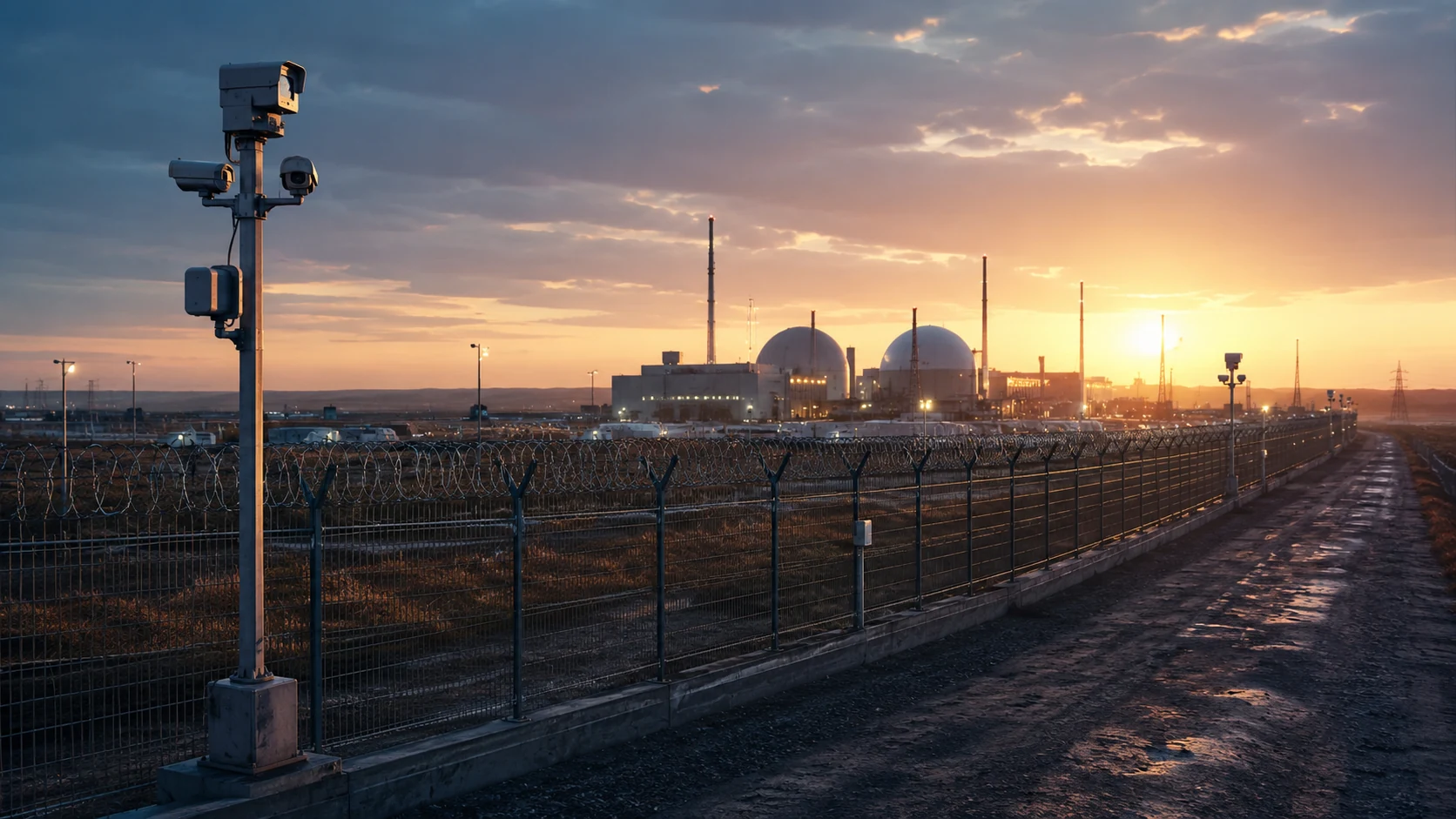
Fence-mounted and buried sensors solve the same basic problem in different ways: detecting unauthorized movement before a person reaches a protected asset. The right choice depends on site geometry, terrain, aesthetics, maintenance and the type of intrusion that must be detected.
Fence-mounted sensors
Fence systems detect vibration, movement or strain caused by climbing, cutting or lifting. Technologies include accelerometers, microphonic cable and fiber-optic sensing. They can provide precise zone information along long boundaries and are relatively easy to inspect because the detection medium follows the visible fence line.
Their performance, however, is closely tied to fence condition. Loose mesh, vegetation, wind-driven objects or poorly tensioned panels can create nuisance alarms. Good mechanical installation and site-specific tuning are essential.
Buried sensors
Buried systems create an invisible detection zone using seismic, pressure, electromagnetic or other sensing methods. They are useful around executive facilities, heritage sites, landscaped areas or locations where a visible sensor system would be undesirable.
Because the sensing medium is underground, soil type, moisture, drainage, frost, nearby roads and heavy machinery can influence performance. Installation can also be more disruptive, and later maintenance may require excavation.
Detection behavior
Fence sensors are naturally associated with a physical barrier and are well suited to detecting climbing or cutting. Buried sensors may detect a person before they reach the fence, providing earlier warning. On the other hand, they can be more sensitive to environmental vibration or non-threatening movement depending on the technology.
Lifecycle cost
The cheapest installation is not always the lowest-cost system over ten years. Fence repairs, vegetation management, battery replacement, excavation and calibration should all be considered in lifecycle planning.
When to combine them
High-security sites sometimes use buried sensors outside the fence for early detection and fence-mounted sensors as a second layer. Cameras, radar or thermal imaging can then verify the alarm.
Conclusion
Fence-mounted sensors are often simpler where a strong fence already exists. Buried sensors are valuable when covert or pre-fence detection is required. The decision should be based on the physical site and operating environment rather than on technology preference alone.