
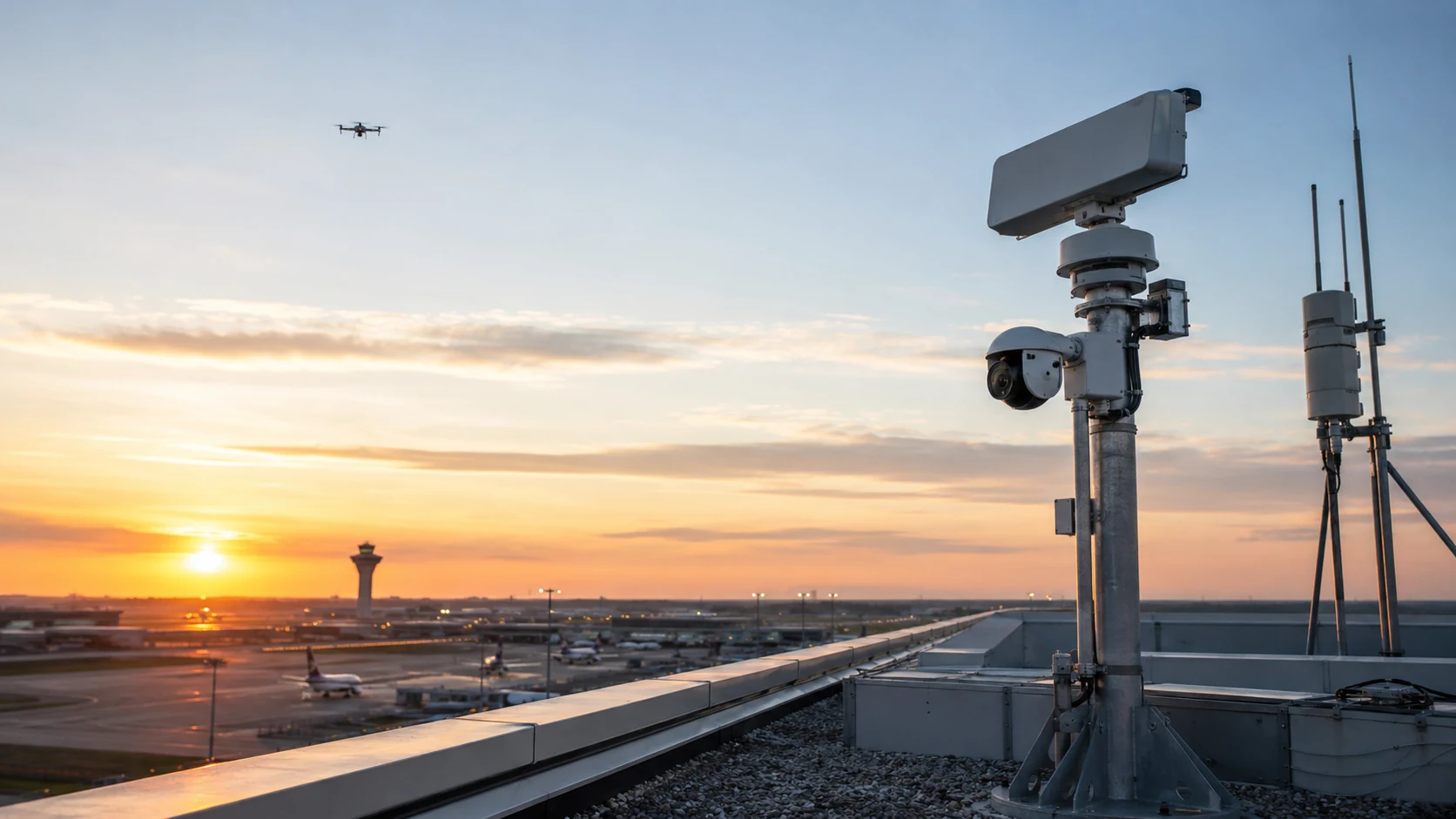
Counter-UAS programs begin with awareness. Before any organization can respond to an unauthorized drone, it must first detect, classify and track the object with enough confidence to support a decision. That is why modern counter-UAS architecture is increasingly built around layered sensing rather than a single device.
The Detection Layer
The first layer is discovery. Security radar is frequently used because it can search a wide area continuously and provide position, speed and trajectory. RF sensors can add information about command links or known drone protocols. Acoustic arrays may contribute in short-range environments, while optical and thermal cameras provide visual confirmation.
Each sensor has weaknesses. Radar can struggle with clutter and small non-drone objects. RF sensors may miss autonomous aircraft. Cameras need line of sight. Acoustic performance changes with wind and background noise. Layering reduces dependence on any one technology.
Classification and Correlation
Raw detections are not the same as actionable intelligence. A command platform must correlate data from different sensors and decide whether several observations represent the same target. Modern systems increasingly use machine learning, micro-Doppler analysis and track behavior to distinguish drones from birds, vehicles and other objects.
The most useful output for an operator is not five separate alarms. It is one track with confidence, location, direction, speed and supporting evidence.
Visual Verification
After a radar or RF system detects a target, a pan-tilt camera can be automatically cued toward the coordinates. Daylight or thermal imagery can then help an operator understand what is in the air and whether the object is approaching a protected zone.
This sensor-to-camera handoff is one of the most important features of an integrated counter-UAS system because it turns machine detection into human-verifiable situational awareness.
Protected Zones and Rules
Effective systems use geofenced zones instead of treating every drone equally. A drone several kilometers away may be informational. The same drone entering a runway approach, prison boundary or power-plant exclusion zone may trigger a higher-priority workflow.
Rules can consider altitude, direction, speed, dwell time and proximity to sensitive assets. This allows operators to focus on behavior rather than simply counting airborne objects.
Integration with Security Operations
Counter-UAS should not exist as a separate island. Events can be integrated with VMS, access control, incident management, maps and command-center software. A drone approaching a substation, for example, can automatically bring nearby cameras onto screen and create an incident record.
This unified workflow is particularly important at airports, critical infrastructure, ports, correctional facilities and large campuses where operators already manage many security systems.
Detection Is Not Mitigation
It is important to separate detection from active mitigation. Technologies that interfere with, take control of or physically defeat a drone are subject to significant legal and regulatory restrictions in many jurisdictions. A commercial security organization may be allowed to detect and document activity without being legally authorized to disrupt the aircraft.
For that reason, system design should start with legal authority, response procedures and evidence requirements, not only hardware specifications.
The Future of Airspace Awareness
Counter-UAS detection is evolving into low-altitude airspace intelligence. Sensor fusion, edge AI, improved radar classification and automatic camera cueing are reducing false alarms and improving operator confidence. As drones become more autonomous, systems will increasingly need to detect physical behavior even when no conventional RF link is present.
The strongest counter-UAS architecture therefore follows a layered principle: discover with multiple sensors, correlate the evidence, verify visually, prioritize by risk and integrate the result into the wider security operation.