

Tag: maritime security

  • Finnish Appeals Court Revives Case Against Eagle S Officers Over Baltic Sea Cable Breaks

    Finnish Appeals Court Revives Case Against Eagle S Officers Over Baltic Sea Cable Breaks

    Finland’s Helsinki Court of Appeal ruled on August 27, 2026 that Finnish courts have jurisdiction to try three senior officers of the Eagle S, the Russia-linked oil tanker that severed multiple subsea telecommunications and power cables in the Baltic Sea on Christmas Day 2024, according to the court’s ruling and reporting by The Record. The decision overturns a district court judgment that had thrown out the prosecution last October, and sends the case back to the Helsinki District Court to be heard on its merits.

    The appeals court found that the alleged crimes were committed in Finland because the resulting damage to the country’s power and telecommunications supply occurred there, rejecting defense arguments that the case could only be heard in the ship’s flag state, the Cook Islands, or the crew members’ home countries. According to the court’s account of the incident, Finnish authorities contacted the vessel shortly after the first cable break and were told, falsely, that both anchors were secured; the ship then continued dragging its port anchor for roughly 90 kilometers over several hours, severing four additional cables before it was boarded and seized by Finnish authorities.

    Maritime law experts had warned that the original ruling, if left standing, could leave vessels flying flags of convenience free to damage undersea infrastructure in international waters without legal consequence. For operators of subsea cables, pipelines and other undersea infrastructure, the case is a closely watched test of whether coastal states can hold ship crews criminally accountable for cable-severing incidents that are increasingly treated as a critical infrastructure security concern rather than solely a maritime accident.
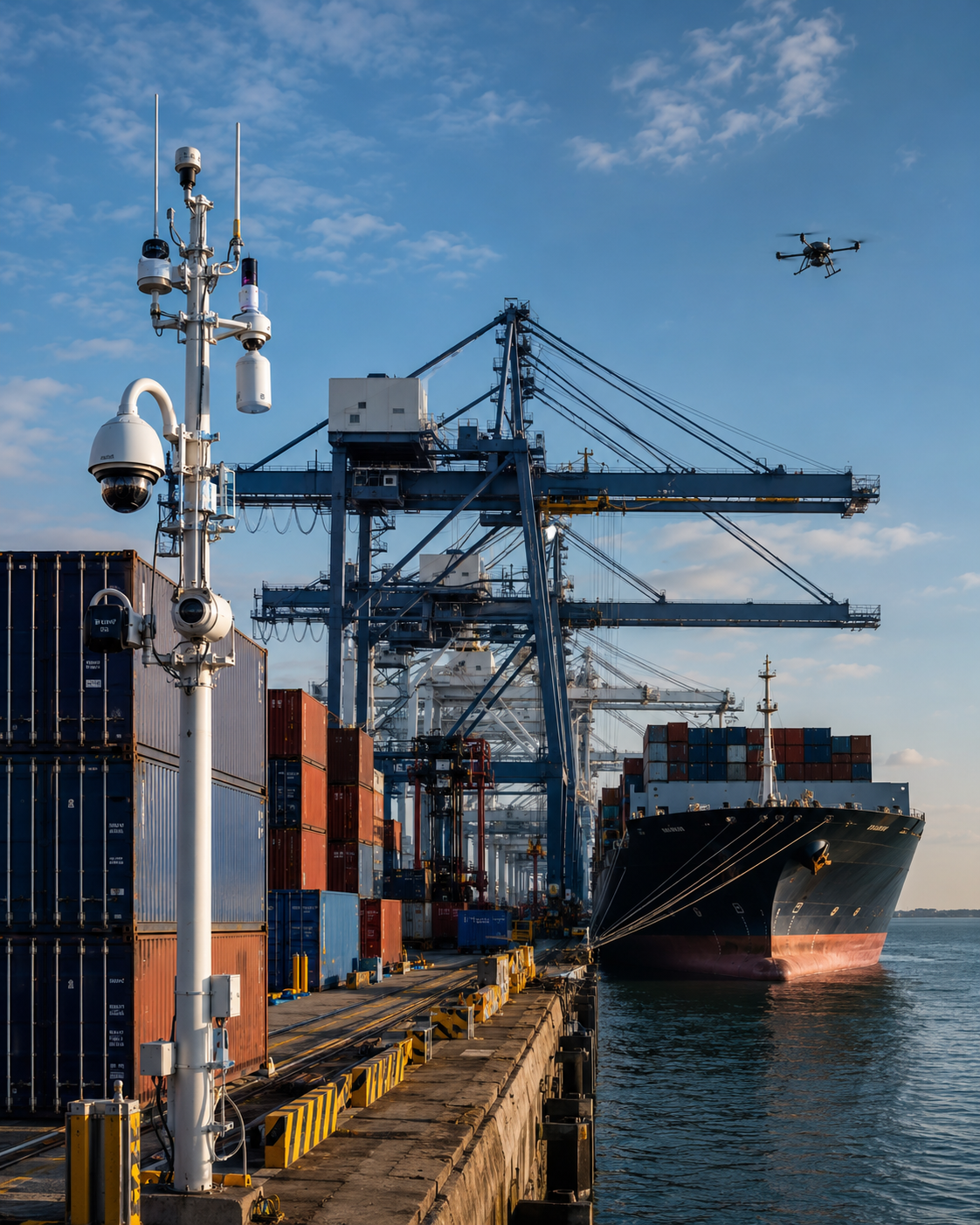
  • Port and Maritime Security Systems: Technologies and Architecture

    Port and Maritime Security Systems: Technologies and Architecture

    Ports are complex security environments where ships, cargo, trucks, workers, visitors and critical infrastructure interact continuously. Effective protection therefore requires coordinated monitoring across land, waterside areas and access points.

    Perimeter and Waterside Detection

    Land boundaries may use fencing, fiber-optic intrusion detection, radar, thermal cameras and fixed video surveillance. Waterside protection requires a different sensor mix. Marine radar, thermal imaging, electro-optical cameras and vessel-tracking data can help operators understand activity approaching restricted areas.

    Access and Identity

    Ports contain numerous restricted zones. Staff, contractors, drivers and visitors require different access permissions. Smart credentials, biometric verification, vehicle identification and gate automation can reduce manual processing while improving auditability.

    Cargo and Vehicle Security

    Container yards and logistics gates need clear chain-of-custody controls. License-plate recognition, container identification, video evidence and screening technologies can be integrated with terminal operating systems so security events are linked to operational records.

    Maritime Domain Awareness

    AIS vessel data provides useful context but should not be treated as a complete detection system. Radar, optical sensors and other independent sources are necessary because not every object will transmit reliable identity information. Sensor fusion helps create a more complete picture of the waterside environment.

    Command and Control

    Large ports may operate thousands of cameras and many independent security systems. A unified command center should correlate video, access-control alarms, radar tracks, intrusion events, vessel information and emergency communications. Map-based visualization is especially valuable in large terminals.

    Critical Infrastructure Protection

    Ports also contain fuel systems, power distribution, communications, cranes and industrial control equipment. Cybersecurity and physical security must be coordinated because disruption to connected operational systems can create physical consequences.

    Conclusion

    Modern port security depends on layered detection and strong operational integration. The objective is not simply to watch more cameras, but to combine identity, cargo, perimeter and maritime data into a coherent picture that allows operators to identify unusual activity early and respond efficiently.