
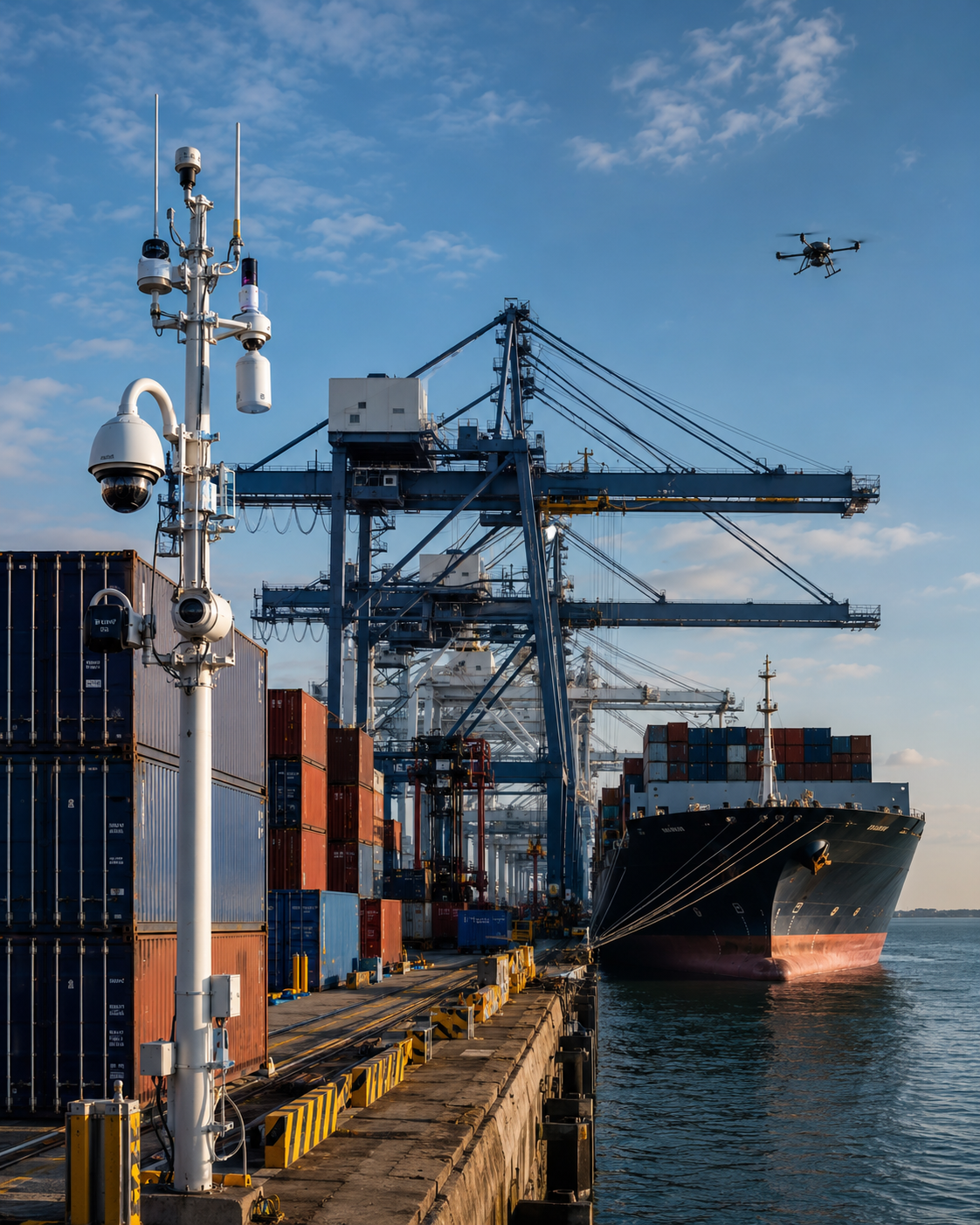
Ports are complex security environments where ships, cargo, trucks, workers, visitors and critical infrastructure interact continuously. Effective protection therefore requires coordinated monitoring across land, waterside areas and access points.
Perimeter and Waterside Detection
Land boundaries may use fencing, fiber-optic intrusion detection, radar, thermal cameras and fixed video surveillance. Waterside protection requires a different sensor mix. Marine radar, thermal imaging, electro-optical cameras and vessel-tracking data can help operators understand activity approaching restricted areas.
Access and Identity
Ports contain numerous restricted zones. Staff, contractors, drivers and visitors require different access permissions. Smart credentials, biometric verification, vehicle identification and gate automation can reduce manual processing while improving auditability.
Cargo and Vehicle Security
Container yards and logistics gates need clear chain-of-custody controls. License-plate recognition, container identification, video evidence and screening technologies can be integrated with terminal operating systems so security events are linked to operational records.
Maritime Domain Awareness
AIS vessel data provides useful context but should not be treated as a complete detection system. Radar, optical sensors and other independent sources are necessary because not every object will transmit reliable identity information. Sensor fusion helps create a more complete picture of the waterside environment.
Command and Control
Large ports may operate thousands of cameras and many independent security systems. A unified command center should correlate video, access-control alarms, radar tracks, intrusion events, vessel information and emergency communications. Map-based visualization is especially valuable in large terminals.
Critical Infrastructure Protection
Ports also contain fuel systems, power distribution, communications, cranes and industrial control equipment. Cybersecurity and physical security must be coordinated because disruption to connected operational systems can create physical consequences.
Conclusion
Modern port security depends on layered detection and strong operational integration. The objective is not simply to watch more cameras, but to combine identity, cargo, perimeter and maritime data into a coherent picture that allows operators to identify unusual activity early and respond efficiently.