
Small unmanned aircraft have changed the way organizations think about perimeter security. A fence can define a property boundary, but it does not protect the airspace above it. Airports, power plants, ports, data centers, prisons, logistics hubs and other sensitive sites increasingly need systems that can discover, classify and track low-flying drones before an operator can make a decision.
There is no single universal drone detector. Modern counter-UAS awareness systems normally combine several sensing methods because each technology sees a different part of the problem.
Radar
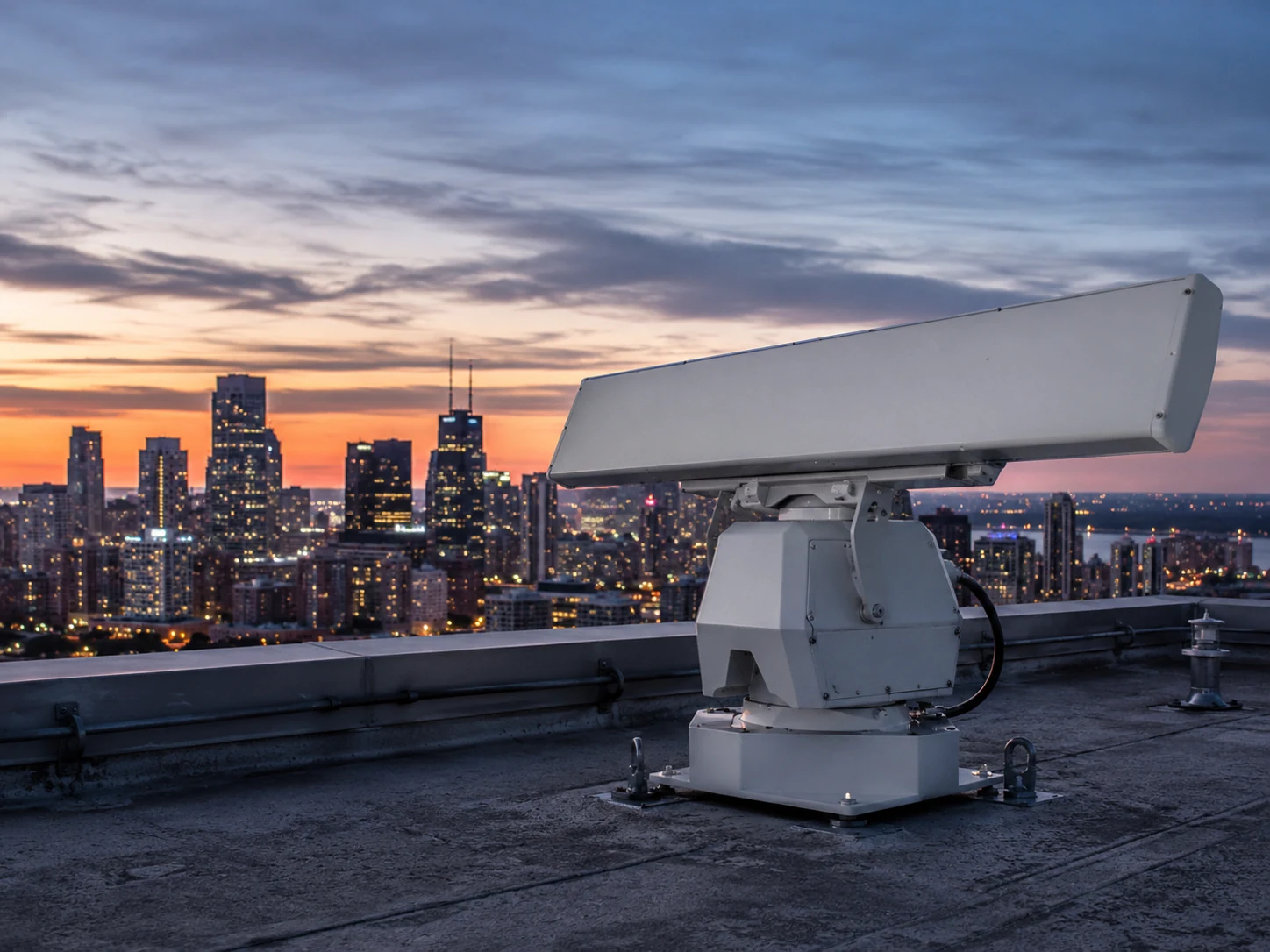
Radar is one of the most important tools for persistent airspace surveillance. It transmits radio energy and analyzes reflections from objects in the monitored area. Security radars designed for small targets can detect and track drones at distances where conventional cameras may not yet provide useful imagery.
Radar works day and night and does not depend on visible light. It can also provide range, direction, speed and track history. Its weakness is classification. Birds, clutter and moving machinery can create difficult signatures, so modern systems use micro-Doppler processing and machine-learning models to improve discrimination.
RF Detection
Radio-frequency detection looks for communication signals between a drone and its controller or for telemetry emitted by the aircraft. When a known protocol is detected, an RF system may identify the drone family, approximate its direction and sometimes locate both aircraft and controller.
RF sensing can be highly effective because it may recognize a drone before the aircraft enters visual range. However, autonomous drones, unusual frequencies, encrypted links or pre-programmed flights may reduce detection opportunities. RF monitoring is therefore strongest when used as one layer rather than the only sensor.
Optical and Thermal Cameras
Visible-light and thermal cameras provide something radar and RF sensors cannot: visual confirmation. A tracking camera can automatically point toward a radar or RF cue and give the operator an image of the object.
Day cameras can provide detailed evidence in good conditions. Thermal cameras remain useful at night and in many low-contrast situations because they detect heat rather than reflected visible light. Long-range optical systems often use motorized pan-tilt units and high-magnification lenses to maintain the target after detection.
Their limitations are familiar: fog, heavy rain, obstacles, glare and extreme distance can reduce usable detail. A camera is usually most effective after another sensor has already told it where to look.
Acoustic Detection
Acoustic arrays listen for characteristic propeller and motor signatures. They are passive and do not emit radio energy, which can be useful in sensitive environments. Acoustic sensors can also help detect drones that do not transmit recognizable RF signals.
The challenge is environmental noise. Wind, vehicles, machinery, aircraft and urban activity can mask or imitate signatures. Detection range is generally shorter than radar, so acoustic sensing is usually a supplementary layer.
Why Sensor Fusion Matters
The strongest architecture combines these technologies. Radar may discover an unknown target. RF analytics may identify the protocol. A camera may provide visual verification. Acoustic sensing may add confidence when the RF link is absent. The command platform then correlates the tracks into one operational picture.
This approach reduces false alarms because the system is not asking a single sensor to make every decision. It also improves resilience: if one technology performs poorly because of weather, terrain or interference, another layer may still provide useful information.
What Buyers Should Evaluate
Detection range alone should never determine a procurement decision. Organizations should examine minimum target size, altitude coverage, update rate, clutter performance, false-alarm behavior, weather tolerance, cyber security, integration with VMS and command platforms, data retention, operator workload and legal constraints.
The site survey is equally important. A sensor that performs well on a flat test field may behave differently beside buildings, cranes, hills, transmission lines or heavy RF activity.
The Direction of the Market
Drone detection is moving from isolated specialty equipment toward integrated airspace-awareness platforms. AI classification, edge processing, automated sensor cueing and unified command software are making it possible to treat the low-altitude air domain as another layer of physical security.
For most critical sites, the practical lesson is simple: reliable drone awareness comes from layered sensing, not from a single detector. Radar, RF, optical, thermal and acoustic technologies are most powerful when they complement one another and present operators with one clear, verified track.