
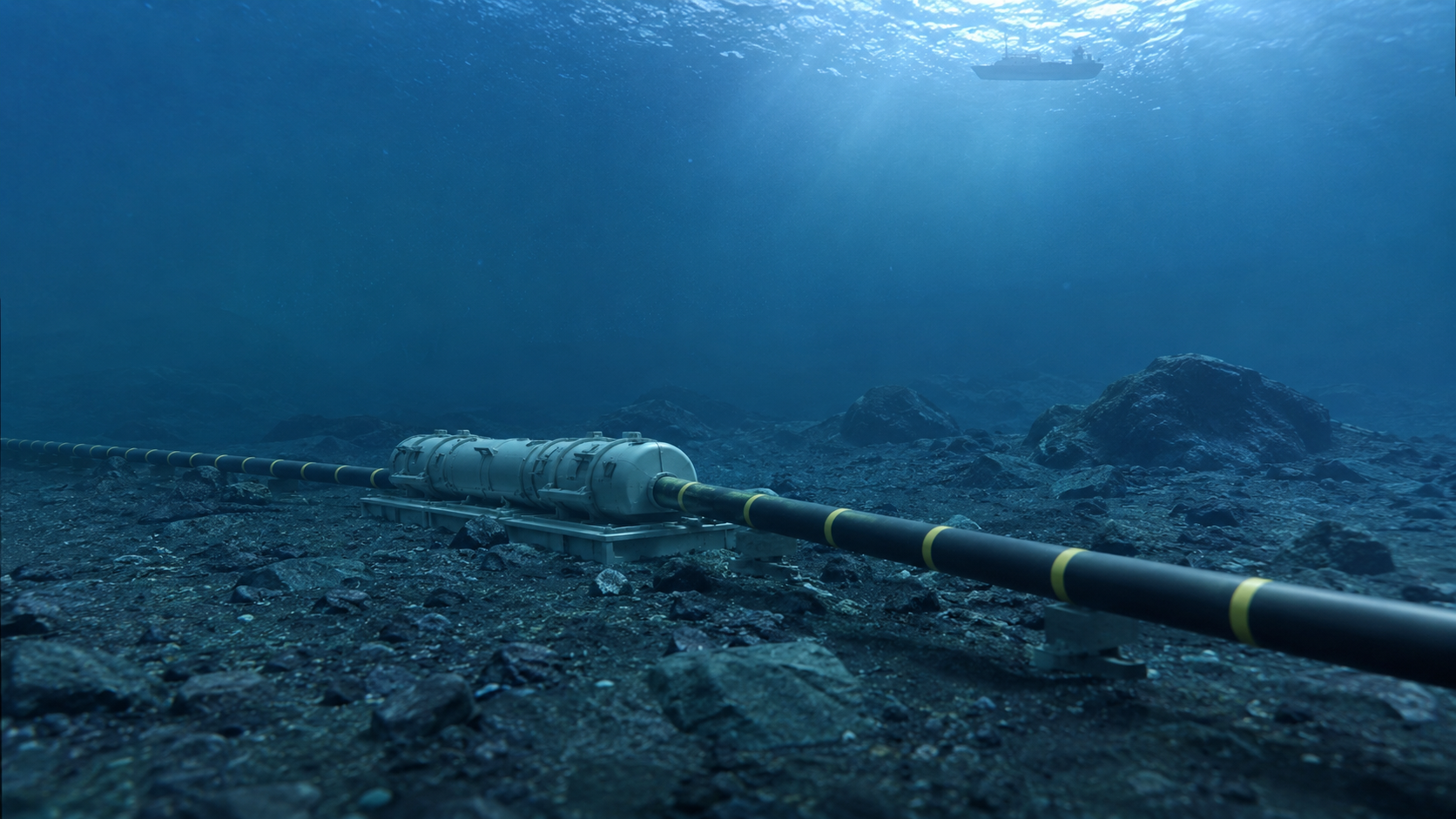
Subsea power and telecom cables are strategic infrastructure, yet they are difficult and expensive to inspect. Distributed Acoustic Sensing can turn optical fiber inside or alongside a cable into a continuous vibration sensor, helping operators detect activity over long marine routes.
How DAS Helps
A DAS interrogator measures tiny changes in backscattered light caused by strain and vibration along fiber. In a marine environment, these signals can reveal vessel-related activity, anchoring, seabed interaction, cable movement, construction work and other disturbances. The system provides both event timing and approximate location along the route.
The strongest use case is early awareness. DAS does not replace sonar, AIS, ROV inspection or marine surveillance, but it can indicate where unusual activity is occurring so other systems can investigate the right location.
Sensor Fusion Matters
Subsea protection becomes much more useful when DAS data is fused with AIS vessel tracks, radar, sonar, weather information and cable route maps. If a strong acoustic event occurs near a cable while a vessel is operating nearby, the combined context is much more actionable than either data source alone.
DAS can also support condition monitoring. Long-term changes in vibration patterns may indicate altered seabed conditions, cable exposure or mechanical stress. Interpretation is complex, however, because ocean environments generate continuous background noise from waves, currents, shipping and biological sources.
Deployment Challenges
Performance depends on fiber construction, coupling, seabed conditions, water depth, interrogator settings and signal-processing models. Not every telecom fiber route is equally suitable, and event classification must be trained against realistic local conditions.
For critical submarine links, DAS should therefore be viewed as one layer in a broader maritime-domain-awareness architecture.
Conclusion
Distributed acoustic sensing gives subsea cable operators something conventional inspection cannot provide: continuous distributed awareness between inspection campaigns. As subsea cables become more important to energy and communications resilience, fiber-optic sensing is likely to play a growing role in their protection and condition monitoring.