
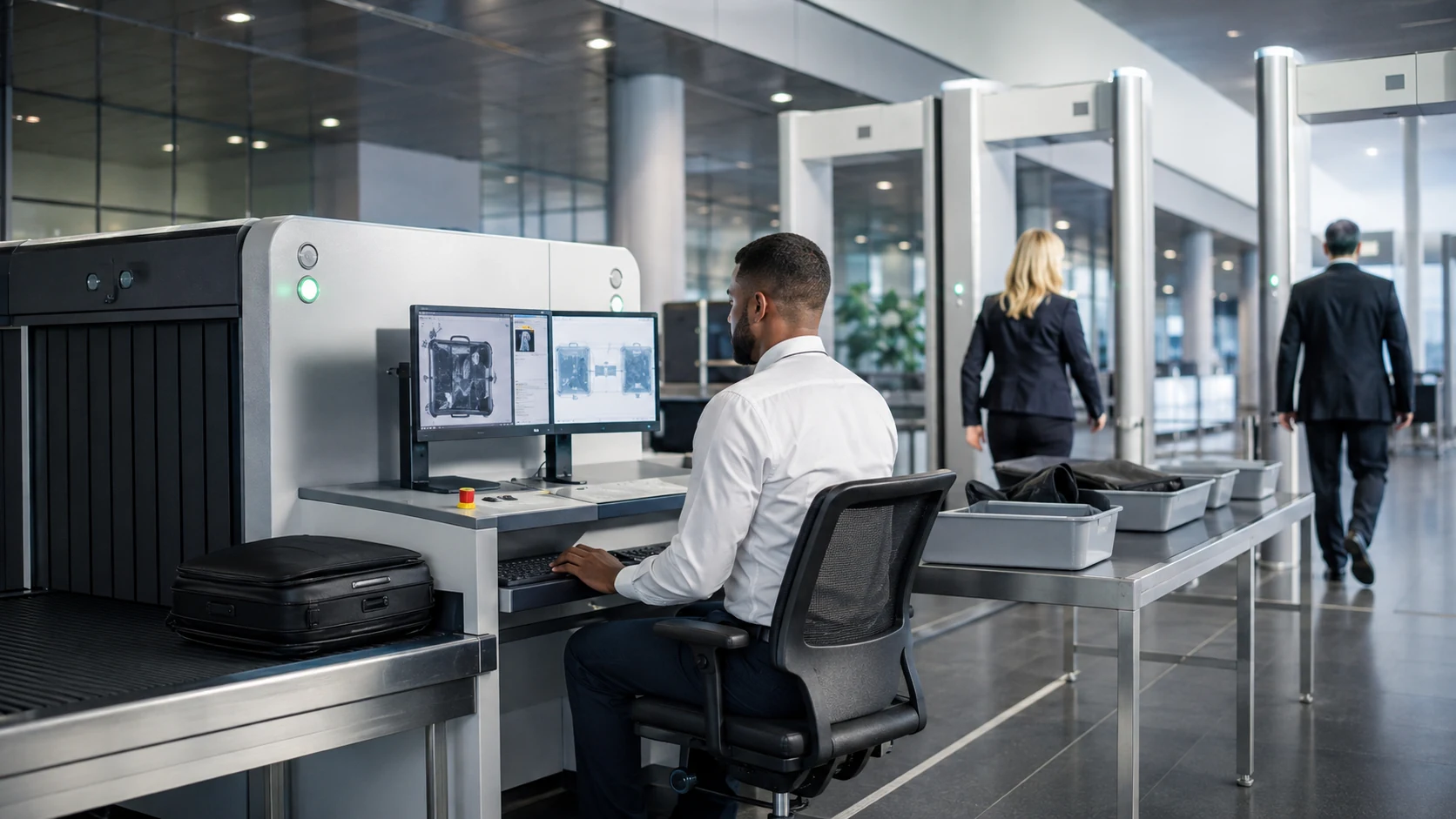
The underside of a vehicle is one of the few spaces that conventional security cameras, guards and X-ray baggage scanners simply cannot see, which is why under-vehicle surveillance systems (UVSS) have become a standard checkpoint technology at facilities where vehicle-borne threats are a serious concern, including government buildings, ports, prisons, data centers, and major event venues.
How a UVSS Scan Actually Works
A typical UVSS installation embeds a line-scan camera, or an array of cameras, in a low-profile housing set into or on top of the road surface at a checkpoint. As a vehicle drives over the unit at low speed, the camera captures a continuous image strip of the undercarriage, which imaging software then stitches together into a single flattened, readable image of the entire underside, similar in concept to how a flatbed scanner builds an image line by line. The resulting image lets an operator, or increasingly an automated analytics system, inspect the chassis, fuel tank, wheel wells and other undercarriage components for anything that looks out of place.
Fixed, Portable and Drive-Through Configurations
Fixed UVSS units are permanently installed at a checkpoint lane and offer the most consistent image quality, since the scanning geometry and lighting are controlled and calibrated for that specific location. Portable UVSS units, often mounted on a wheeled pallet or ramp, trade some image consistency for the ability to be moved between checkpoints or deployed temporarily for a specific event. Both configurations are generally designed for vehicles to drive over slowly rather than stop, keeping traffic moving through a checkpoint rather than creating a bottleneck.
From Manual Review to Automated Threat Detection
Early UVSS deployments relied entirely on a human operator visually reviewing each scanned image for anomalies, a process that works but depends heavily on operator attention and experience. Newer systems increasingly pair the scan with automated image analysis that compares the captured undercarriage against a reference image of the same vehicle model, or flags common anomaly patterns, to help operators catch changes they might otherwise miss during a high-volume shift, while still leaving the final determination to a trained person.
FAQ
Do vehicles need to stop for a UVSS scan? No, most systems are designed to scan a vehicle driving over the unit at low speed, though some very high-resolution or high-security deployments may require a brief stop or reduced speed for optimal image quality.
Can UVSS detect explosives directly? UVSS provides a visual image of the undercarriage for anomaly detection; it does not chemically detect explosives the way a trace-detection or canine screening does, which is why it is often paired with other screening methods at the highest-security checkpoints.
Where are under-vehicle surveillance systems most commonly deployed? Government and military facility entrances, ports and border crossings, prisons and correctional facilities, data centers, and major stadium or event venues are among the most common deployment locations.
Leave a Reply