
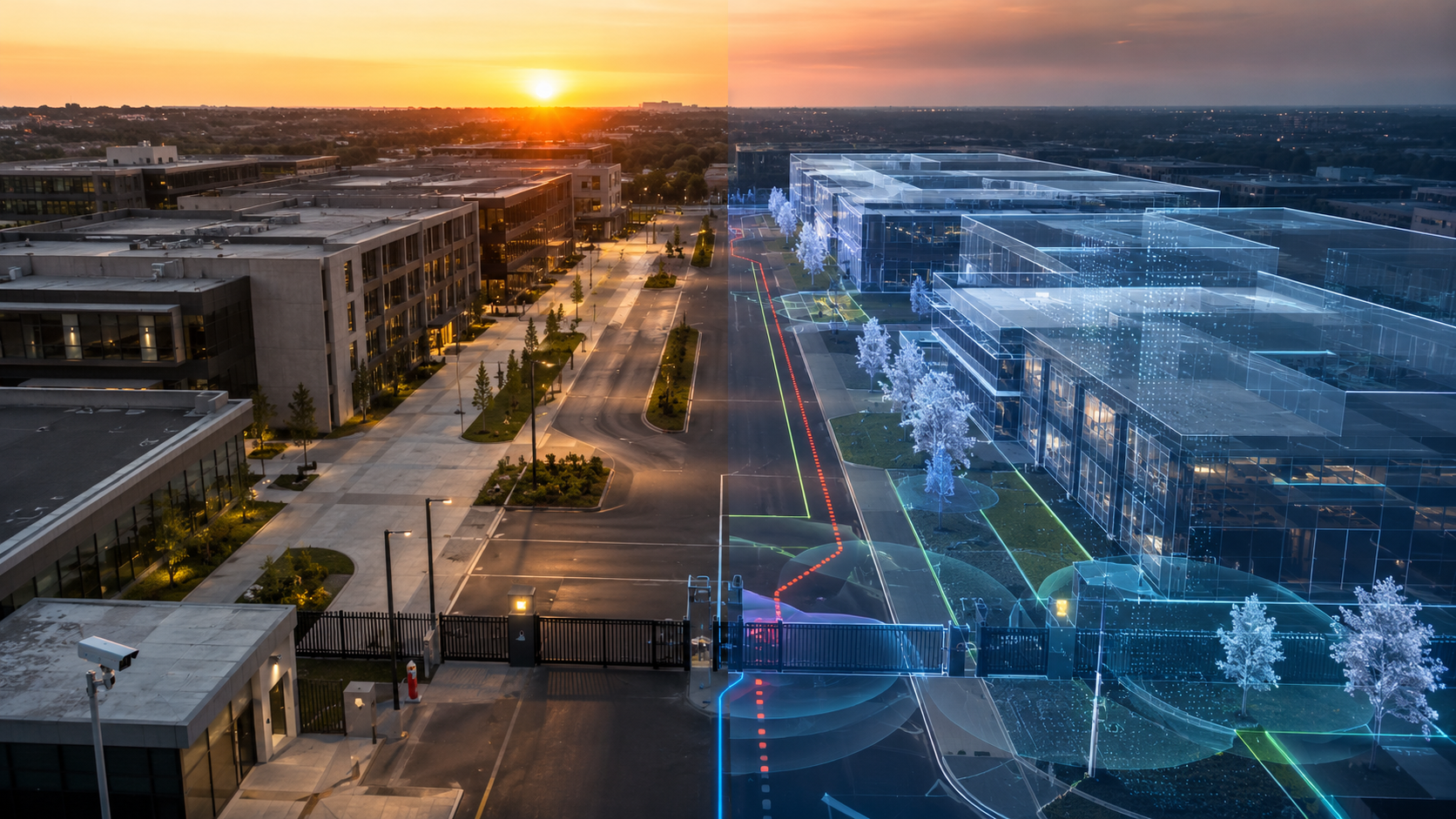
Not every security deployment has the luxury of a conduit run or existing fiber path. Large campuses, agricultural sites, construction projects, parking lots, and remote infrastructure locations often need to connect cameras, sensors, and access control points across distances or terrain where trenching cable is expensive, disruptive, or simply impossible on the project timeline. Wireless mesh networking has become one of the standard answers to this problem, offering a way to extend a security network’s reach without a continuous physical cable path.
Point-to-Point, Point-to-Multipoint and True Mesh
Wireless backhaul for security systems generally falls into three topologies. Point-to-point links connect two fixed locations directly, useful for bridging a single gap such as across a road or between two buildings. Point-to-multipoint extends one central node’s connectivity out to several remote locations, common when a single equipment room serves multiple outlying camera clusters. True mesh networking goes further: every node can relay traffic for its neighbors, and the network automatically recalculates routing paths if a node fails or a link degrades. This self-healing property makes mesh particularly attractive for large or irregularly shaped sites where a single point of failure in a point-to-multipoint design could take an entire branch of cameras offline.
Bandwidth, Latency and Video Traffic
Video is a demanding payload for wireless infrastructure. Unlike simple sensor telemetry, camera streams require sustained bandwidth and are sensitive to latency and jitter, particularly for live monitoring or analytics that depend on consistent frame delivery. Mesh network design for security applications has to account for the cumulative bandwidth each hop needs to carry as traffic aggregates back toward the wired network edge. Designers typically size wireless links with meaningful headroom above camera bitrate requirements, and may selectively favor point-to-point links for the highest-bandwidth camera clusters while reserving mesh for lower-bandwidth sensor and access control traffic.
Spectrum, Interference and Environmental Factors
Outdoor wireless security links operate in either licensed or unlicensed spectrum, each with trade-offs. Unlicensed bands are cheaper to deploy but share spectrum with other users and consumer devices, creating interference risk in dense environments. Licensed spectrum offers more predictable performance but adds cost and regulatory lead time. Weather, foliage growth, and physical line-of-sight obstructions all affect wireless link reliability over time in ways a buried cable simply doesn’t experience, which is why wireless security deployments typically include a maintenance plan for periodic link health verification rather than a one-time installation.
Securing the Wireless Link Itself
A wireless backhaul link is also a network attack surface that a buried cable is not. Security-grade wireless deployments use strong encryption on every hop, disable unnecessary management interfaces on outdoor radios, and monitor for rogue access points or unauthorized devices attempting to join the mesh. Because these radios are often physically accessible in a way core network switches are not, mounted on poles, roofs, or perimeter fencing, physical tamper resistance and secure mounting are treated as part of the cybersecurity posture, not just the mechanical installation.
Where Mesh Makes Sense
Wireless mesh is rarely the first choice when wired infrastructure is feasible; fiber and copper remain more predictable in bandwidth and less susceptible to environmental interference. Its value is clearest in scenarios where wired installation costs or timelines are prohibitive: temporary event security, construction sites with cameras that need to relocate as the project progresses, large agricultural or logistics yards, and remote infrastructure sites where trenching across the full distance simply isn’t economical relative to the value of the assets being monitored.
Leave a Reply