
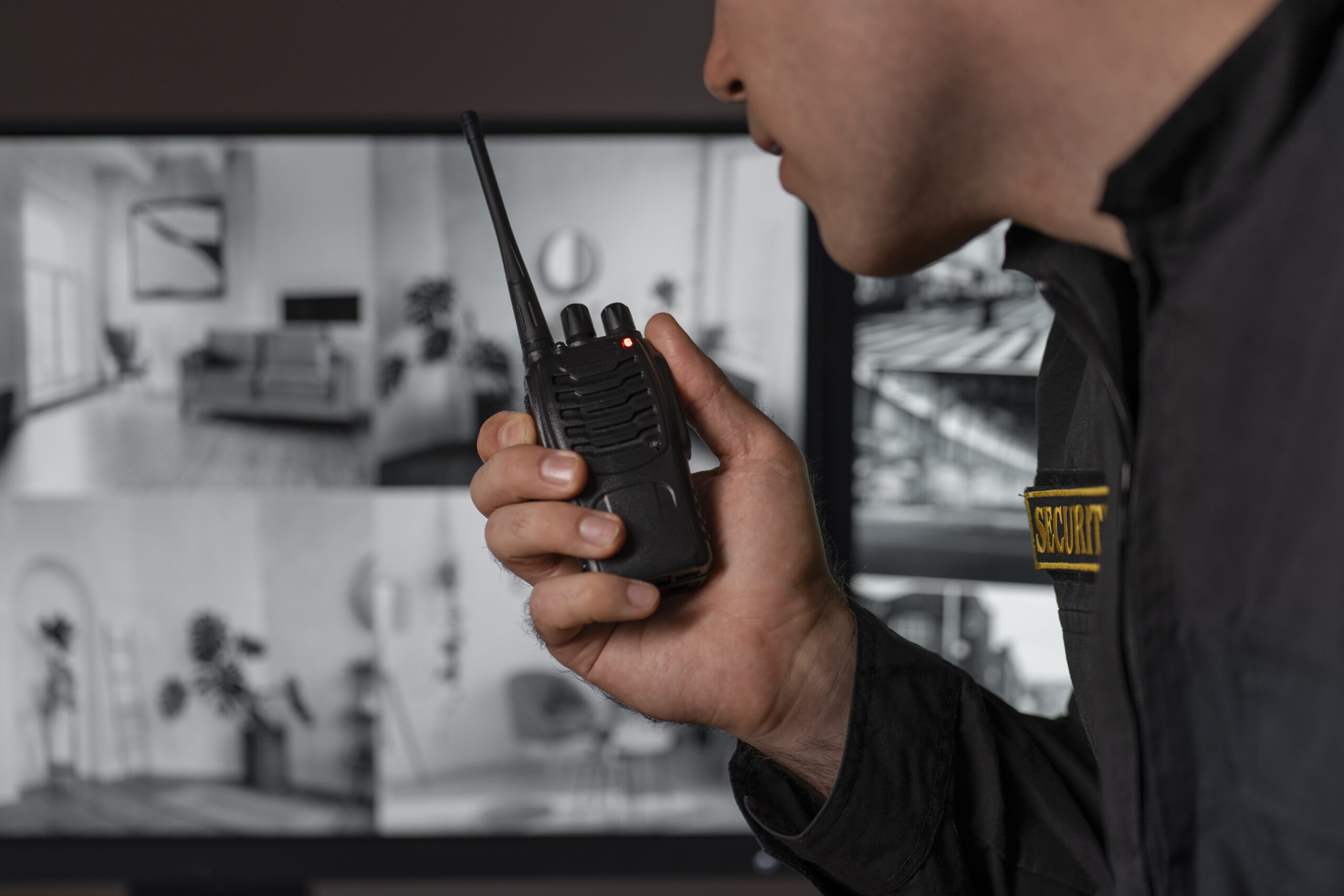
Body-worn cameras began as a law enforcement accountability tool, but the same core technology has spread into private security guarding, retail loss prevention, healthcare security, and transit enforcement roles. Wherever a person rather than a fixed camera is the primary vantage point for an incident, a body-worn camera captures a perspective that fixed surveillance infrastructure simply cannot: close-range audio, direct interaction context, and a first-person view that moves with the officer or guard through the environment.
Core Hardware and the Pre-Event Buffer
A body-worn camera unit combines a compact camera, onboard storage or wireless upload capability, a battery sized for a full shift, and an activation mechanism, typically a physical button, though some systems support automatic activation triggered by a paired device such as a holstered weapon or a vehicle light bar. One of the more important design features is pre-event buffering: many units continuously record a rolling buffer of the preceding 30 seconds to two minutes even before the wearer manually activates recording, so that when an incident prompts activation, the footage captures how the situation developed rather than starting only at the moment someone remembered to press the button.
Recording, Upload and Video Management Integration
Footage can be stored locally on the device pending a docking-station upload at the end of a shift, or streamed live over cellular or Wi-Fi to a cloud platform in real time. Live streaming supports use cases where a control room or supervisor needs situational awareness during an active incident, but consumes considerably more bandwidth and battery than local recording with a later upload. Many deployments increasingly connect body-worn footage into the same video management platform used for fixed camera infrastructure, letting an investigator pull footage from a body camera and nearby fixed cameras side by side for a single incident timeline.
Chain of Custody and Evidentiary Integrity
Because body-worn footage frequently becomes evidence in a criminal case, civil claim, or internal investigation, the platform managing it needs the same evidentiary rigor applied to any other video evidence: cryptographic hashing to prove footage hasn’t been altered after capture, detailed access logs showing who viewed or exported a clip, and retention policies that prevent footage from being deleted before a legal hold period expires. Redaction tools that blur faces or license plates before footage is released publicly or to third parties have become a standard feature.
Privacy, Consent and Policy Considerations
Continuous recording of interactions raises privacy questions that vary significantly by jurisdiction and use case; some regions require notifying individuals that they’re being recorded, and policies differ on whether cameras should record continuously during a shift or only during specific activations. Organizations deploying body-worn cameras generally need a clear written policy covering when recording is mandatory, when it’s discretionary, and how footage of non-incident interactions is retained or discarded.
Beyond Law Enforcement
Retail loss prevention teams use body-worn cameras to document shoplifting confrontations and de-escalate disputes by making both parties aware they’re being recorded. Hospital security teams use them in similarly high-tension patient and visitor interactions. Transit and event security staff use them to document crowd incidents in environments where fixed cameras can’t capture close-range detail. Across all these applications, the underlying technology stack, capture hardware, buffering, upload workflow, and evidentiary video management, remains largely the same, even as the operational policy governing when and how it’s used varies by industry.
Leave a Reply