
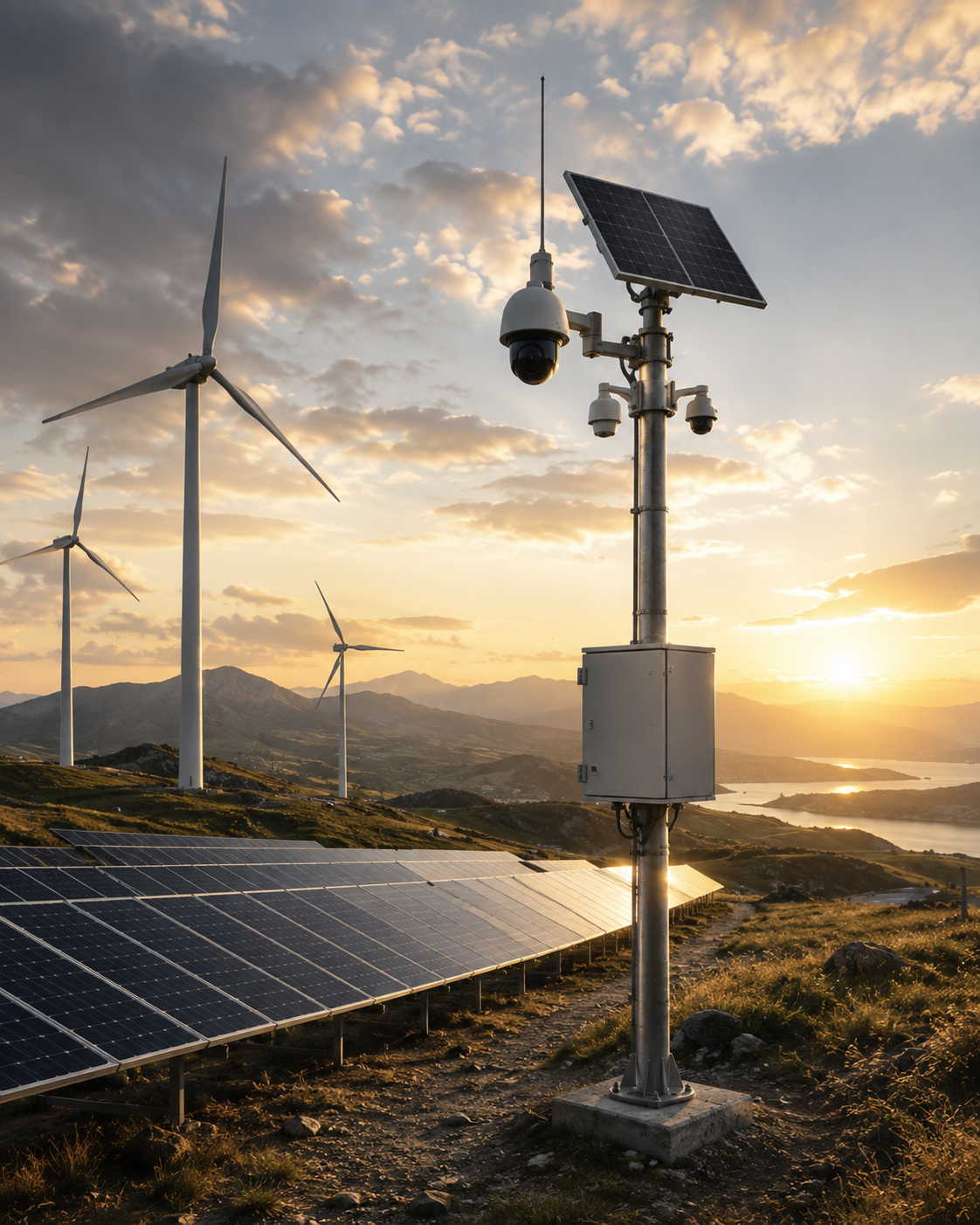
Utility-scale solar farms combine expensive distributed assets with very large perimeters, remote locations and limited staff presence. Their security architecture must therefore emphasize early detection, reliable communications and low false-alarm rates.
The perimeter problem
A solar site may stretch across hundreds of hectares. Traditional guard-intensive protection becomes expensive, so operators increasingly rely on layered detection using fence sensors, radar, thermal imaging and video analytics.
Remote verification
Every alarm should be quickly verifiable. Thermal cameras are useful at night and in low-light conditions, while visible cameras provide identification detail. Radar can cue PTZ cameras toward moving targets and reduce dependence on fixed camera coverage.
Asset and cable protection
Inverters, transformers, copper cabling, battery systems and communications cabinets require local protection. Access control, cabinet monitoring and tamper alarms create a second layer inside the perimeter.
Operations and maintenance
Environmental conditions such as heat, dust, vegetation and wildlife can create nuisance alarms. Analytics and regular tuning are essential. Solar-powered field devices can be useful, but maintenance planning and communications redundancy remain critical.
Integrated renewable-site security
The strongest model connects perimeter detection, video, access control, fire monitoring and operational telemetry in one command workflow. For long boundaries, fiber-optic sensing can add continuous linear awareness without thousands of powered field sensors.
Conclusion
Solar Farm and Renewable-Energy Site Security should be evaluated as part of a broader operational architecture. The strongest deployments combine suitable sensing technology, resilient communications, clear procedures and measurable performance rather than relying on a single device or headline specification.
Leave a Reply