
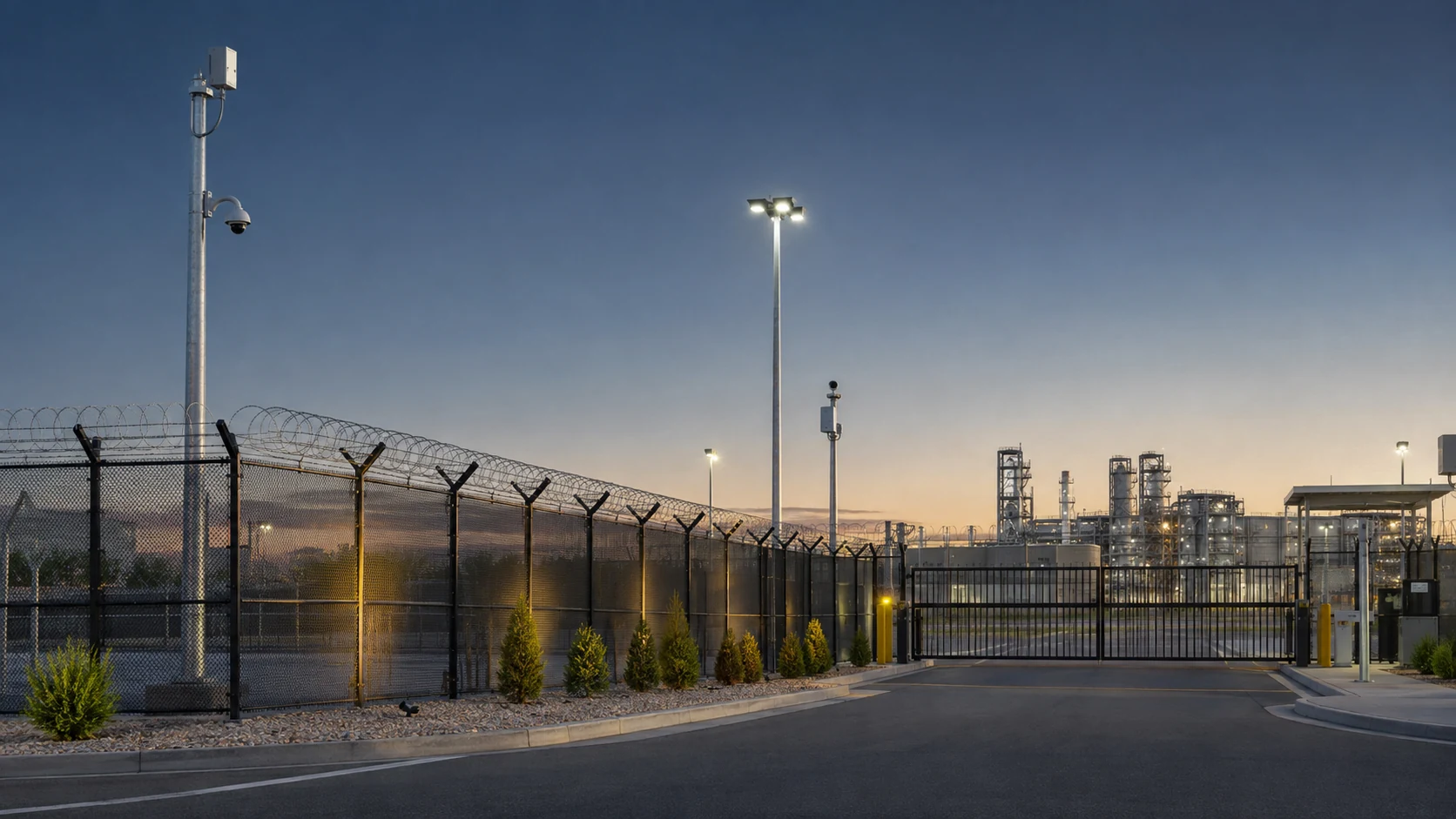
A complete introduction to perimeter security, from fencing and vehicle barriers to radar, thermal cameras, buried sensors and fiber-optic intrusion detection.
Physical perimeter measures
Fences, walls, gates, security doors and anti-climb features create a visible boundary and add delay. Their value depends on height, construction, terrain, foundations, gate design and what an adversary is expected to attempt. Vehicle threats require separate analysis: bollards, road blockers and other hostile-vehicle-mitigation measures are designed around vehicle mass, speed, approach geometry and stand-off distance. CISA’s Vehicle Incident Prevention and Mitigation Security Guide recommends a Plan–Prevent–Protect framework.
Perimeter intrusion detection systems (PIDS)
PIDS is a broad term covering technologies that detect activity at or near a boundary. Fence-mounted sensors measure vibration or movement caused by climbing, cutting or impact. Buried systems can detect footsteps or vehicles. Microwave barriers create an invisible detection field between transmitters and receivers, and infrared beams detect interruption of a defined path. Each technology has environmental trade-offs, and good design starts with the site, not the brochure.
Radar
Ground-surveillance radar detects and tracks moving targets across an area, covering open terrain beyond the fence and cueing PTZ or thermal cameras toward a detected target. Radar performance varies with terrain, clutter, target size, speed, mounting and frequency—a maximum-range figure alone says little about reliable detection of the target class that matters to the project.
Thermal and video analytics
Thermal cameras are valuable for detection in darkness because they respond to thermal contrast rather than visible illumination. Video analytics can classify people and vehicles or apply rules such as line crossing and loitering. In many perimeter systems the camera’s most important role is assessment: giving the operator visual evidence immediately after another sensor alarms.
Fiber-optic PIDS and DAS
Fiber-optic sensing can monitor long boundaries with passive sensing cable in the field, attached to a fence, buried or installed along a linear asset. Distributed Acoustic Sensing uses changes in Rayleigh backscatter to detect strain and vibration along the fiber. The attraction is continuous sensing over long distances with minimal active electronics along the protected line; the engineering challenge is classification—distinguishing digging, climbing or vehicle movement from weather and other background vibration.
Sensor fusion and response
The strongest perimeter systems increasingly combine complementary sensors: radar may detect and track a person, a thermal camera verifies the target, a fence sensor confirms interaction with the boundary, and a VMS or PSIM presents the event to the operator. Detection range is meaningless without a response concept—perimeter engineering should combine threat assessment, delay analysis, detection probability, nuisance alarms, camera coverage, lighting and procedures.
FAQ
Is a fence enough for perimeter security? A fence is an important physical layer but does not necessarily provide timely detection or assessment.
Radar or thermal camera: which is better? They do different jobs. Radar is strong for wide-area detection and tracking; thermal imaging is strong for visual assessment and detection based on heat contrast. They are often used together.
Where does fiber sensing fit? It is particularly relevant to long perimeters and linear assets where continuous distributed detection is valuable.
Verification note: Never compare perimeter technologies using a single nominal range figure. Target class, terrain and nuisance-alarm performance must be considered.
Leave a Reply