
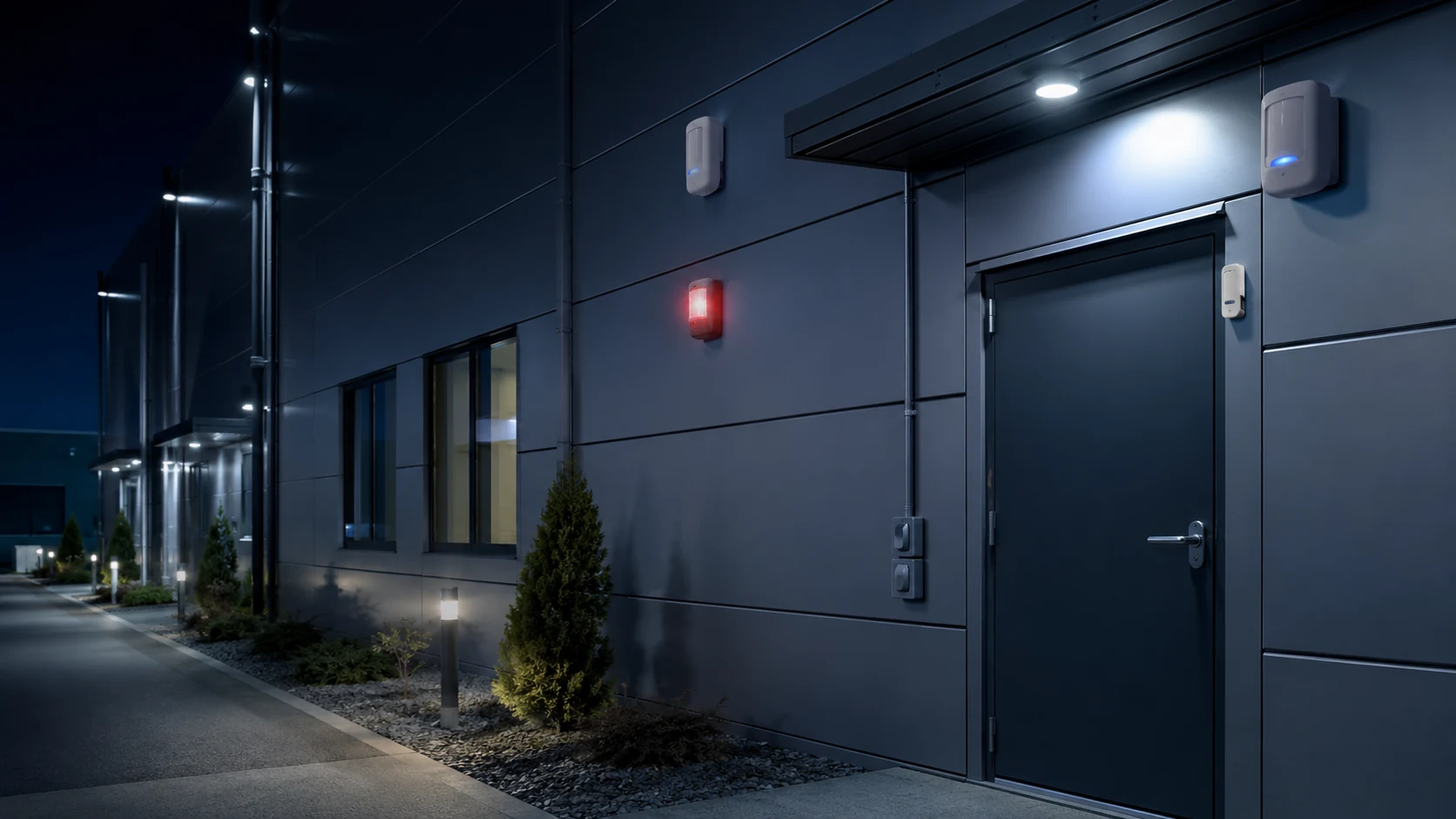
Learn how intrusion detection systems use PIR, microwave, magnetic contacts, seismic sensors, alarm panels and video verification to identify security events.
Perimeter and opening sensors
Magnetic contacts are widely used on doors and windows, indicating a change in the protected opening rather than identifying who caused it. For higher-security applications, balanced magnetic switches and supervised circuits may be used. Glass-break detectors listen for acoustic signatures or sense physical shock associated with breaking glass, while seismic detectors can identify vibration patterns from attacks on walls or safes.
Volumetric detection
Passive infrared (PIR) detectors sense changes in infrared energy across zones in their field of view; they do not emit a beam and do not “see” a person like a camera. Microwave motion detectors emit radio-frequency energy and analyze changes in the reflected signal. Dual-technology detectors combine sensing principles—commonly PIR and microwave—to improve confidence and reduce nuisance alarms.
Outdoor intrusion detection
Outdoor environments are harder: wind, rain, moving vegetation, animals and temperature swings create nuisance sources. Outdoor PIR, microwave barriers, fence sensors, buried sensors, radar, thermal analytics and fiber-optic systems each address different parts of the problem. The right question is what event must be detected, over what distance, in what terrain, with what acceptable nuisance-alarm rate.
Alarm control panels and supervision
The panel receives sensor states, applies logic and communicates alarms or faults. A professional system should also supervise critical wiring, power, communication paths and device health. Modern platforms may combine intrusion events with access control and video, so a door-contact alarm can automatically display the nearest camera.
Verification changes the value of an alarm
An alarm tells the operator that a rule has been triggered; it does not automatically explain what happened. Video verification, sequential confirmation from multiple sensors or operator call procedures can help distinguish a genuine intrusion from a nuisance event, avoiding the alarm fatigue that undermines system effectiveness.
Layered security
CISA physical-security guidance repeatedly emphasizes layered approaches to protection. Intrusion detection works best as one layer alongside physical delay, lighting, surveillance, access control, procedures and response.
FAQ
What is the difference between detection and verification? Detection identifies a condition that meets alarm logic. Verification adds evidence—often video or a second sensor—to help determine whether the alarm represents a real threat.
Can one sensor type protect an entire facility? Usually not. Different spaces and threats require different sensing methods.
Why do false alarms happen? Common causes include poor placement, environmental conditions, incorrect sensitivity, movement outside the intended area, maintenance issues and weak commissioning.
Verification note: Detection ranges and immunity claims should be taken from specific product test data, not generalized across a technology class.
Leave a Reply