Category: Industrial Safety & Monitoring

  • Industrial AI for Physical Security Operations: Predictive Maintenance Meets Threat Detection

    Industrial AI for Physical Security Operations: Predictive Maintenance Meets Threat Detection

    For most of its history, industrial artificial intelligence has lived in a separate silo from physical security. Predictive maintenance teams watched vibration sensors, thermal signatures and power-draw curves to forecast when a compressor or conveyor motor would fail. Security teams watched cameras, access logs and perimeter sensors to catch intruders and policy violations. The two disciplines rarely shared data, tooling or staff.

    That separation is eroding. As industrial facilities instrument more of their operational technology (OT) environment with connected sensors, the same telemetry streams that feed predictive-maintenance models are increasingly valuable to security operations — and vice versa. An unexplained vibration pattern on a pump, for instance, can indicate mechanical wear, or it can indicate physical tampering. A model trained to distinguish the two cases needs a security-aware view of the asset, not just a maintenance-aware one.

    Where the Overlap Is Real

    Three areas show the clearest convergence between industrial AI and physical security today:

    • Anomaly detection on shared sensor infrastructure. Vibration, thermal, acoustic and power-quality sensors originally deployed for condition monitoring can also flag events consistent with tampering, unauthorized equipment access, or sabotage — provided the analytics layer is trained to separate mechanical degradation signatures from disruption events.
    • Video analytics tied to process state. Rather than analyzing camera feeds in isolation, some facilities now correlate video analytics with process control data, so that a person detected near a valve or control panel is evaluated against whether that area is expected to be active, under maintenance, or should be unoccupied at that point in the process cycle.
    • Predictive risk scoring for OT assets. Machine-learning models that already rank equipment by failure risk are being extended to also incorporate cybersecurity exposure — patch status, network segmentation, and known-vulnerability data — producing a single risk score that blends reliability and security concerns for the same physical asset.

    Why This Convergence Is Accelerating Now

    Several forces are pushing industrial AI and physical security together. Regulatory attention on critical infrastructure has increased scrutiny of both operational reliability and cyber-physical resilience simultaneously, making it harder to justify maintaining separate, uncoordinated monitoring programs. At the same time, the cost of deploying and training separate machine-learning pipelines for maintenance and security has made a shared data platform more attractive from a budget standpoint. And as attacks on industrial control systems and programmable logic controllers have drawn public attention — including advisories from agencies such as CISA covering active reconnaissance and exploitation attempts against OT protocols — security leaders have become more willing to treat OT telemetry as a security signal in its own right, not just a reliability metric.

    Implementation Challenges

    The convergence is not without friction. OT and security teams typically report through different organizational structures, use different tools, and are measured against different KPIs — uptime for one, incident count for the other. Merging their data streams requires governance decisions about who owns alert triage, how false positives are handled without disrupting production, and how sensitive process data is protected when it becomes visible to a broader set of security personnel.

    There is also a technical challenge in model training: industrial equipment failure signatures are often well-documented after years of maintenance history, but tampering and sabotage events are comparatively rare, making it harder to train reliable classifiers without synthetic data or carefully designed red-team exercises to generate labeled examples.

    FAQ

    Does industrial AI replace dedicated physical security systems?

    No. Industrial AI applied to OT telemetry is a complementary signal, not a replacement for access control, video surveillance, or perimeter detection. Its value lies in correlating operational anomalies with security context that purpose-built security systems may not otherwise capture.

    What data is typically shared between maintenance and security teams in a converged model?

    Common shared signals include vibration and acoustic sensor data, thermal imaging, power-quality metrics, and access-control logs tied to specific equipment zones. Process control data itself is usually kept segmented and shared only in summarized or access-controlled form.

    Conclusion

    The line between predictive maintenance and physical security is blurring for a straightforward reason: both disciplines are trying to answer variations of the same question — is this asset behaving as expected? Facilities that build a shared data and governance layer between OT reliability teams and security operations are positioned to catch a wider range of anomalies than either discipline could catch alone, provided they invest in the organizational coordination the convergence requires, not just the underlying sensors and models.

  • CISA Publishes New Round of ICS Advisories Covering Industrial Test, Fleet and IoT Devices

    CISA Publishes New Round of ICS Advisories Covering Industrial Test, Fleet and IoT Devices

    The Cybersecurity and Infrastructure Security Agency published a new batch of industrial control system advisories on August 27, 2026, covering vulnerabilities in products used across manufacturing, transportation and utility test environments. Among the advisories was one for Rockwell Automation’s OTTO Fleet Manager, tagged to the Critical Manufacturing and Transportation Systems sectors, which CISA said contains a flaw (CVE-2026-75112) that could reduce the computational cost required for an attacker to carry out offline brute-force attacks against stored password hashes in versions up to V2.36.2.

    A separate advisory covered the Applied Systems Engineering ASE2000 V2 Communications Test Set, a tool used to test IEC 60870-5-104 protocol communications common in electric utility SCADA environments. According to the advisory and a technical writeup published by Trout Software, the affected versions (2.25 through 2.37) carry two flaws: a legacy XML external entity issue tied to an outdated bundled Apache log4net library, and an improper certificate validation weakness in the product’s IEC 60870-5-104 TLS client that could allow an attacker to intercept and impersonate a trusted peer during protocol testing. CISA credited researcher Enoch Wang with the report and noted the vendor has released version 2.38 as a fix.

    CISA also published advisories for the Xiiaozet LK100W device, warning that successful exploitation of the flaws it identified could allow an attacker to take control of the device, and for the All-Line Equipment Company Fuel-Boss and Ebyte NA111-M products. As with its standard ICS advisory practice, CISA’s guidance recommends that asset owners minimize network exposure of control system devices, ensure they are not directly reachable from the internet, and place control system networks behind firewalls, isolated from business IT networks.

    The advisories arrive amid a broader pattern industry researchers have flagged this year: security vendor Forescout reported that ICS advisory volume topped 500 for the first time in 2025, with a growing share of vulnerabilities affecting field controllers, remote terminal units and other Purdue Model Level 1 devices that directly interface with physical processes. CISA continues to publish advisories on a rolling weekly basis covering vendors ranging from major industrial automation suppliers to smaller niche device manufacturers used in specific utility and manufacturing test workflows.

  • CISA Details Credential Exposure Flaw in Johnson Controls Simplex Incident Manager

    CISA Details Credential Exposure Flaw in Johnson Controls Simplex Incident Manager

    Cleartext Credentials Found in Memory

    The Cybersecurity and Infrastructure Security Agency published ICS advisory ICSA-26-232-01 on August 20, 2026, disclosing a vulnerability in Johnson Controls Simplex Incident Manager, a fire and life-safety incident-management application used across critical manufacturing, commercial facilities, government facilities, transportation systems and energy sites worldwide. Tracked as CVE-2026-27875, the flaw stores user credentials, including passwords and authentication tokens, in an unencrypted form in system memory while the application is running.

    CISA assigned the vulnerability a CVSS v3.1 base score of 5.8 (medium), rating it CWE-316, Cleartext Storage of Sensitive Information in Memory. A local attacker with low privileges, or an insider with memory-dumping tools, could extract the exposed credentials and use them for unauthorized access to the application and connected systems. Exploitation requires local access to the host, and CISA rates the attack complexity as high.

    Patch Available

    Johnson Controls has released version v2.01.01 to address the flaw and published Product Security Advisory JCI-PSA-2026-28 with mitigation guidance. CISA and the vendor recommend upgrading affected Simplex Incident Manager deployments (v2.01 and earlier), restricting local system access to authorized personnel, deploying endpoint monitoring to detect memory-dumping activity, enforcing least-privilege access controls, and using full-disk encryption and secure boot to reduce the risk of offline memory analysis.

    Johnson Controls reported the vulnerability to CISA. No public evidence of active exploitation has been disclosed.

    Sources

  • CISA, NSA and FBI Warn of Active AI-Assisted Reconnaissance Against Siemens S7 PLCs

    CISA, NSA and FBI Warn of Active AI-Assisted Reconnaissance Against Siemens S7 PLCs

    Joint Advisory Warns of Active Targeting

    The National Security Agency, the Cybersecurity and Infrastructure Security Agency, the FBI, the Department of Energy and the Environmental Protection Agency released a joint cybersecurity advisory on August 19, 2026, warning that threat actors are actively targeting Siemens S7 Series programmable logic controllers (PLCs) that are exposed to the internet or insufficiently segmented from it. The advisory, designated AA26-231A, covers the S7-200, S7-300, S7-400, S7-1200 and S7-1500 controller families, including the F-series safety variants.

    According to the agencies, the activity spans several critical infrastructure sectors, with Critical Manufacturing, Energy, Water and Wastewater, Chemical, Food and Agriculture, and Commercial Facilities named as the most-targeted. Siemens S7 controllers are also used in the Defense Industrial Base, which the advisory says could be affected as well. CISA describes the threat as “not a theoretical risk” and says exploitation of poorly protected PLCs could disrupt industrial processes, damage equipment, trigger safety incidents through manipulation of interlocks or emergency shutdown systems, and cause cascading effects across interconnected systems.

    AI-Generated Scripts and the Snap7 Library

    The advisory says the threat actors are combining publicly available industrial automation tooling with AI-assisted scripting to build custom software that mimics legitimate operational-technology monitoring tools. Specifically, the agencies describe adversaries using internet-scanning services such as Censys and ZoomEye to locate exposed S7 controllers, then deploying AI-generated Python scripts built on the open-source snap7 library to read and write PLC memory, configuration data and ladder-logic programs over the S7comm protocol on TCP port 102. CISA characterizes the use of AI to generate this exploitation code as “an evolution in threat actor capabilities” that lowers the technical bar for building working industrial-control exploitation tools and speeds adversaries’ ability to adapt to defenses.

    The agencies assess the pattern observed so far as consistent with reconnaissance and capability development — testing techniques against specific PLC models and using read access to understand target environments — rather than a confirmed disruptive attack. The advisory maps the observed techniques to the MITRE ATT&CK for ICS and Enterprise frameworks and to MITRE D3FEND countermeasures.

    A Distinct Threat From the Iran-Linked Water Sector Warning

    AA26-231A is separate from an earlier joint advisory, AA26-097A, which described confirmed Iran-linked exploitation of PLCs at a U.S. water-sector victim, including modification of ladder logic that disabled safety shutdown and alarm functions. The new Siemens-specific advisory does not attribute the reconnaissance activity it describes to any named nation-state or group, and it explicitly frames the observed activity as pre-attack staging rather than a confirmed disruptive incident. CISA also cautions that PLC targeting more broadly extends beyond Siemens equipment, and that the Siemens-specific guidance in the advisory should be treated as one subset of a wider threat landscape facing internet-exposed industrial controllers.

    Mitigations Recommended by the Authoring Agencies

    The agencies are urging asset owners to inventory all Siemens S7 controllers in their environments, apply available firmware and engineering-software patches, verify that PLCs are not reachable from the internet, and block TCP port 102 at perimeter firewalls. Additional recommendations include restricting engineering-workstation access through IP or MAC allowlisting, enabling PLC password protection and configurable read/write protection levels, deploying ICS-aware intrusion detection, and monitoring for anomalous S7comm traffic patterns, unauthorized write operations, and use of the snap7 library outside approved engineering systems. The advisory also recommends organizations that rely on third-party systems integrators or managed service providers share the guidance with those parties directly, since asset owners may not always be aware that PLCs accessible to vendors are also exposed to the wider internet.

    Sources

  • Integrated DAS and DTS: Combining Acoustic and Thermal Intelligence

    Integrated DAS and DTS: Combining Acoustic and Thermal Intelligence

    DAS and DTS observe different physical phenomena, but together they can provide a richer view of critical infrastructure. Acoustic events may indicate movement or mechanical activity while temperature changes reveal thermal stress, fire or abnormal operating conditions.

    Complementary sensing

    DAS detects vibration and acoustic signatures; DTS measures distributed temperature. Combining both allows the same corridor to be monitored for security events and asset-condition changes.

    Power and cable networks

    DTS can identify thermal loading while DAS detects nearby digging, disturbance or unusual vibration. The combination supports both reliability and physical protection.

    Pipeline corridors

    DAS can classify activity and acoustic events while DTS contributes thermal context where product temperature or leak-related effects are relevant.

    Unified analytics

    The challenge is turning two large data streams into usable alarms. Edge processing, event correlation and GIS visualization can help operators focus on meaningful anomalies.

    Procurement implications

    Buyers should evaluate integration at the data and workflow level, not simply whether two interrogators can be installed in the same cabinet. Shared timing, location mapping, APIs and alarm management are central to real operational value.

    Conclusion

    Integrated DAS and DTS for Critical Infrastructure Monitoring should be evaluated as part of a broader operational architecture. The strongest deployments combine suitable sensing technology, resilient communications, clear procedures and measurable performance rather than relying on a single device or headline specification.

  • Electrical Substation Security and Condition Monitoring

    Electrical Substation Security and Condition Monitoring

    Substations are compact but high-consequence sites. Physical intrusion, equipment failure, overheating and fire can all disrupt the grid, so security and condition monitoring increasingly converge.

    Layered physical protection

    Fences, gates, access control and intrusion detection form the basic security perimeter. Radar, thermal and video analytics can provide earlier awareness around remote or unmanned substations.

    Thermal condition monitoring

    Transformers, connectors, switchgear and cable terminations can develop abnormal heat before failure. Fixed thermal cameras and temperature-sensing systems help operations teams identify trends before they become outages.

    Fiber sensing opportunities

    DTS can monitor power cables and long routes for thermal anomalies, while DAS can detect vibration, digging or physical disturbance near critical lines. Together they create a continuous sensing layer beyond the fence.

    Cyber-physical integration

    Modern substations contain networked protection and control equipment. Physical security events should therefore be correlated with network and operational alarms rather than handled in a separate silo.

    Resilience as the design goal

    The purpose of substation security is not simply to detect trespass. It is to protect continuity of service. Redundant communications, backup power, secure remote access and tested response procedures are therefore core design requirements.

    Conclusion

    Electrical Substation Security and Condition Monitoring should be evaluated as part of a broader operational architecture. The strongest deployments combine suitable sensing technology, resilient communications, clear procedures and measurable performance rather than relying on a single device or headline specification.

  • Thermal Runaway Detection in Lithium-Ion Battery Facilities

    Thermal Runaway Detection in Lithium-Ion Battery Facilities

    Lithium-ion battery facilities require a fire-safety strategy built around the chemistry of the cells themselves. One of the most important hazards is thermal runaway: a self-accelerating process in which internal heat generation drives further chemical reactions and can eventually produce venting, fire or propagation to neighboring cells.

    What can be detected before flames appear? Early indicators may include abnormal cell voltage, temperature rise, pressure changes and the release of volatile gases. Battery management systems provide valuable electrical and temperature data, but they should not be the only source of warning. Independent gas, smoke and thermal sensing can create a second layer of protection.

    Gas detection During cell decomposition, gases can be released before visible smoke or flame. Properly selected gas sensors can therefore provide valuable pre-fire warning. Their performance depends on airflow, sensor location, battery chemistry and alarm thresholds.

    Thermal monitoring Point temperature sensors, distributed temperature sensing and infrared thermal imaging can identify unusual heating. In large installations, the advantage of distributed monitoring is the ability to observe temperature trends across many racks, cables or zones rather than relying on a few isolated measurement points.

    Smoke and aspirating detection Very early warning smoke detection can identify small concentrations of aerosols. Aspirating systems are particularly useful where air movement is controlled and where conventional point detectors might not sample the most relevant airflow path quickly enough.

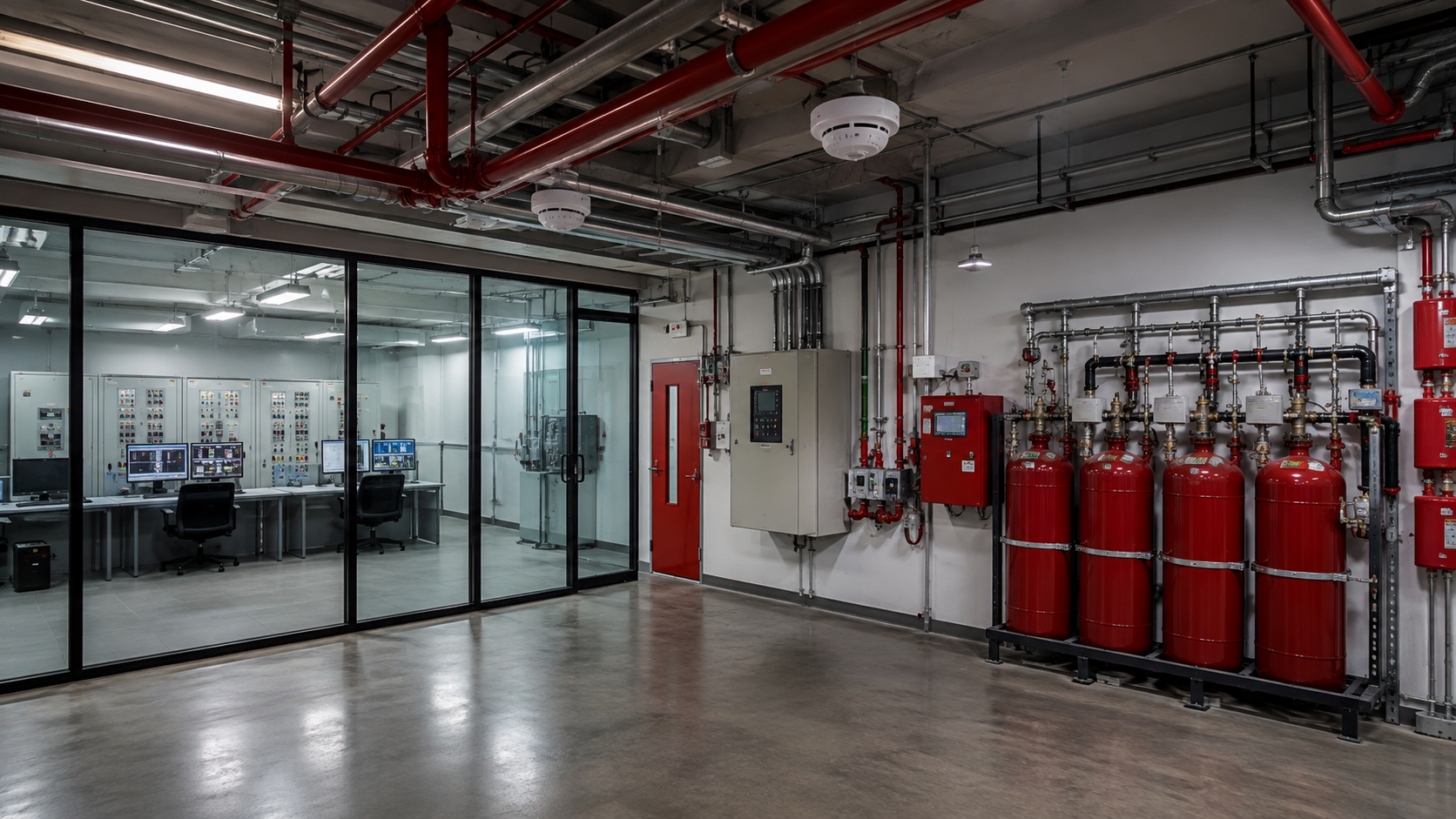
    From alarm to action Detection is only useful if it drives a defined response. A facility should specify what happens when a battery warning, off-gas alarm, elevated temperature or confirmed fire condition occurs. Possible responses include isolating a rack, stopping charge or discharge, controlling ventilation, initiating suppression, notifying emergency teams and increasing separation from adjacent equipment.

    The most resilient approach is multi-layered. Electrical telemetry sees one part of the problem, gas sensing another, thermal monitoring another and fire detection another. Correlating those signals can provide earlier and more reliable warning than relying on a single technology.

  • BESS Fire Detection: Early Warning for Battery Energy Storage Systems

    BESS Fire Detection: Early Warning for Battery Energy Storage Systems

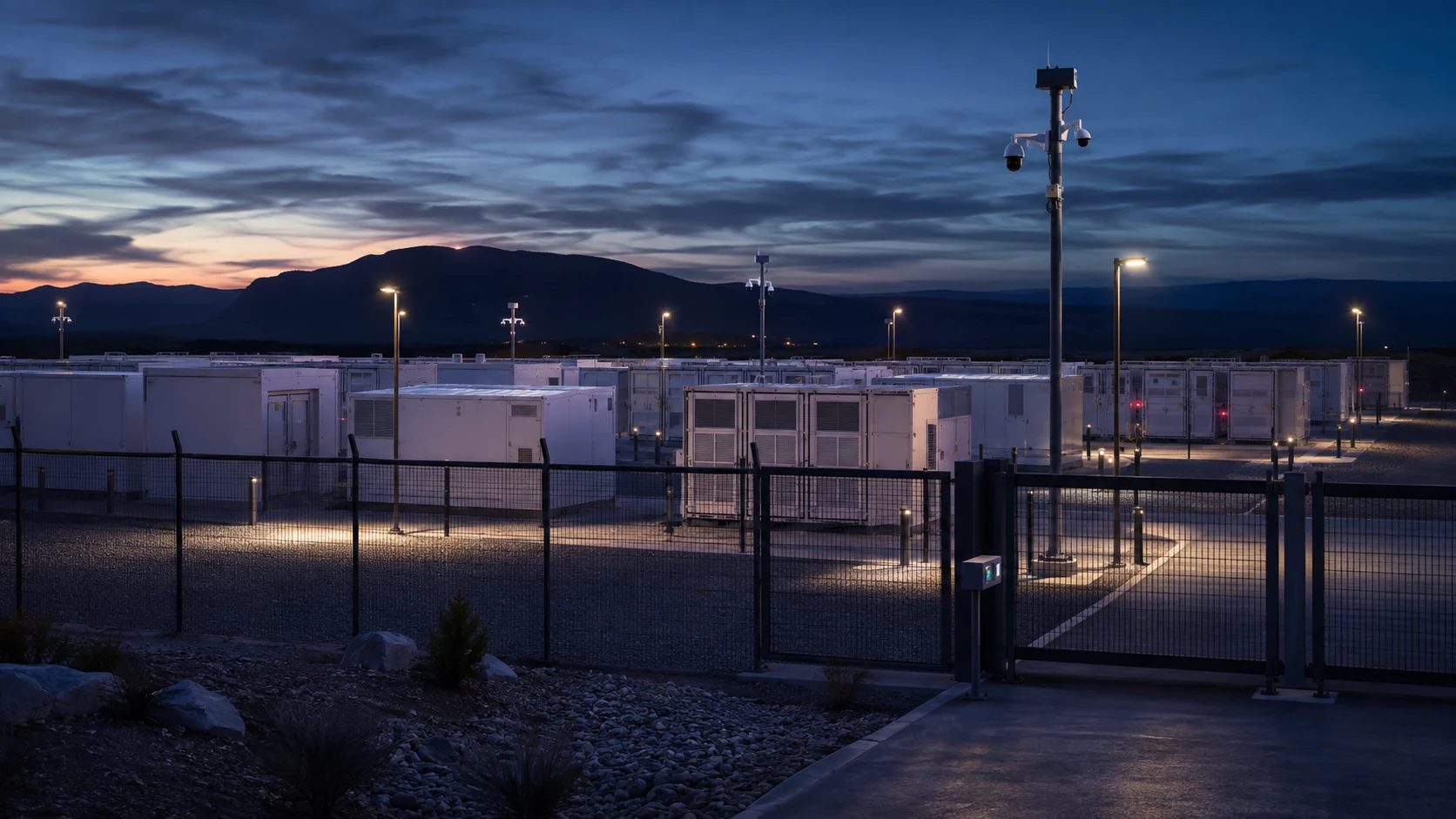
    Battery energy storage systems are expanding rapidly because they help stabilize grids, support renewable energy and provide backup power. Their fire-safety challenge is different from that of conventional buildings: lithium-ion cells can fail internally, generate heat and flammable gases, and progress into thermal runaway before visible flames appear.

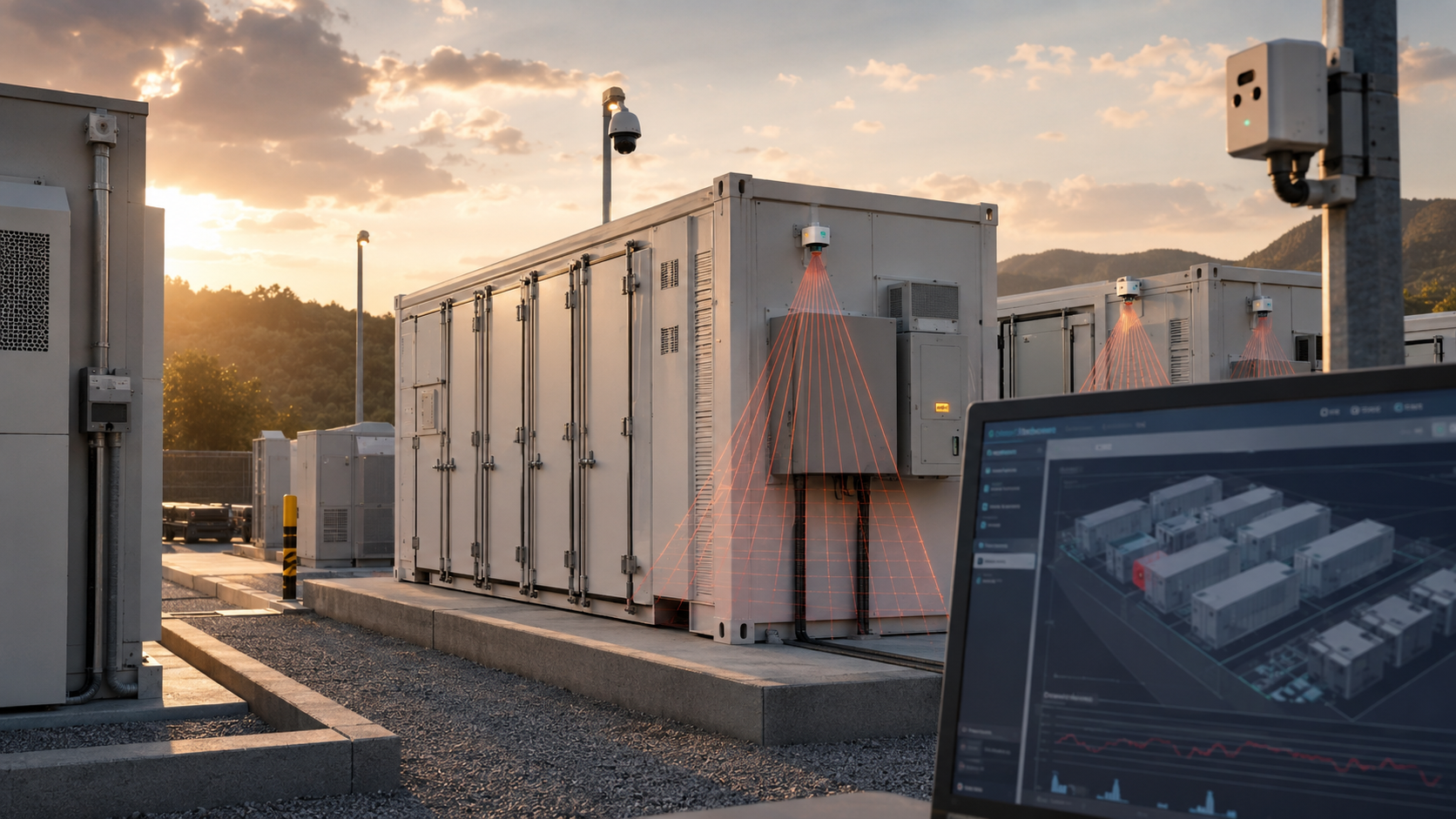
    Why early warning matters A traditional smoke detector may only respond after decomposition has advanced. BESS protection therefore benefits from layered detection. Battery management systems can track abnormal voltage, current and temperature. Gas sensors can identify characteristic off-gassing. Aspirating smoke detection can reveal very small combustion aerosols, while thermal sensors and infrared monitoring can highlight localized heating.

    Thermal runaway is a process, not a single event Thermal runaway occurs when heat generation inside a cell exceeds its ability to dissipate heat. The rising temperature can accelerate chemical reactions, release gases and transfer heat to neighboring cells. A key engineering objective is to detect abnormal conditions early enough to isolate equipment, reduce propagation risk and give operators useful time to respond.

    Detection architecture A robust BESS design combines cell- and rack-level telemetry with room or container-level fire detection. Alarm thresholds should be coordinated so operators can distinguish equipment warnings, confirmed fire conditions and emergency states. Integration with ventilation, shutdown logic, suppression systems and remote monitoring is essential.

    Avoiding a single-sensor strategy No single sensing technology provides a complete picture. Temperature alone can miss early off-gassing; gas detection can be affected by airflow; smoke detection may respond later than internal battery diagnostics. Combining independent indicators reduces blind spots and improves confidence.

    Commissioning and maintenance Detector placement, airflow modelling, sensor calibration and alarm verification are critical. Battery layouts change, firmware evolves and ventilation patterns can be modified during maintenance. Fire detection should therefore be reviewed whenever the storage system is reconfigured.

    The direction of the industry is toward integrated battery intelligence: BMS data, gas detection, thermal monitoring and fire systems feeding a common operational view. In BESS safety, the most valuable alarm is usually the one that arrives before a visible fire begins.

  • Gas Detection in Industrial Facilities

    Gas Detection in Industrial Facilities

    Industrial gas detection protects people, processes and facilities by identifying hazardous concentrations before they cause poisoning, fire or explosion. The system design depends on the gas, process conditions and the physical behavior of a potential release.

    Combustible gas detectors monitor flammable vapors or gases and are commonly used around fuel systems, process equipment and storage areas. Toxic gas detectors target substances that can harm personnel at relatively low concentrations. Oxygen sensors are used where depletion or enrichment can create danger.

    Several sensing technologies are available, including catalytic bead, infrared, electrochemical and semiconductor methods. Each has different strengths, cross-sensitivities, maintenance requirements and expected service life.

    Placement is one of the hardest engineering decisions. Gas density, ventilation, wind, leak sources and enclosure geometry influence where a cloud may travel. Detectors should therefore be positioned using hazard analysis rather than simple spacing rules.

    Fixed systems can be complemented by portable instruments worn by workers or used during maintenance. Wireless detectors may provide temporary coverage during shutdowns, construction or changing process conditions.

    Gas detection should connect to alarms and, where appropriate, ventilation, shutdown or emergency-isolation systems. Calibration, bump testing and sensor replacement are critical because a detector that is installed but not maintained can create false confidence.

    The strongest gas-detection programs combine correct sensor technology, risk-based placement, disciplined maintenance and clear response procedures. Detection is only valuable when the organization knows what action should follow the alarm.

  • Flame Detection Technologies: UV, IR and Multispectrum

    Flame Detection Technologies: UV, IR and Multispectrum

    Flame detectors are designed for hazards where open combustion may develop rapidly and waiting for smoke or heat to travel to a ceiling detector would be too slow. They are widely used in oil and gas, petrochemical plants, fuel storage, turbines, aircraft hangars and other high-risk industrial environments.

    Ultraviolet detectors respond to UV radiation produced by many flames. They can react quickly but may require careful management of other UV sources. Infrared detectors monitor characteristic IR wavelengths associated with combustion and can be effective over longer distances.

    Dual- and multispectrum detectors compare several wavelength bands to improve discrimination. By analyzing the relationship between bands and the flicker characteristics of fire, modern detectors can reject many false-alarm sources while maintaining fast response.

    Coverage is line-of-sight. A flame detector cannot see through equipment, walls or dense smoke, so field of view and mounting geometry are essential design factors. Multiple detectors may be required around complex process equipment.

    Environmental conditions also matter. Sunlight, welding, hot machinery, reflections and weather can influence performance depending on detector type. Selection should be based on the expected fuel and credible fire scenario, not simply maximum advertised range.

    Flame detection is most effective when integrated with process shutdown, alarm and suppression logic. In high-hazard facilities, a few seconds of earlier detection can materially change the outcome of an incident.