
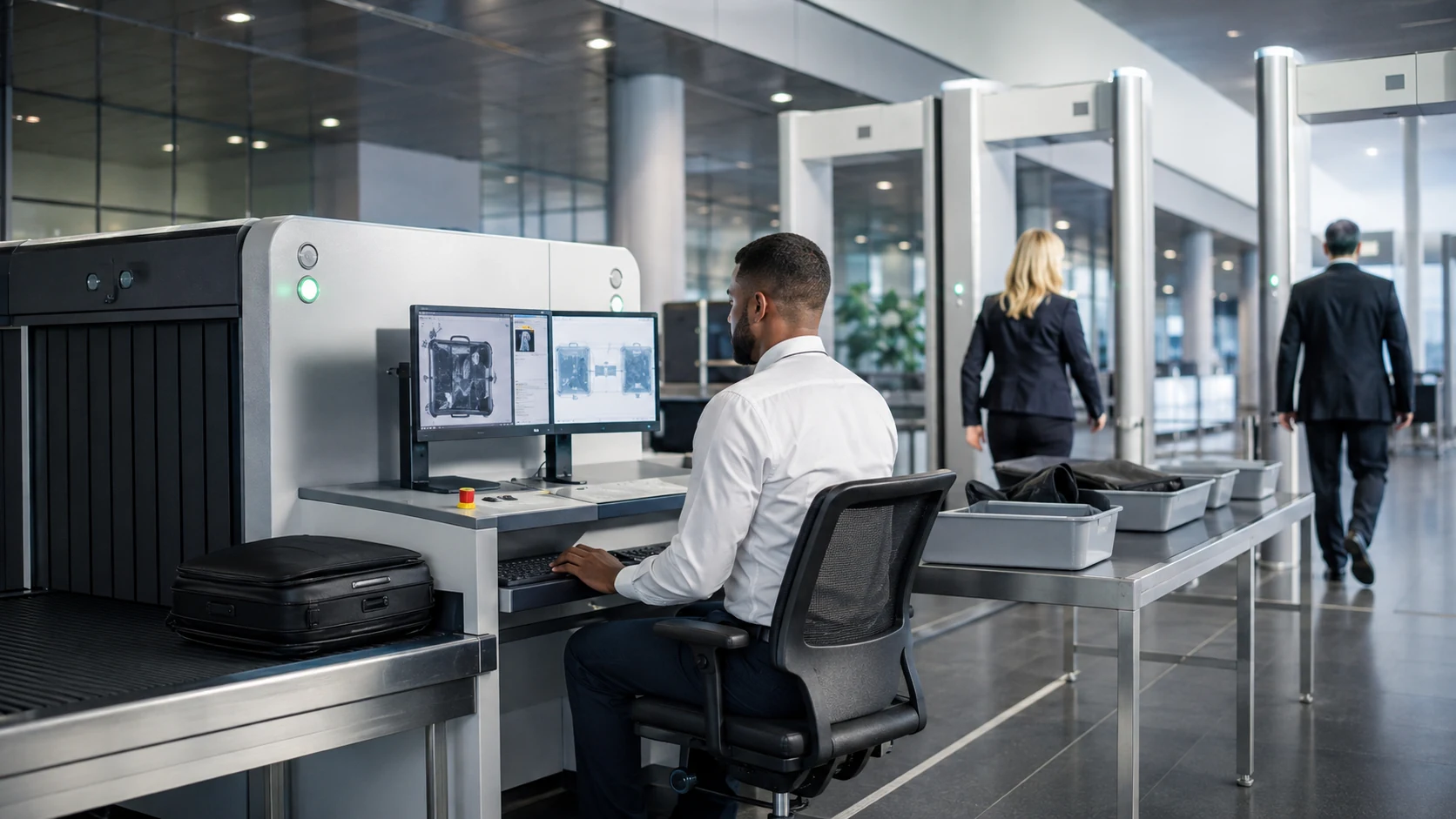
Security screening sits at the entry point of airports, courthouses, stadiums, schools and corporate campuses, tasked with finding weapons, explosives and other prohibited items before they reach a protected space. The technology behind that job has moved well beyond the single-view X-ray machine, now combining several imaging and detection methods, often stitched together with AI-based image analysis.
X-Ray Imaging: The Foundation
Conventional X-ray screening remains the backbone of checkpoint security for bags and parcels. Dual-energy X-ray systems distinguish organic materials, such as explosives, from inorganic ones, such as metal, by measuring how differently two X-ray energy levels are absorbed by an object. Operators view color-coded images where organic, inorganic and mixed materials appear in different hues, helping them spot items that warrant a closer look.
Computed Tomography Adds a Third Dimension
Computed tomography (CT) scanning, long used in medical imaging, has moved into checkpoint security because it captures a full 3D image of a bag’s contents rather than a flat 2D projection. A CT scanner rotates an X-ray source and detector array around the object, reconstructing a volumetric image that can be rotated and examined from any angle. This additional depth of information is a major reason aviation security programs in the United States, the European Union and elsewhere have pushed to replace older 2D X-ray checkpoint lanes with CT-based lanes, since 3D imaging makes it easier to isolate the shape and density of a suspicious item without the operator needing to ask a traveler to remove it from the bag.
Millimeter Wave and Body Scanning
For screening people rather than bags, millimeter wave scanners have become the standard alternative to metal detectors at many checkpoints. These scanners bounce low-energy electromagnetic waves off the body and surrounding clothing, building an image that can reveal non-metallic items, such as ceramic weapons or plastic explosives, that a traditional walk-through metal detector would miss. Automated target recognition software increasingly processes that image directly, flagging areas of concern on a generic body outline rather than displaying a detailed image of the person, which addresses a long-standing privacy objection to earlier body-scanning technology.
Where AI Fits Into Screening
Artificial intelligence has entered checkpoint screening primarily as an assistant to human operators rather than a replacement for them. AI-based automatic threat recognition software, trained on large libraries of scanned images, highlights or outlines items in an X-ray or CT image that match the visual signature of prohibited items, such as firearms or explosive shapes. Vendors and regulators generally frame this as a way to reduce operator fatigue and inconsistency across long shifts, rather than as a fully autonomous decision system; a human screener typically still makes the final call on whether a flagged bag needs secondary inspection.
Trace Detection and Complementary Methods
Screening programs typically layer imaging technologies with trace detection, which identifies microscopic particles of explosive residue on a swab taken from a bag, laptop or hand. Some checkpoints also use chemical vapor detection to sample the air around a bag or person. These methods do not replace imaging but add a second, independent detection layer that can catch threats an X-ray or CT image alone might not clearly reveal, such as explosive residue on the outside of an otherwise unremarkable item.
FAQ
Is CT screening only used in aviation? No. While aviation checkpoints have driven much of the recent investment in CT-based screening, similar imaging systems are used in courthouses, government buildings, correctional facilities and some large venues.
Does AI screening replace human operators? Not currently. AI automatic threat recognition tools are generally deployed to flag likely threats for a human operator to review, rather than to make autonomous accept/reject decisions.
Are millimeter wave scanners safe? Millimeter wave technology uses non-ionizing radio frequency energy at power levels regulators consider safe for repeated screening, unlike ionizing technologies such as X-ray, which is why walk-through millimeter wave scanners are used directly on people while X-ray and CT are reserved for bags and cargo.
Leave a Reply