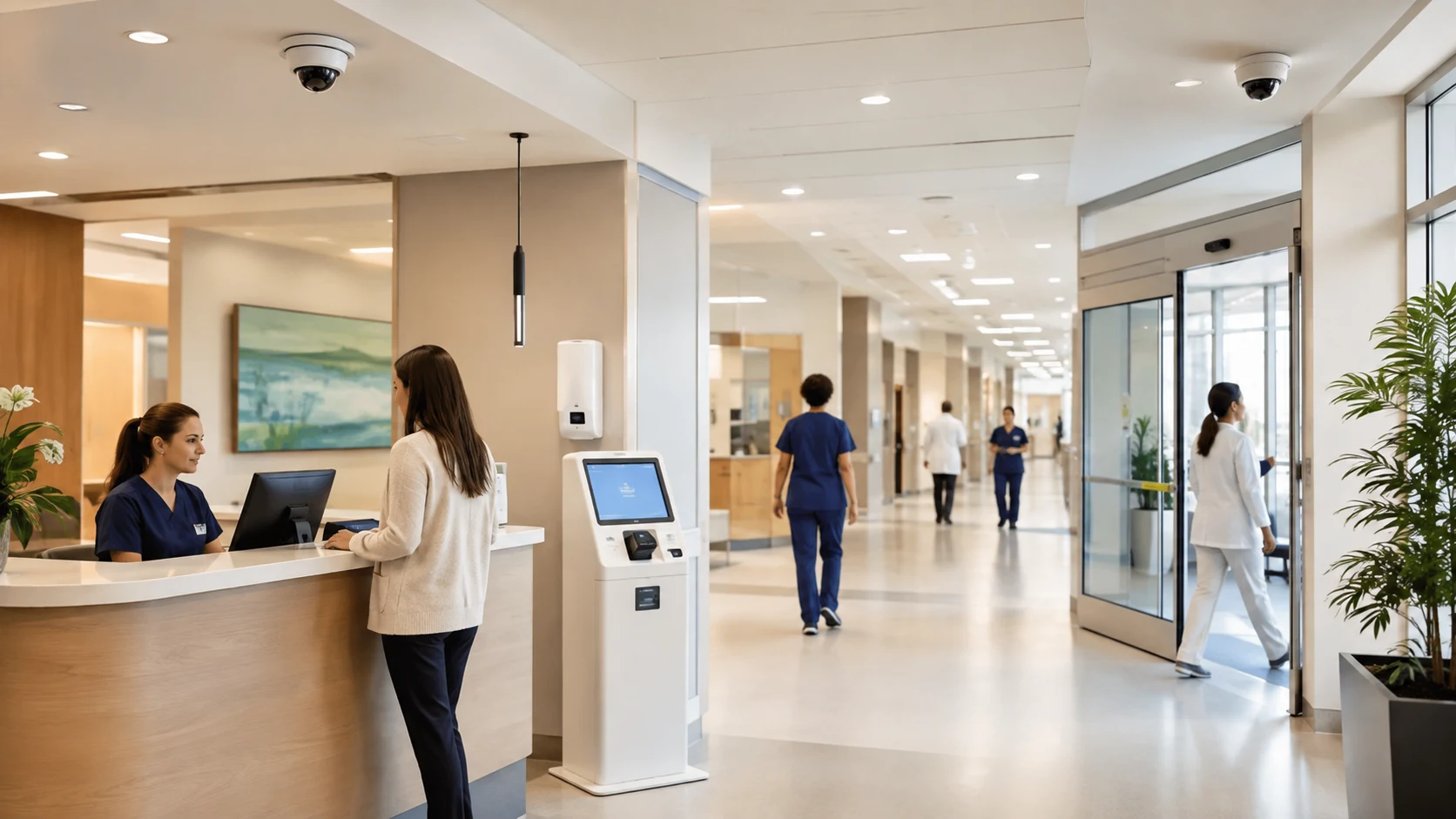
Hospitals are open environments with a difficult security balance: they must remain accessible to patients and visitors while protecting people, medicine, data, critical equipment and restricted clinical areas.
A uniquely open security environment
Unlike many critical facilities, hospitals cannot operate as closed campuses. Emergency departments, outpatient clinics and public entrances create continuous flows of people, making identity, visitor management and staff workflows central to the security design.
Access and identity
Modern hospitals commonly combine staff credentials, mobile access, role-based permissions and visitor registration. Sensitive zones such as pharmacies, laboratories, operating rooms, neonatal areas and data rooms require stronger controls and detailed audit trails.
Video and analytics
Video systems support investigation, crowd awareness and protection of entrances, parking areas and high-risk corridors. Analytics can help detect unusual movement or congestion, but privacy rules and clinical context require careful policy design.
Duress and emergency communication
Staff duress devices, fixed panic buttons and location-aware alerts can shorten response time. Mass notification must reach clinical staff without creating alarm fatigue or interfering with critical care.
Integration matters
The most effective hospital security platform connects access events, alarms, video, visitor data and emergency communications. Cybersecurity and privacy governance must be built in because physical-security systems increasingly share the hospital network.
Conclusion
Hospital Security Technology should be evaluated as part of a broader operational architecture. The strongest deployments combine suitable sensing technology, resilient communications, clear procedures and measurable performance rather than relying on a single device or headline specification.