
Tag: fire engineering

  • FSRI Report Examines Systems Behind 2025 Southern California Fire Losses

    FSRI Report Examines Systems Behind 2025 Southern California Fire Losses

    The Fire Safety Research Institute (FSRI) has released a systems-level analysis of the January 2025 Palisades and Eaton fires in Southern California. Commissioned after the disaster, the report examines how preparedness, infrastructure, evacuation, emergency operations and the built environment interacted during fast-moving community conflagrations.

    Analysis identifies interconnected pressures

    FSRI’s report contains 175 findings and 266 recommendations. Its evidence base includes technical discussions with responders and subject-matter experts, resident interviews and surveys, site assessments, geospatial analysis, radio communications, dispatch records and vehicle-location data.

    The institute says the outcomes were shaped by the combined performance of multiple systems rather than one point of failure. Areas examined include emergency management, water and electric utilities, weather and vegetation, evacuation warnings, transportation, fire and law-enforcement operations, fatalities and building conditions.

    Recommendations extend beyond one incident

    The recommendations address community-scale wildfire mitigation, readiness for wind-driven conflagrations, situational awareness, infrastructure resilience, evacuation coordination, interoperable communications, wildfire-resistant construction, suppression strategy and post-suppression monitoring. That systems approach matters because extreme fire conditions can exceed assumptions built into otherwise well-established preparedness programs.

    For public-safety and critical-infrastructure teams, the report provides a structured basis for reviewing dependencies between warning systems, communications, utilities and field operations. SectechMedia’s fire and safety coverage tracks technologies and operational practices used to improve detection, response and resilience.
    Sources

  • Smoke Control Engineering for Large Buildings and Tunnels

    Smoke Control Engineering for Large Buildings and Tunnels

    In many fires, smoke creates the greatest immediate threat to occupants. It reduces visibility, carries toxic products of combustion and can make escape routes unusable long before flames reach them. Smoke-control engineering is therefore a central part of fire strategy in atriums, high-rise buildings, shopping centers, transit facilities and tunnels.

    The objective Smoke control is not simply about removing smoke as fast as possible. The engineering objective is to manage smoke movement so evacuation routes remain tenable, firefighting access is supported and smoke does not spread unnecessarily into protected areas.

    Pressure differential systems Stairwells, refuge spaces and selected corridors may be protected by maintaining positive pressure relative to the fire zone. The pressure must be high enough to resist smoke leakage but not so high that occupants cannot open doors.

    Mechanical smoke extraction Large spaces and tunnels often use dedicated exhaust fans, shafts and dampers to remove smoke from a defined zone. Replacement air must be carefully managed; poorly positioned make-up air can disturb the smoke layer and reduce system effectiveness.

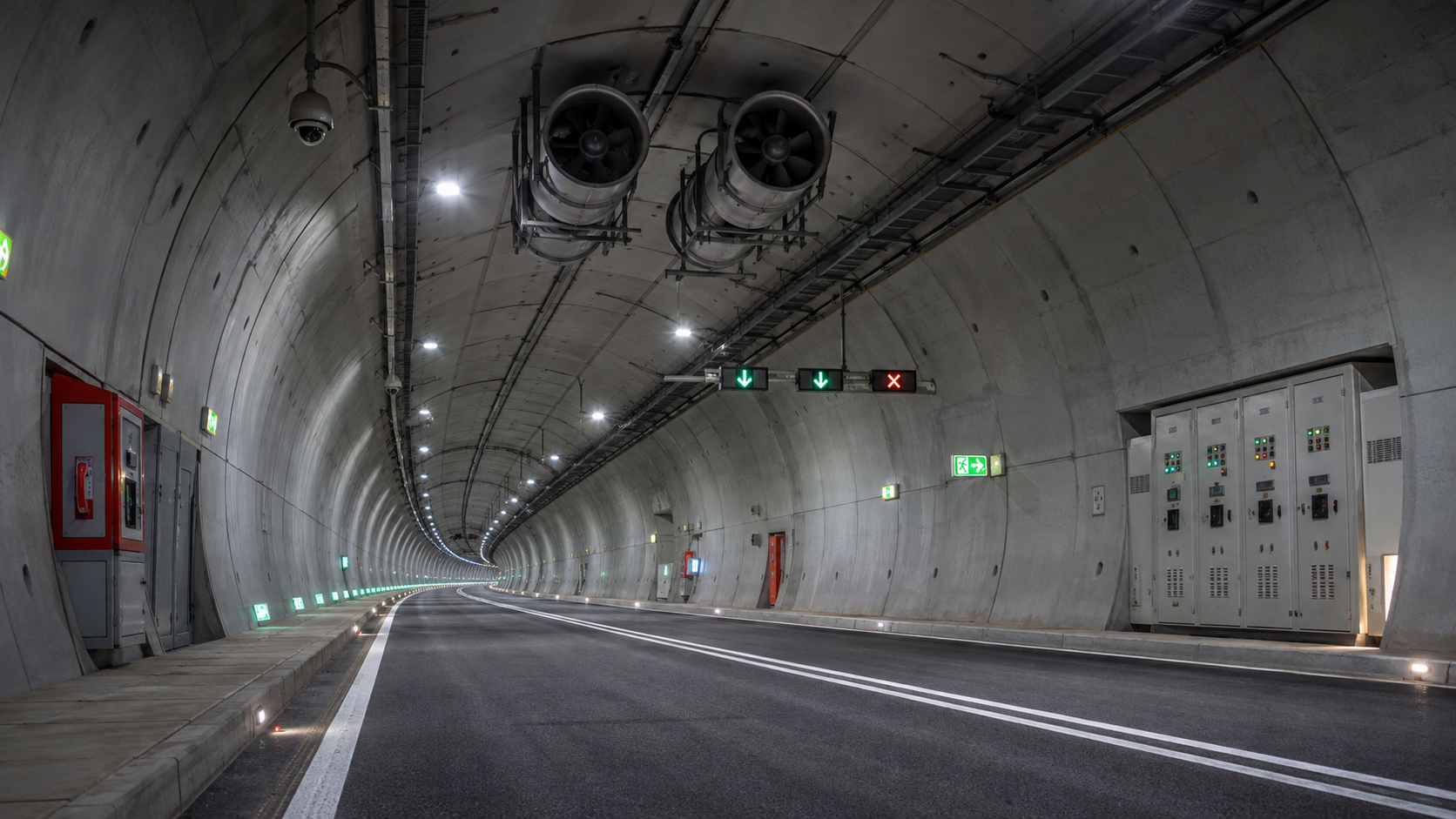
    Tunnels require a different approach In road and rail tunnels, longitudinal ventilation may be used to influence the direction of smoke movement. Jet fans, extraction points, fire location and traffic conditions all affect the strategy. The design must consider evacuation paths, cross passages and access for emergency services.

    Detection and controls A smoke-control system depends on reliable fire detection and correctly sequenced controls. Fans, dampers, doors, lifts and building management functions may all need to change state after a confirmed alarm. Cause-and-effect logic must be tested as a complete system, not as isolated components.

    Modelling and commissioning Computational fluid dynamics can help engineers study smoke movement in complex geometries, but modelling assumptions must be validated. On site, functional testing should verify airflow, pressure relationships, equipment response and emergency operating modes.

    A successful smoke-control design is therefore a combination of fire science, mechanical engineering, detection, controls and operational planning. Its real purpose is simple: preserve usable space and time for people to escape safely.