
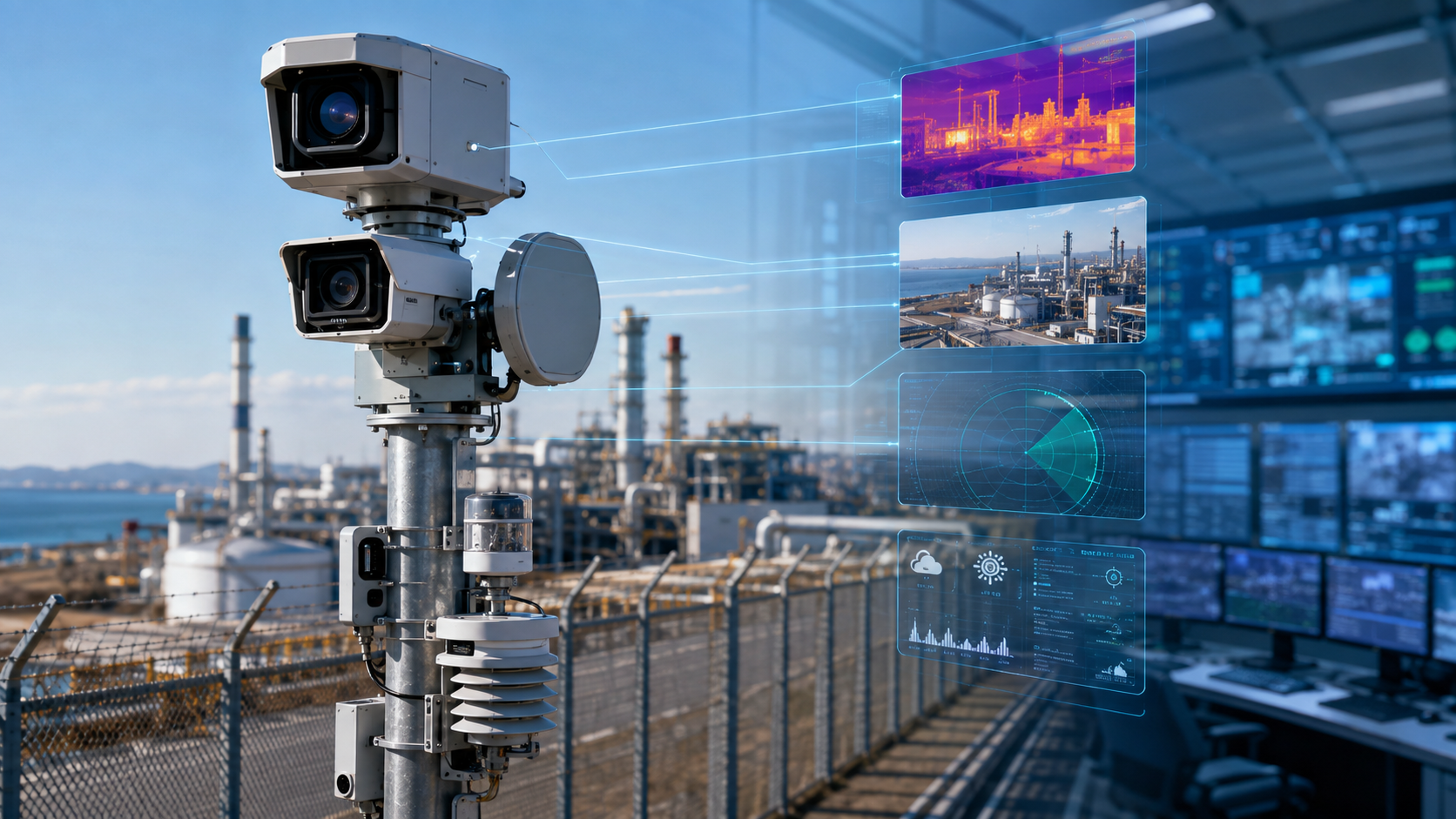
Compact radar has become increasingly practical for commercial security. Modern sensors can detect, locate and track people or vehicles across wide outdoor areas, often in conditions where cameras struggle.
How security radar works
Radar transmits radio-frequency energy and analyzes reflections from objects. By measuring distance, angle and Doppler movement, a system can estimate a target’s position, speed and direction.
Where radar outperforms cameras
Radar does not depend on visible light and can operate in darkness. It can detect movement over wide open areas without requiring a detailed visual image, making it useful for large yards, airports, solar farms, ports, logistics areas and critical infrastructure.
Tracking, verification and camera cueing
Radar excels at tracking but does not provide identity. A visible or thermal PTZ camera can be cued automatically to verify a target and provide richer visual context.
Coverage and nuisance alarms
Vegetation, water, machinery, terrain, buildings and metal structures can affect performance or create shadow zones and reflections. Placement requires a site survey and realistic acceptance testing.
Privacy, cybersecurity and integration
Radar can support detection where continuous video raises privacy concerns, with video activated for verification. Networked radar also requires secure configuration, firmware management, segmentation and reliable VMS integration.
Conclusion
Radar is not a camera replacement. It is a complementary sensor that is often better at answering where a moving target is, how fast it is moving and where it is going.
Leave a Reply