
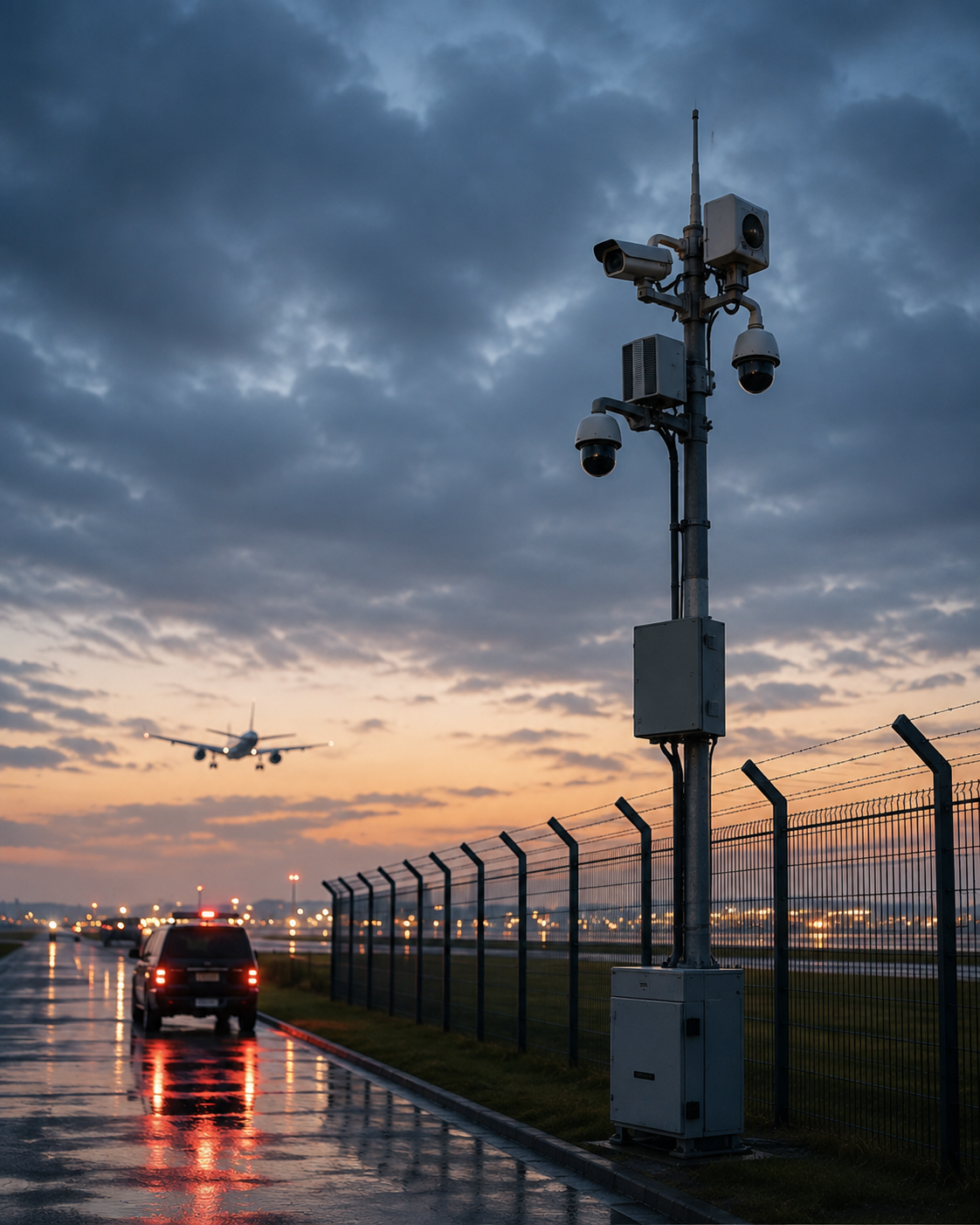
Airports combine public spaces, restricted operational zones, aircraft movement areas, baggage systems, cargo facilities and critical communications infrastructure. Effective airport security therefore depends on layered architecture rather than a single technology.
The Outer Perimeter
The first layer protects the airfield boundary. Typical technologies include intelligent fencing, fiber-optic intrusion detection, radar, thermal cameras, fixed video surveillance and controlled vehicle gates. The objective is early detection and rapid verification, not simply creating a physical barrier.
Airside Access
Access points between landside and airside areas require strong identity controls. Staff credentials, biometric verification, vehicle authorization and anti-passback rules can reduce unauthorized movement. Temporary contractors and service vehicles deserve particular attention because their access requirements change frequently.
Terminal Security
Inside terminals, video surveillance, analytics, access control, screening systems and public-address platforms operate together. The challenge is scale: thousands of cameras and alarms can overwhelm operators unless information is prioritized through a unified command-and-control platform.
Baggage and Cargo
Baggage handling and cargo areas have different risk profiles from passenger spaces. Screening equipment, restricted access, chain-of-custody controls and video evidence must be integrated with operational workflows.
Airspace Awareness
Small unmanned aircraft have added another security layer. Airports increasingly evaluate radar, RF, optical and acoustic technologies for drone detection. Detection architecture must minimize interference with aviation systems and comply with national regulations.
Cyber-Physical Integration
Modern airport security is deeply networked. Cameras, access controllers, screening devices and building systems must therefore be treated as cyber-physical assets. Network segmentation, device hardening, credential management and monitoring are part of physical-security design.
Conclusion
A secure airport is not built by purchasing isolated systems. The strongest architecture connects perimeter detection, identity, screening, video, airspace awareness and command-and-control into a layered operational model. The design goal is to detect early, verify quickly and give operators enough context to respond appropriately.
Leave a Reply