
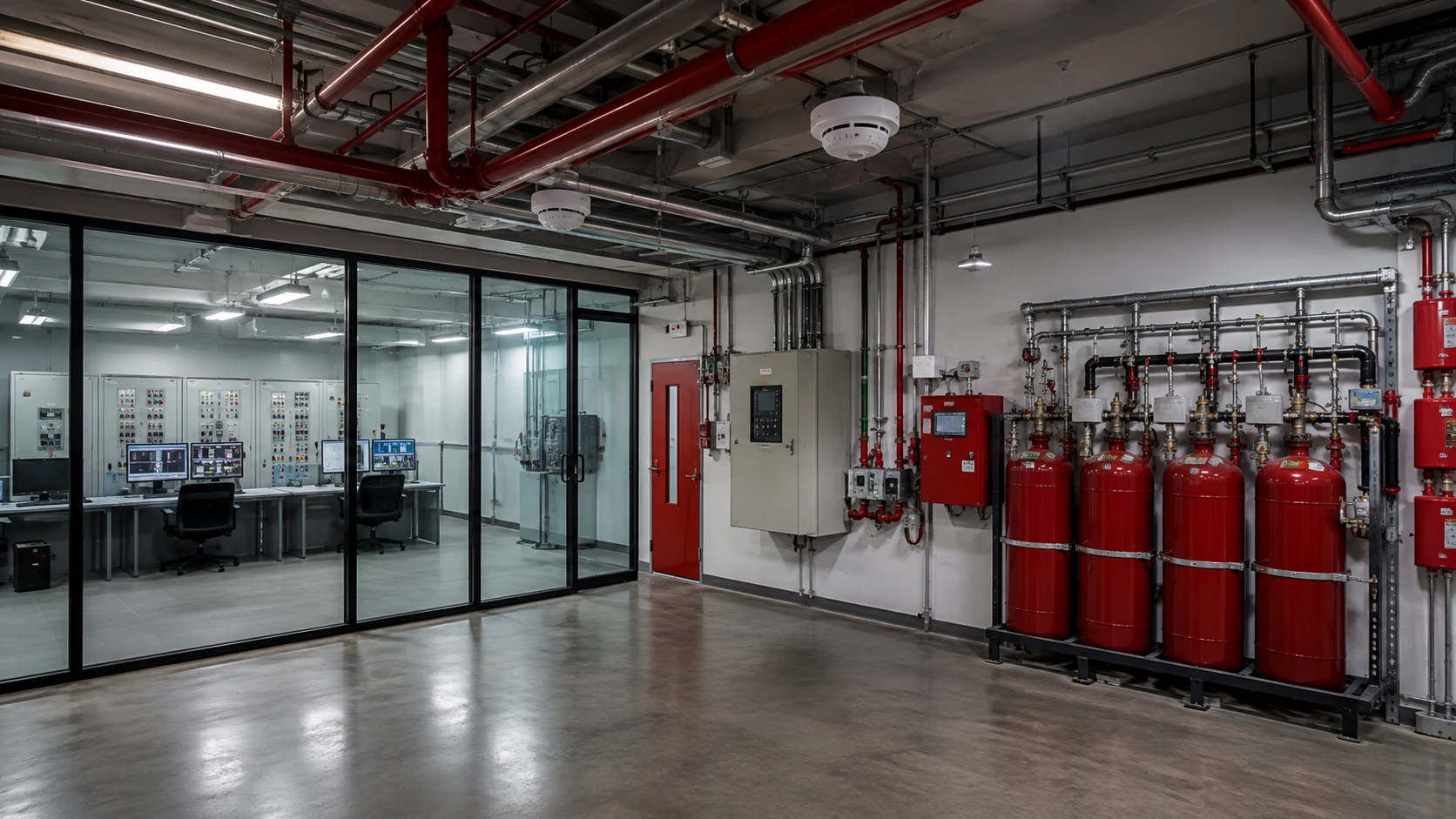
Understand fire detection, alarm and automatic suppression systems, from smoke and heat detection to sprinklers, water mist, foam and clean-agent systems.
How fire detection works
Different detectors respond to different products of combustion. Smoke detectors respond to airborne particles or changes caused by smoke. Heat detectors react when temperature reaches a threshold or rises rapidly. Flame detectors identify characteristic radiation from flames. Gas detection can identify combustible or toxic gases associated with an industrial process or battery event.
Aspirating smoke detection actively draws air through sampling pipework to a sensitive detector and can provide early warning in environments such as data centers, high-bay facilities and clean spaces. Linear heat detection monitors temperature along a cable or sensing path and is useful for long assets such as tunnels, conveyors and cable trays.
Automatic sprinklers
Automatic sprinklers remain one of the most widely used forms of fixed fire protection. Individual sprinkler heads generally operate when local heat causes the thermal element to activate, meaning a typical system does not release water from every head at once. OSHA’s fire-protection rules distinguish automatic sprinkler systems from other fixed extinguishing systems and require fixed-system components and agents to be designed and approved for the specific hazards they are intended to control.
Water mist, water spray and deluge
Water-mist systems use very fine droplets to influence heat and radiant heat transfer, depending on the application and design. Water-spray and deluge systems can protect industrial hazards, transformers or process equipment where rapid, broad application is required. These are engineered solutions where nozzle position and hydraulic calculations matter.
Foam and clean-agent systems
Foam is primarily associated with flammable-liquid hazards because it can form a blanket over a fuel surface and reduce vapor release. Fixed gaseous systems are commonly used where water damage is a major concern or where three-dimensional hazards require agent distribution throughout an enclosure. OSHA requires safeguards for hazardous discharge areas and, for certain total-flooding systems, a pre-discharge alarm that gives employees time to exit.
Detection-to-release logic
Automatic release should be designed to avoid both delayed suppression and unwanted discharge. Engineered systems may use cross-zoned detection, confirmation logic, manual release stations, abort controls, pre-discharge alarms and equipment shutdowns, verified during commissioning.
How to choose the right technology
Start with the fire hazard, not the preferred product. Ask what can burn, how quickly the fire can develop, whether people occupy the space, whether water is acceptable, and what business interruption would result from a discharge. Design, installation, inspection and maintenance should be handled by qualified professionals under the applicable local standards.
FAQ
Does every automatic suppression system need smoke detectors? No. The detection and activation method depends on the system and hazard; some systems have independent thermal activation.
Are clean agents safe for occupied rooms? Suitability depends on agent concentration, exposure conditions, system design and applicable standards. Occupancy safety must be engineered, not assumed.
Is water mist the same as a sprinkler system? No. Both use water, but droplet characteristics, operating pressures, design methods and applications differ.
Verification note: Fire codes and accepted extinguishing agents vary by jurisdiction. Final published versions should identify relevant NFPA, EN, UL/FM or local standards for the target geography.
Leave a Reply