Author: Osiris

  • DAS vs DTS vs DSS vs DTSS: Fiber Optic Sensing Explained

    DAS vs DTS vs DSS vs DTSS: Fiber Optic Sensing Explained

    Distributed fiber-optic sensing is not one technology. Several sensing methods use optical fiber to measure different physical effects along long distances. The most common terms are DAS, DTS, DSS and DTSS.

    DAS: Distributed Acoustic Sensing DAS measures dynamic strain and vibration. It is used to detect acoustic and mechanical events such as footsteps, digging, vehicles, trains, fence disturbance, machinery vibration and seismic activity. Many systems analyze coherent Rayleigh backscatter and can sample events at high frequency.

    DTS: Distributed Temperature Sensing DTS measures temperature continuously along a fiber. Raman-based systems are widely used for power cables, tunnels, pipelines, fire detection and industrial temperature monitoring. The output is a temperature profile rather than an acoustic waveform.

    DSS: Distributed Strain Sensing DSS measures static or slowly changing strain. Applications include structural monitoring, geotechnical movement, pipelines, bridges, dams and other assets where deformation develops over minutes, hours or longer periods. Brillouin scattering is commonly associated with this type of measurement, although architectures vary.

    DTSS: Distributed Temperature and Strain Sensing DTSS combines temperature and strain information, often through Brillouin-based measurements or hybrid configurations. Because temperature and strain can both influence the optical signal, system design and compensation methods are important.

    Different physics, different questions DAS asks: where is vibration occurring and what kind of event is it? DTS asks: where is the temperature changing? DSS asks: where is the fiber being stretched or compressed? DTSS seeks to characterize both temperature and strain.

    Can one fiber support several measurements? In some architectures, the same cable can support multiple interrogators or hybrid sensing systems. This allows an infrastructure owner to combine acoustic, temperature and strain information along the same route. Integration can create a richer condition-monitoring picture, but optical budgets, fiber allocation and system compatibility must be engineered carefully.

    The correct technology depends on the physical phenomenon that matters. A pipeline intrusion problem is usually acoustic; a power cable thermal-capacity problem is temperature-based; a slope movement problem may require strain. Understanding that distinction is the first step toward specifying the right distributed sensing system.


  • Distributed Temperature Sensing (DTS): Complete Technology Guide

    Distributed Temperature Sensing (DTS): Complete Technology Guide

    Distributed Temperature Sensing, or DTS, uses optical fiber as a continuous temperature sensor over long distances. Instead of installing individual electronic temperature probes every few meters, a single fiber can provide a temperature profile across cables, tunnels, pipelines, conveyors, storage areas and other extended assets.

    How DTS works Many DTS systems use Raman backscatter. A laser pulse travels through the fiber and a very small amount of light is scattered back toward the interrogator. The relative intensity of temperature-sensitive Raman components changes with the local fiber temperature. By measuring the return time, the system determines where along the fiber each temperature reading originated.

    Continuous temperature profiles The key advantage of DTS is not simply measuring temperature. It is seeing temperature as a continuous spatial profile. Operators can identify hot spots, compare zones, detect rate-of-rise conditions and follow thermal behavior over time.

    Power cable monitoring High-voltage cables are a major application. Cable loading capacity is influenced by conductor temperature, soil conditions, duct arrangement and surrounding thermal resistance. DTS can monitor the cable route and support dynamic cable rating, hotspot detection and asset-management decisions.

    Fire detection Linear heat detection with fiber is useful in tunnels, cable trays, conveyor galleries, warehouses and industrial facilities. Because the sensing fiber is passive and immune to electromagnetic interference, it can operate in environments where conventional electronics are difficult to deploy.

    Pipelines and industrial assets DTS can help identify temperature anomalies associated with leaks, process changes or insulation problems. In wells and pipelines, distributed temperature profiles provide information that would be impractical to obtain with sparse point sensors.

    Performance considerations Important parameters include sensing range, spatial resolution, temperature accuracy, measurement time and fiber configuration. Installation geometry and thermal coupling strongly influence how quickly the fiber reflects the temperature of the surrounding asset.

    DTS is most valuable when temperature is not a single point measurement but a distributed condition. By converting kilometers of passive optical fiber into a thermal map, it gives operators a continuous view of infrastructure that conventional sensors can only sample at selected locations.

  • Distributed Acoustic Sensing (DAS): Complete Technology Guide

    Distributed Acoustic Sensing (DAS): Complete Technology Guide

    Distributed Acoustic Sensing, or DAS, turns an ordinary optical fiber into a continuous line of virtual vibration sensors. Instead of placing thousands of electronic detectors along a pipeline, railway, fence or cable route, a DAS interrogator sends coherent laser pulses into the fiber and analyzes tiny changes in the backscattered light.

    How DAS works Most DAS systems rely on Rayleigh backscatter. Imperfections that naturally exist inside the glass return a very small portion of the launched optical energy. When vibration or strain changes the local optical path, the phase or intensity of the returned signal changes. By measuring the return time, the interrogator can estimate where along the fiber the disturbance occurred.

    One fiber, thousands of sensing points A major advantage of DAS is spatial coverage. A single interrogator can monitor many kilometers of fiber with virtual sensing channels distributed along the route. Spatial resolution, gauge length, sampling rate and total sensing range depend on system architecture and application requirements.

    What DAS can detect Typical event classes include footsteps, fence climbing, digging, vehicle movement, pipeline excavation, train movement, rockfall, cable activity, mechanical vibration and some leak-related signatures. The fiber does not directly identify an event; classification software interprets the vibration pattern.

    The role of AI Machine-learning models can separate relevant events from wind, traffic, machinery and other background vibration. Good performance still depends on installation quality, ground coupling, fiber position and representative training data.

    Applications DAS is increasingly used for pipeline security, railway monitoring, perimeter protection, power and telecom cable monitoring, seismic observation, subsea infrastructure and critical-infrastructure surveillance. Existing telecom fibers can sometimes be reused, reducing the need to install a separate sensor network.

    Limitations DAS performance is highly site dependent. Poor coupling can reduce sensitivity, while nearby machinery can create complex noise. Long sensing range may also require compromises in resolution or bandwidth. System evaluation should therefore be based on field trials and measurable detection requirements rather than headline range alone.

    Why DAS matters The strategic value of DAS is that the sensing element is passive fiber. It requires no electrical power along the monitored route and can provide dense, continuous awareness across distances that would be expensive to cover with conventional point sensors. As analytics improve, fiber networks are increasingly becoming infrastructure-intelligence networks rather than simple communication links.

  • AI-Assisted Evacuation Planning: Dynamic Routes and Safer Decisions

    AI-Assisted Evacuation Planning: Dynamic Routes and Safer Decisions

    Conventional evacuation plans are usually static. They assume designated exits, predefined routes and a limited number of emergency scenarios. Real incidents are dynamic: a corridor may fill with smoke, an escalator may stop, a crowd may block an exit or a secondary hazard may make the shortest route unsafe.

    What AI can add AI-assisted evacuation systems can combine data from fire alarms, smoke control, cameras, access control, occupancy sensors and building management systems. The objective is to estimate which areas are becoming unsafe and which routes remain available.

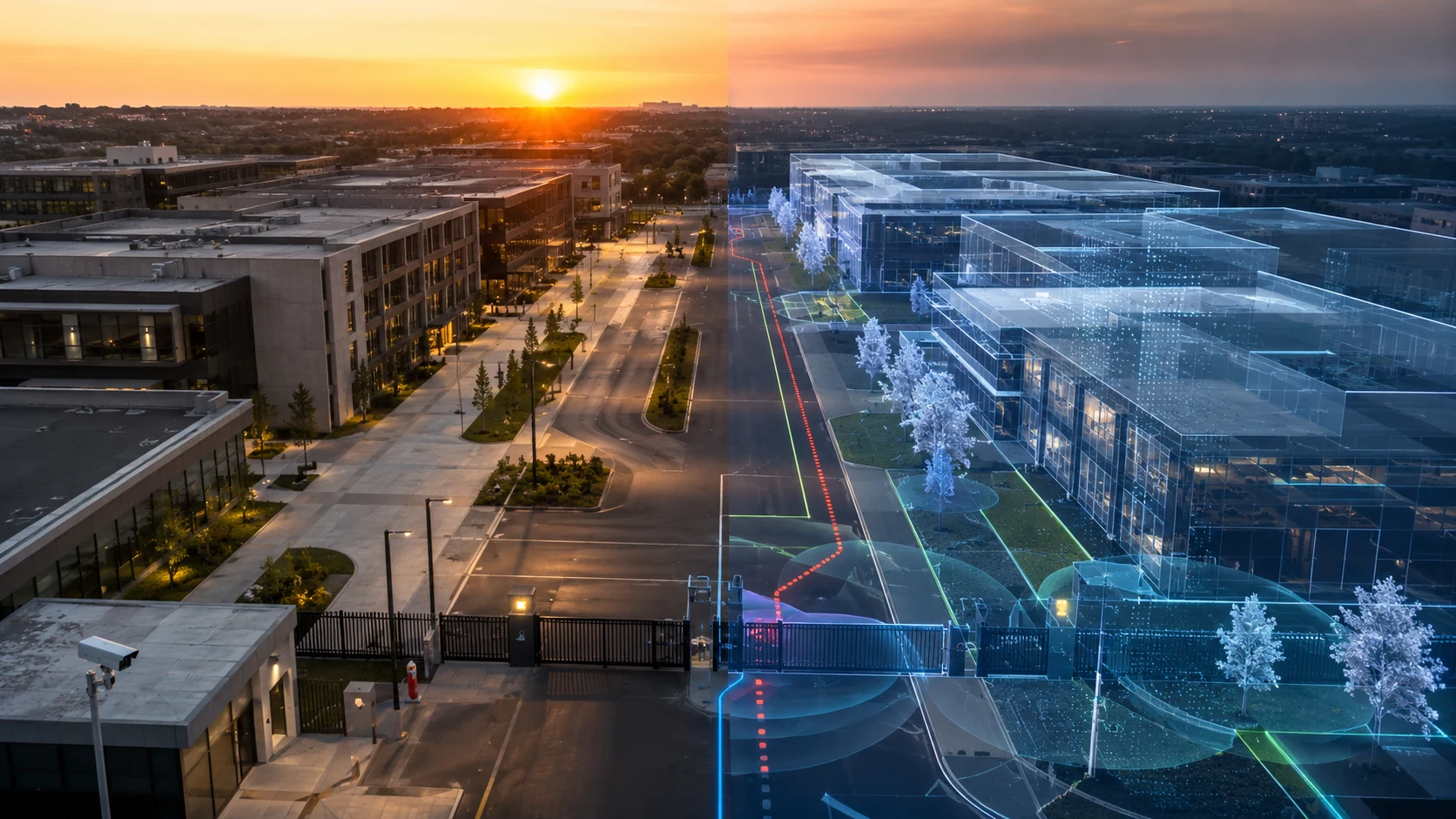
    Dynamic routing A digital building model can represent doors, stairs, refuge areas and travel distances. When live sensor data is added, software can recalculate recommended routes. Digital signage, mobile applications or voice systems can then direct different groups toward different exits.

    Crowd awareness Video analytics and occupancy sensors can estimate congestion. A route that is physically open may still be a poor choice if too many people are moving toward it. Dynamic planning can balance flow and reduce bottlenecks.

    Human factors Automation must not create confusing or contradictory instructions. People under stress tend to follow familiar routes and other people. Messages therefore need to be simple, consistent and supported by visible cues.

    Limits of AI Evacuation software cannot know every physical condition with certainty. Sensor failure, network loss or incorrect occupancy data can affect recommendations. For this reason, dynamic routing should supplement—not replace—code-compliant exits, passive fire protection and trained emergency procedures.

    The most promising use of AI is decision support. By combining real-time information with a verified building model, operators can understand changing conditions faster and communicate safer options. The goal is not autonomous evacuation; it is better situational awareness during the minutes when conditions are changing fastest.

  • Smoke Control Engineering for Large Buildings and Tunnels

    Smoke Control Engineering for Large Buildings and Tunnels

    In many fires, smoke creates the greatest immediate threat to occupants. It reduces visibility, carries toxic products of combustion and can make escape routes unusable long before flames reach them. Smoke-control engineering is therefore a central part of fire strategy in atriums, high-rise buildings, shopping centers, transit facilities and tunnels.

    The objective Smoke control is not simply about removing smoke as fast as possible. The engineering objective is to manage smoke movement so evacuation routes remain tenable, firefighting access is supported and smoke does not spread unnecessarily into protected areas.

    Pressure differential systems Stairwells, refuge spaces and selected corridors may be protected by maintaining positive pressure relative to the fire zone. The pressure must be high enough to resist smoke leakage but not so high that occupants cannot open doors.

    Mechanical smoke extraction Large spaces and tunnels often use dedicated exhaust fans, shafts and dampers to remove smoke from a defined zone. Replacement air must be carefully managed; poorly positioned make-up air can disturb the smoke layer and reduce system effectiveness.

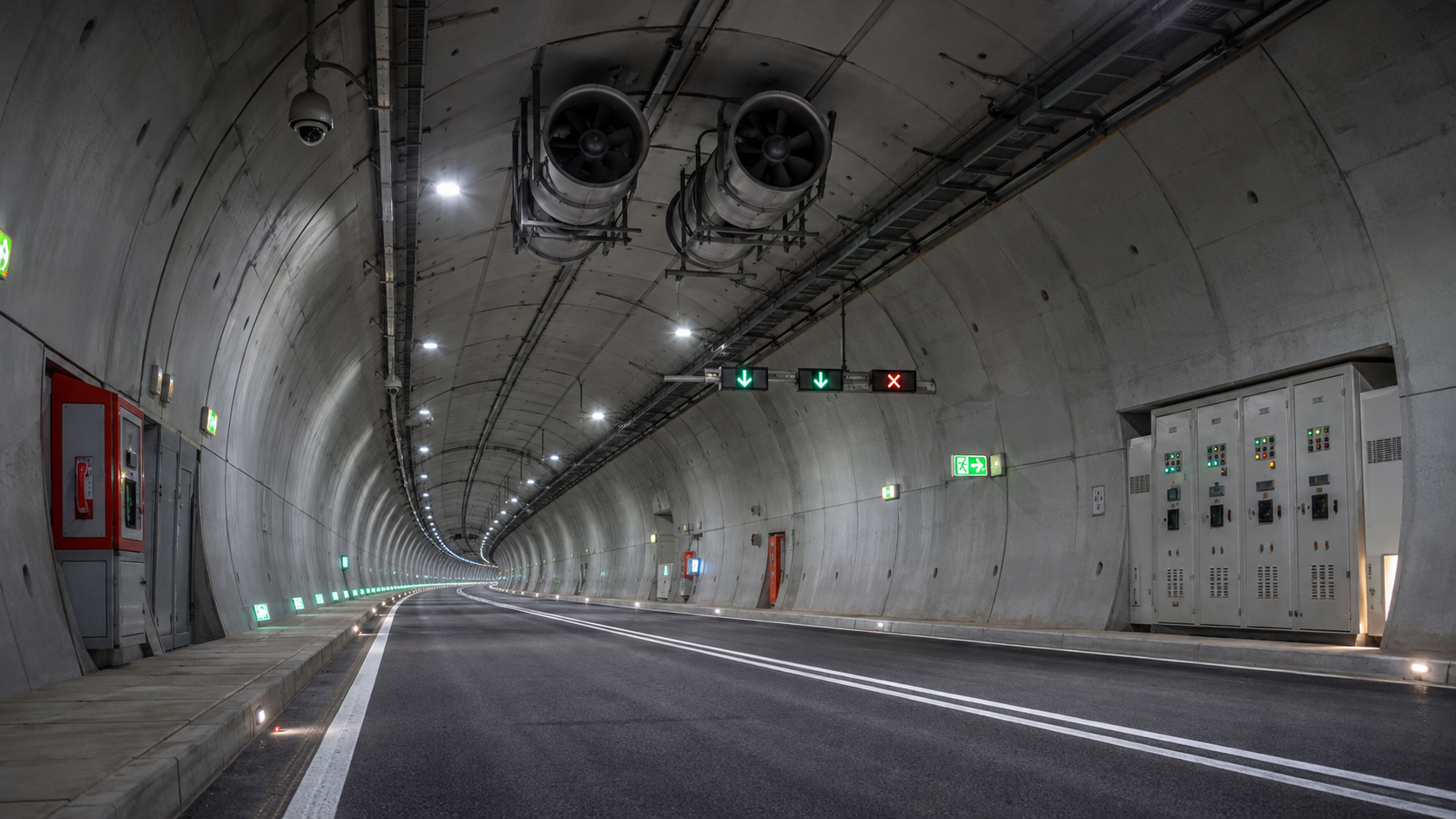
    Tunnels require a different approach In road and rail tunnels, longitudinal ventilation may be used to influence the direction of smoke movement. Jet fans, extraction points, fire location and traffic conditions all affect the strategy. The design must consider evacuation paths, cross passages and access for emergency services.

    Detection and controls A smoke-control system depends on reliable fire detection and correctly sequenced controls. Fans, dampers, doors, lifts and building management functions may all need to change state after a confirmed alarm. Cause-and-effect logic must be tested as a complete system, not as isolated components.

    Modelling and commissioning Computational fluid dynamics can help engineers study smoke movement in complex geometries, but modelling assumptions must be validated. On site, functional testing should verify airflow, pressure relationships, equipment response and emergency operating modes.

    A successful smoke-control design is therefore a combination of fire science, mechanical engineering, detection, controls and operational planning. Its real purpose is simple: preserve usable space and time for people to escape safely.

  • Mass Notification Systems: Emergency Communication for Complex Sites

    Mass Notification Systems: Emergency Communication for Complex Sites

    Emergency communication is no longer limited to bells, sirens or a single public-address message. Modern mass-notification systems are designed to deliver clear, coordinated instructions across multiple channels and to reach people wherever they are.

    Why communication fails during emergencies In a crisis, occupants may not know what has happened, where the hazard is or whether they should evacuate, shelter in place or avoid a specific route. A simple alarm tone communicates urgency but not context. Voice messages, visual displays, mobile alerts and desktop notifications can provide more actionable information.

    Multiple channels, one message A modern platform may integrate voice alarm, public address, SMS, mobile applications, email, digital signage, desktop pop-ups and radio interfaces. The goal is not to send as many messages as possible; it is to ensure that the same verified instruction reaches the right audience quickly.

    Integration with detection systems Emergency communication becomes more powerful when linked with fire alarms, gas detection, security systems, weather alerts and building management platforms. A confirmed incident can trigger pre-approved message templates while operators retain control over escalation.

    Message intelligibility A loud announcement is not necessarily an understandable announcement. Reverberation, machinery noise, language differences and hearing impairment can all reduce comprehension. Acoustic design, speaker placement and message testing are therefore essential.

    Cybersecurity and resilience Because many notification platforms use IP networks and cloud services, they require strong authentication, role-based permissions and fallback communication paths. Emergency communication must continue even when part of the IT infrastructure is unavailable.

    The best systems combine automation with human judgment. Predefined workflows reduce delay, while trained operators validate the situation and adapt instructions as conditions change. The real performance measure is not how many channels a platform supports, but whether people receive a clear, trusted instruction when seconds matter.

  • Predictive Maintenance for Fire Alarm Systems: From Faults to Early Warning

    Predictive Maintenance for Fire Alarm Systems: From Faults to Early Warning

    Fire alarm maintenance has traditionally been calendar-based: inspect devices, test circuits, replace components and respond to faults after they appear. Connected fire systems are changing that model by making condition data available continuously.

    What predictive maintenance means Predictive maintenance uses trends, diagnostics and operating history to estimate when a component may drift out of tolerance or fail. Instead of treating every detector, loop and power supply as identical, the system can highlight devices that show unusual contamination, communication errors, battery degradation or repeated intermittent faults.

    Useful data sources Modern panels and addressable devices can expose sensitivity levels, contamination values, loop quality, voltage conditions, communication statistics and event history. Environmental data can add context. A detector in a dusty production area will age differently from a detector in a clean office.

    AI is not the starting point Good predictive maintenance begins with clean data, accurate asset records and meaningful thresholds. Machine learning may help identify patterns across large estates, but it cannot compensate for poor commissioning or missing maintenance records.

    Benefits for multi-site operators For campuses, hospitals, data centers, retail chains and industrial estates, remote diagnostics can help prioritize technician visits. A maintenance team can arrive with the correct replacement parts and focus on the devices most likely to cause nuisance alarms or service disruption.

    Cybersecurity and governance Connected fire systems should not expose life-safety infrastructure unnecessarily. Remote access, cloud analytics and integration platforms require network segmentation, authentication, logging and clear responsibility between fire, IT and facilities teams.

    Predictive maintenance does not replace statutory inspection and testing. It adds another layer of intelligence. The long-term value is a shift from reacting to faults toward understanding system health continuously, reducing nuisance alarms, improving availability and making maintenance resources more efficient.

  • Thermal Runaway Detection in Lithium-Ion Battery Facilities

    Thermal Runaway Detection in Lithium-Ion Battery Facilities

    Lithium-ion battery facilities require a fire-safety strategy built around the chemistry of the cells themselves. One of the most important hazards is thermal runaway: a self-accelerating process in which internal heat generation drives further chemical reactions and can eventually produce venting, fire or propagation to neighboring cells.

    What can be detected before flames appear? Early indicators may include abnormal cell voltage, temperature rise, pressure changes and the release of volatile gases. Battery management systems provide valuable electrical and temperature data, but they should not be the only source of warning. Independent gas, smoke and thermal sensing can create a second layer of protection.

    Gas detection During cell decomposition, gases can be released before visible smoke or flame. Properly selected gas sensors can therefore provide valuable pre-fire warning. Their performance depends on airflow, sensor location, battery chemistry and alarm thresholds.

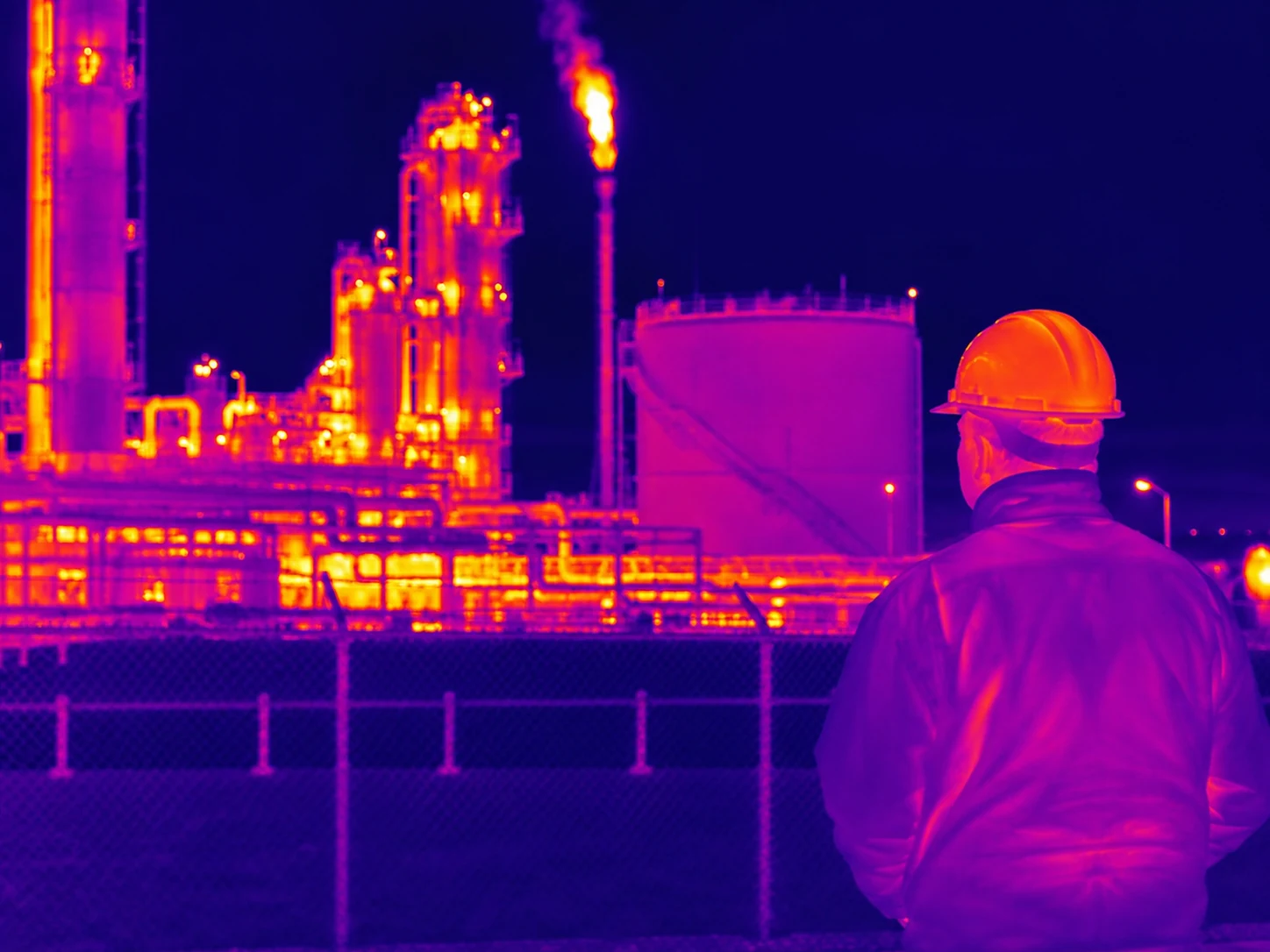
    Thermal monitoring Point temperature sensors, distributed temperature sensing and infrared thermal imaging can identify unusual heating. In large installations, the advantage of distributed monitoring is the ability to observe temperature trends across many racks, cables or zones rather than relying on a few isolated measurement points.

    Smoke and aspirating detection Very early warning smoke detection can identify small concentrations of aerosols. Aspirating systems are particularly useful where air movement is controlled and where conventional point detectors might not sample the most relevant airflow path quickly enough.

    From alarm to action Detection is only useful if it drives a defined response. A facility should specify what happens when a battery warning, off-gas alarm, elevated temperature or confirmed fire condition occurs. Possible responses include isolating a rack, stopping charge or discharge, controlling ventilation, initiating suppression, notifying emergency teams and increasing separation from adjacent equipment.

    The most resilient approach is multi-layered. Electrical telemetry sees one part of the problem, gas sensing another, thermal monitoring another and fire detection another. Correlating those signals can provide earlier and more reliable warning than relying on a single technology.

  • BESS Fire Detection: Early Warning for Battery Energy Storage Systems

    BESS Fire Detection: Early Warning for Battery Energy Storage Systems

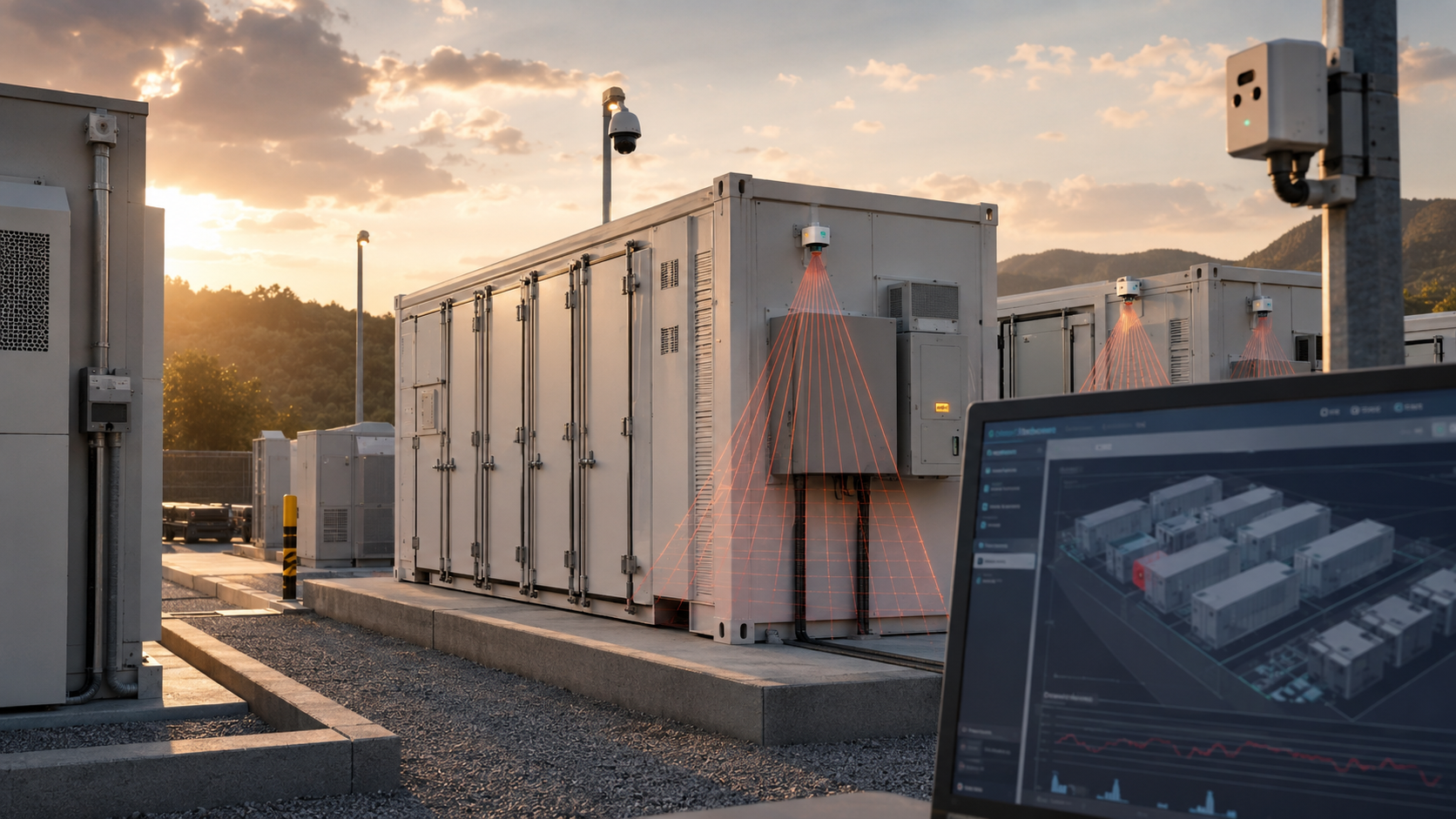
    Battery energy storage systems are expanding rapidly because they help stabilize grids, support renewable energy and provide backup power. Their fire-safety challenge is different from that of conventional buildings: lithium-ion cells can fail internally, generate heat and flammable gases, and progress into thermal runaway before visible flames appear.

    Why early warning matters A traditional smoke detector may only respond after decomposition has advanced. BESS protection therefore benefits from layered detection. Battery management systems can track abnormal voltage, current and temperature. Gas sensors can identify characteristic off-gassing. Aspirating smoke detection can reveal very small combustion aerosols, while thermal sensors and infrared monitoring can highlight localized heating.

    Thermal runaway is a process, not a single event Thermal runaway occurs when heat generation inside a cell exceeds its ability to dissipate heat. The rising temperature can accelerate chemical reactions, release gases and transfer heat to neighboring cells. A key engineering objective is to detect abnormal conditions early enough to isolate equipment, reduce propagation risk and give operators useful time to respond.

    Detection architecture A robust BESS design combines cell- and rack-level telemetry with room or container-level fire detection. Alarm thresholds should be coordinated so operators can distinguish equipment warnings, confirmed fire conditions and emergency states. Integration with ventilation, shutdown logic, suppression systems and remote monitoring is essential.

    Avoiding a single-sensor strategy No single sensing technology provides a complete picture. Temperature alone can miss early off-gassing; gas detection can be affected by airflow; smoke detection may respond later than internal battery diagnostics. Combining independent indicators reduces blind spots and improves confidence.

    Commissioning and maintenance Detector placement, airflow modelling, sensor calibration and alarm verification are critical. Battery layouts change, firmware evolves and ventilation patterns can be modified during maintenance. Fire detection should therefore be reviewed whenever the storage system is reconfigured.

    The direction of the industry is toward integrated battery intelligence: BMS data, gas detection, thermal monitoring and fire systems feeding a common operational view. In BESS safety, the most valuable alarm is usually the one that arrives before a visible fire begins.

  • Clean-Agent Fire Suppression for Data Centers: Design Guide

    Clean-Agent Fire Suppression for Data Centers: Design Guide

    Data centers concentrate electrical equipment, energy, cooling infrastructure and business-critical services into spaces where even a small fire can create disproportionate operational loss. Clean-agent suppression is designed for environments where rapid extinguishment and minimal residue are priorities.

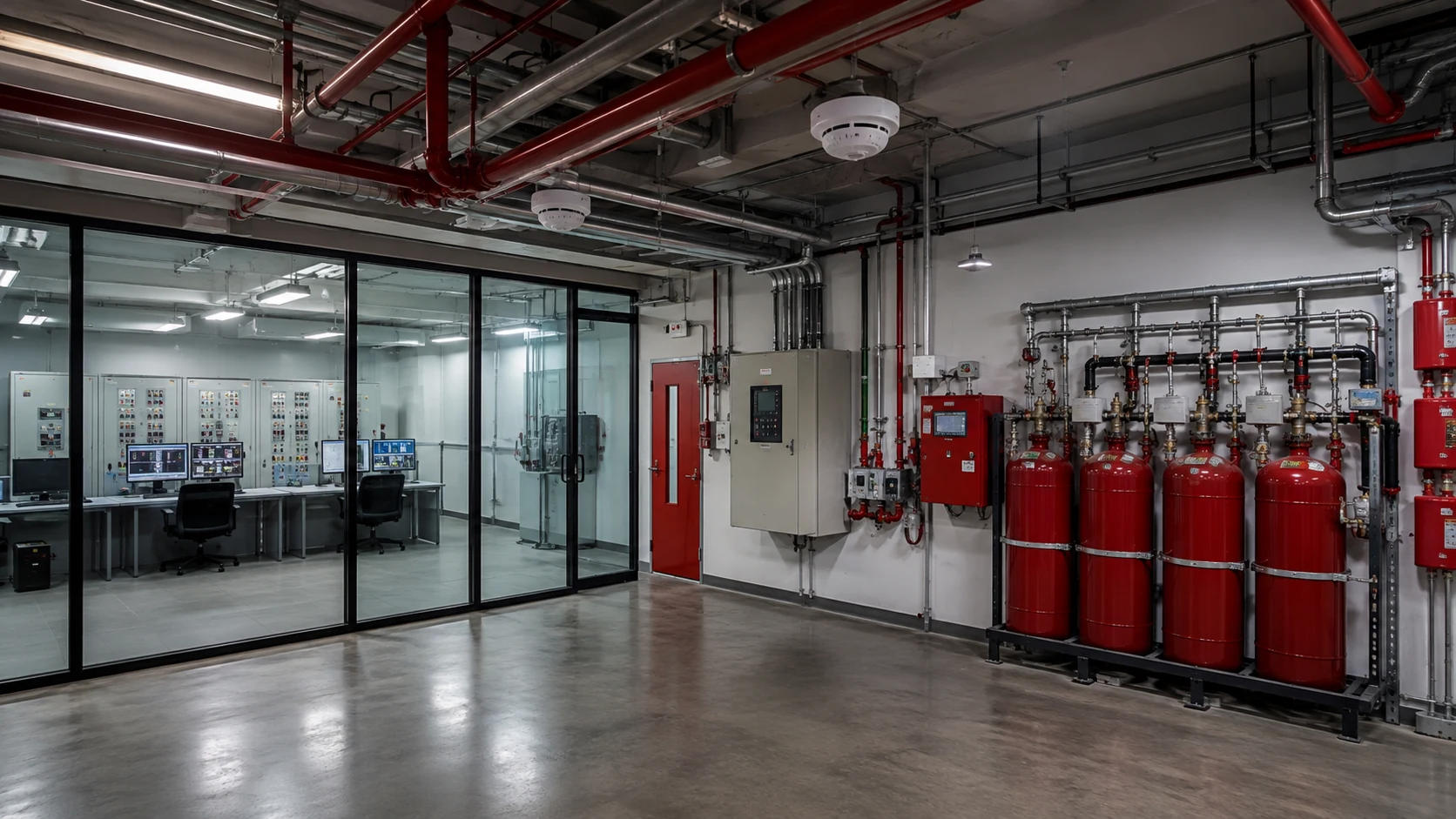
    What is a clean agent? Clean agents are gaseous fire-suppression media that leave little or no residue after discharge. Depending on the technology, suppression may be achieved through heat absorption, chemical interaction with the flame process, or reduction of oxygen concentration within safe design limits.

    Why data centers use them Water remains an essential fire-protection tool, but uncontrolled water exposure can damage servers, storage and electrical distribution. Clean-agent systems can suppress a developing fire without coating equipment in powder or liquid residue. They are therefore commonly considered for server rooms, network rooms, control rooms and other high-value electronic spaces.

    Detection matters as much as suppression The most effective design starts with early detection. Aspirating smoke detection can identify incipient smoke before conditions become severe. A staged alarm sequence can verify the event, alert operators, stop selected ventilation systems and initiate the discharge logic.

    Room integrity and pressure relief A gaseous system only performs as intended if the protected enclosure can retain the required concentration for the specified period. Door gaps, cable penetrations and ventilation openings can reduce performance. Enclosure integrity testing and pressure-relief design are therefore critical parts of commissioning.

    Not a substitute for an overall fire strategy Clean-agent systems should sit inside a broader architecture that includes detection, compartmentation, emergency power procedures, portable extinguishers, possible sprinkler protection and documented recovery plans.

    For data-center owners, the engineering objective is not simply to extinguish fire. It is to limit downtime, protect people, preserve critical infrastructure and make recovery predictable. The best clean-agent design is therefore one that integrates suppression with detection, HVAC control, electrical isolation and business-continuity planning.