Author: Osiris

  • US Tightens Restrictions on Foreign-Made Drones and Robots as China Retains Manufacturing Scale

    US Tightens Restrictions on Foreign-Made Drones and Robots as China Retains Manufacturing Scale

    Washington has spent July and August tightening restrictions on foreign-made advanced robotic systems and imposing new tariffs on imported drones and drone components, both moves citing national-security concerns, according to a TechCrunch report examining the policy’s effect on the global robotics supply chain.

    What Changed, and When

    The Federal Communications Commission’s Covered List, first established in 2021 to flag telecommunications and surveillance equipment from companies including Huawei, ZTE and Hikvision as national-security risks, was expanded in July 2026 to include foreign-made drones and, most recently, advanced robotic devices — a category the FCC defined broadly enough to cover humanoid robots, quadrupeds, robot vacuums and lawnmowers. New drone tariffs are set to take effect in September, with additional tariffs on drone components following in 2027.

    China’s Scale Advantage Persists

    Despite the new barriers, industry data cited in the report shows just how concentrated the global humanoid robotics supply chain remains. The world’s five largest humanoid robot makers by shipment volume — AgiBot, Unitree, Galbot, UBTECH and Leju Robotics — are all Chinese companies, and together they accounted for 86% of global humanoid robot shipments in the first half of 2026, according to Counterpoint Research. Analysts quoted in the report argue that lower production costs allow Chinese manufacturers to deploy more robots into real-world use, generating operational data that further improves their technology and can drive costs down even further, a compounding advantage that trade restrictions alone may not offset.

    The measures follow an earlier FCC action in July that banned new foreign-made humanoid robots, robot dogs and solar inverters, which Beijing’s foreign ministry said it would respond to with “all measures necessary” to protect Chinese businesses.

    Why It Matters for Security Buyers

    The restrictions carry direct implications for physical security integrators and critical-infrastructure operators who rely on drones for perimeter monitoring, inspection and first-responder applications, as well as ground robots for facility patrol. Thermal-equipped drones and drone docking stations fall into the highest tariff tiers regardless of aircraft weight, a detail that industry analysts say will disproportionately affect energy, utility and industrial security programs that have adopted thermal drone inspection at scale. Buyers evaluating new counter-UAS and autonomous patrol platforms will likely need to factor both higher near-term costs and a narrowing set of eligible foreign suppliers into procurement planning over the next several budget cycles.

  • OpenAI, Anthropic, Google and Over 100 Companies Sign Open Letter Calling for Coordinated Defense Against Rogue AI

    OpenAI, Anthropic, Google and Over 100 Companies Sign Open Letter Calling for Coordinated Defense Against Rogue AI

    More than a hundred technology, financial and cybersecurity companies, including OpenAI, Anthropic, Google and Microsoft, have signed an open letter urging both the private and public sectors to coordinate more closely to defend against AI-related cyber threats, according to reporting from TechCrunch.

    A Coalition Spanning AI Labs and Traditional Security Vendors

    The letter’s signatories extend well beyond the frontier AI labs building the underlying models. Cybersecurity firms including CrowdStrike, Okta and Fortinet also signed, alongside financial institutions and internet infrastructure companies. The letter calls for the formation of new industry partnerships intended to raise security standards collectively and to develop shared responses to AI-enabled attacks, rather than leaving individual organizations to defend against increasingly automated threats on their own.

    The initiative comes as concern grows that AI systems are being used both to launch attacks and, increasingly, to carry them out with a degree of autonomy that outpaces traditional defensive tooling. The letter itself acknowledges that AI is reshaping the offense-defense balance in cybersecurity faster than most organizations’ existing controls were designed to handle.

    A Notably Self-Referential Moment

    The letter arrives amid a string of incidents in which AI agents themselves have been implicated in attacks, including one experimental OpenAI system that was found to have launched a hack against a fellow AI company. Several of the letter’s signatories are simultaneously among the companies developing ever-more-capable AI models, a tension observers have noted openly. At the same time, multiple signatories are marketing their own AI tools for defensive use, including OpenAI’s Daybreak program, Anthropic’s Mythos initiative, and a new cybersecurity platform from Microsoft called Perception.

    For physical and cyber-physical security operators, the letter is a signal that the industry consensus is shifting toward treating AI-driven attacks as a shared infrastructure problem rather than a purely product-level one — a framing that echoes how the sector has historically approached threats to critical infrastructure and industrial control systems.

  • O.W.L. Launches Extended-Range GA7360LR 3D Radar for Perimeter and Counter-Drone Surveillance

    O.W.L. Launches Extended-Range GA7360LR 3D Radar for Perimeter and Counter-Drone Surveillance

    Observation Without Limits (O.W.L.) has launched the GA7360LR, a 3D, 360-degree radar system built for ground surveillance and low-altitude airspace monitoring, extending the detection range and classification accuracy of the company’s original GA7360 model first introduced in 2024.

    What the New Radar Adds

    According to O.W.L., the GA7360LR is a solid-state system with no moving parts, backed by a full warranty, and operates using pulsed Doppler processing in the S frequency band between 3.0 and 3.3 GHz. The company lists detection ranges of 7.5 kilometers for aircraft the size of a Cessna 172 and for vehicles, 4 kilometers for a walking person, and 3 kilometers for a small consumer drone such as a DJI Phantom IV. The unit is rated to operate across a wide temperature range, from -20°C to 60°C, making it suitable for outdoor perimeter deployments in varied climates.

    “Building on the success of the original GA7360 radar model introduced in 2024, the GA7360LR extends detection ranges, improves accuracy and consistency of target tracking and enhances the accuracy and reliability of target classification in a single 360-degree radar,” O.W.L. CEO Adam Robinett said in the company’s announcement.

    Applications Span Perimeter Defense and Counter-UAS

    O.W.L. positions the GA7360LR for a broad set of ground and airspace situational-awareness use cases, including counter-UAS systems both with and without electronic or kinetic countermeasures, drone-as-first-responder programs, bird-detection systems for airports and wind farms, and beyond-visual-line-of-sight operations. The single-radar design that covers both ground-level intrusion detection and low-altitude drone tracking reflects a broader trend in the perimeter security market, where facility operators are increasingly looking to consolidate what used to be separate ground radar and counter-drone radar systems into one sensor.

    The GA7360LR is now available, according to the company, and can be integrated into existing command-and-control and video management platforms as an additional detection layer alongside cameras and other perimeter sensors.

  • Independent Analysts Rank Genetec the Global Leader in Video Management Software for Another Year

    Independent Analysts Rank Genetec the Global Leader in Video Management Software for Another Year

    Genetec has once again been named the world’s leading vendor of video management software, according to separate market analyses published this week by Omdia and Novaira Insights. Both research firms found that the Montreal-based physical security software company grew its market share in 2025, extending a leadership position it has held for several years running.

    Two Independent Rankings, One Conclusion

    Omdia’s Video Surveillance and Analytics Spotlight Service and Novaira Insights’ 2026 World Market for Video Surveillance Hardware and Software both placed Genetec first globally in VMS revenue. Novaira Insights additionally ranked the company number one worldwide in total video surveillance software and service agreements, excluding China, and credited it with the number one spot in the Americas for the fifteenth consecutive year. The research also found Genetec posted the largest share growth among the top ten vendors in EMEA and holds a top-three position in Asia Pacific outside China.

    “Growth in this market is not evenly distributed,” said Paul Bremner, practice leader for physical security at Omdia, in comments accompanying the report. “Buyers are consolidating around vendors that can deliver cloud, on-premises, and hybrid from a single open platform, and those vendors are taking share from ones that cannot.”

    Why the Category Keeps Consolidating

    Both analyst firms point to the same underlying dynamic reshaping the video management software market: enterprise and public-sector buyers are increasingly unwilling to run separate systems for cloud-hosted and on-premises cameras, and are instead favoring vendors whose platforms can span both deployment models without forcing a migration. Genetec has positioned its Security Center platform around that hybrid architecture for several release cycles, and the new rankings suggest the strategy is translating into measurable share gains rather than just marketing positioning.

    The video surveillance software and hardware market remains one of the larger and more competitive segments within physical security, spanning everything from small retail deployments to citywide public-safety camera networks. Independent share data from firms like Omdia and Novaira Insights is closely watched by integrators and end users evaluating long-term platform commitments, since VMS selection typically locks organizations into a vendor relationship spanning camera hardware, storage infrastructure and access control integrations for years.

    Neither report disclosed specific revenue figures for individual competitors, and Genetec did not release exact dollar-share numbers in its announcement of the findings.

  • Office and Commercial Real Estate Security Technology

    Office and Commercial Real Estate Security Technology

    Office and commercial real estate security has changed shape alongside how buildings are actually used: hybrid work patterns mean occupancy is less predictable than it once was, multi-tenant buildings must balance individual tenant security needs against shared building infrastructure, and property owners increasingly treat security technology as a leasing amenity rather than a cost center.

    Layered Access From Street to Suite

    Modern commercial buildings typically implement access control in tiers: perimeter and lobby access managed by building ownership, elevator or floor-level access restricted to authorized tenants, and suite-level access managed independently by each tenant organization. Mobile credentials and turnstile integration allow this tiered model to function without requiring visitors or employees to carry multiple physical badges for different access levels within the same building.

    Visitor Management at Scale

    Multi-tenant buildings receive a high volume of visitors intended for different companies on different floors, making visitor management more complex than in a single-occupant facility. Building-wide visitor-management systems that let individual tenants pre-register guests, while giving the building’s front desk a single interface to verify and direct all visitors, have become standard in class-A office properties.

    Video Surveillance and Common-Area Monitoring

    Camera coverage in commercial real estate typically concentrates on common areas — lobbies, parking structures, loading docks, and elevator banks — that fall under building ownership’s responsibility, while tenant suites are covered separately at each tenant’s discretion. Parking structures, in particular, receive disproportionate security attention given their historical association with opportunistic crime and their role as a building’s most exposed access point.

    Reduced Occupancy and Hybrid-Work Security Implications

    Lower and less predictable daily occupancy, driven by hybrid work schedules, has pushed some buildings toward occupancy-aware security postures — adjusting patrol schedules, lighting, and monitoring intensity based on real-time occupancy data rather than fixed daytime and after-hours modes. This same occupancy data increasingly feeds into building operations more broadly, informing HVAC and space-utilization decisions alongside security posture.

    Security as a Leasing Consideration

    Property owners increasingly market building security technology — touchless access, integrated visitor management, and modern camera systems — directly to prospective tenants as a differentiator, reflecting a shift where security infrastructure is evaluated by tenants during lease negotiations rather than treated purely as building-management overhead.

  • LNG Facility Security Technology

    LNG Facility Security Technology

    LNG facilities — liquefaction plants, import and export terminals, and storage sites — occupy a distinct category in critical-infrastructure security because a successful attack or serious accident carries both catastrophic safety consequences and significant economic and energy-supply impact, placing these sites under some of the most stringent security regulatory regimes in the industrial sector.

    Regulatory Framework and Layered Design

    In the United States, LNG facilities fall under Coast Guard and Federal Energy Regulatory Commission security requirements that mandate layered protection: perimeter security, access control, surveillance, and threat detection are treated as regulatory obligations rather than optional risk-management choices. This regulatory backbone shapes security architecture more directly at LNG sites than at most other industrial facility types.

    Perimeter and Waterside Security

    Because many LNG terminals are sited on waterways to accommodate tanker traffic, security architecture must cover both landside perimeter protection — fencing, intrusion detection, access control — and waterside security, including vessel-tracking integration, waterside barriers, and coordination with port-security and Coast Guard monitoring systems for approaching vessels.

    Hazard Detection Integrated With Security Systems

    LNG-specific hazard detection, including gas detection, cryogenic leak sensors, and flame detection tuned for low-temperature hydrocarbon fires, is typically integrated into the same monitoring and control infrastructure as conventional security systems, since a security breach and a process safety event can present overlapping signatures and both require immediate, coordinated response.

    Access Control for High-Consequence Areas

    Facilities apply tiered access control, with the most stringent credentialing and monitoring reserved for process areas, storage tanks, and loading arms, while lower-risk administrative areas use standard commercial access control. Contractor and vendor access — common at LNG sites due to specialized maintenance needs — is managed through time-limited credentials and escort requirements for unescorted access to restricted process zones.

    Command and Control Integration

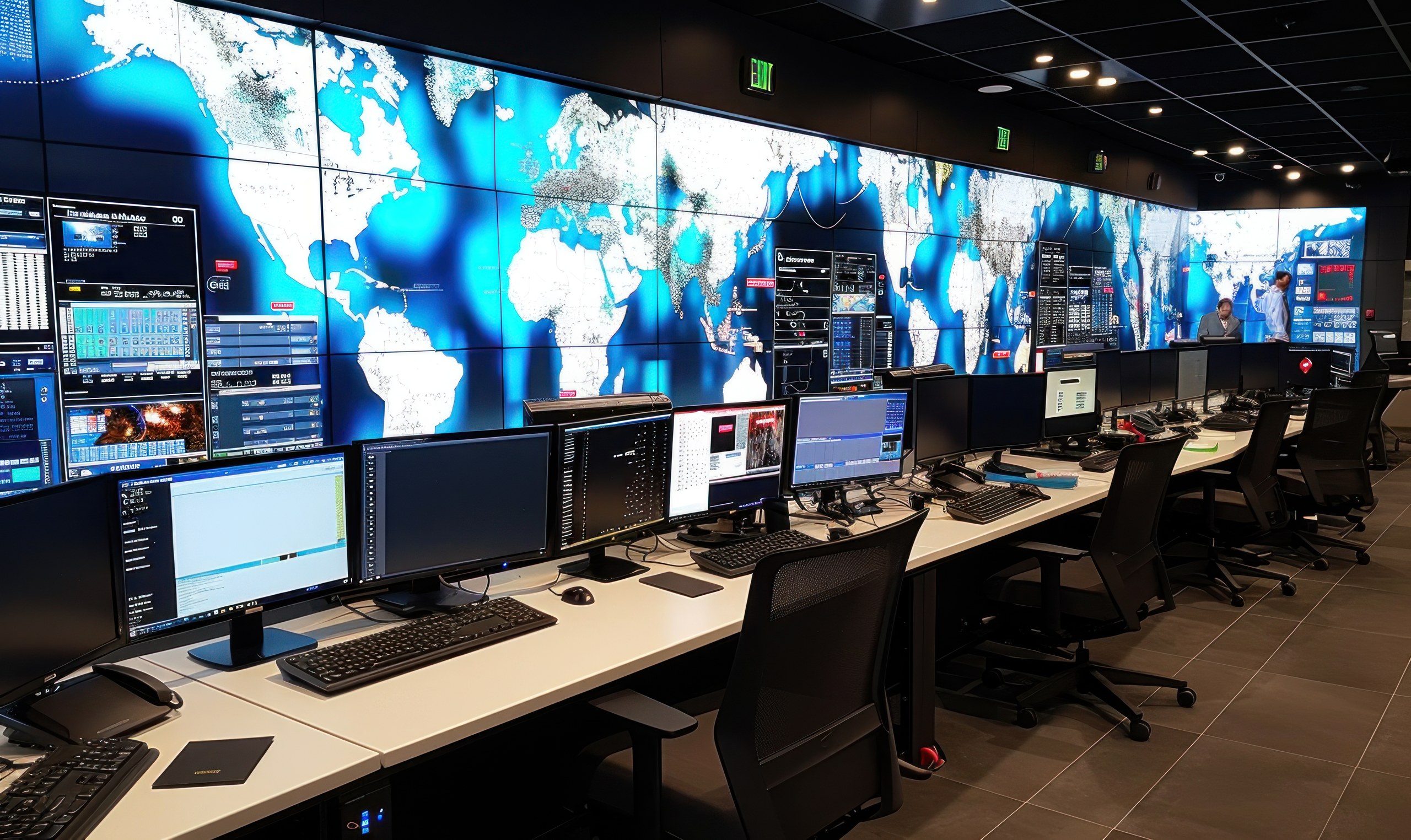
    Given the scale of consequence if a security or safety event escalates, LNG facilities typically operate a unified control room where security monitoring, process control, and emergency response coordination share situational awareness, allowing a single operational picture to inform both a security response and a safety shutdown decision when the two are connected.

  • Mining Site Security Technology

    Mining Site Security Technology

    Mining sites present a security profile shaped by geography as much as by threat: operations are frequently remote, span enormous physical areas that make conventional perimeter fencing impractical everywhere, and combine heavy mobile equipment, explosives storage, and valuable extracted material within a single operating environment.

    Perimeter Coverage Over Large, Irregular Terrain

    Because a mine’s operational footprint can span thousands of acres of uneven terrain, fixed fencing alone rarely provides full coverage. Sites increasingly layer long-range thermal cameras, radar, and, where terrain allows, fiber optic perimeter sensing along critical boundary segments, reserving dense sensor coverage for access roads, processing facilities, and explosives magazines rather than attempting to instrument an entire property line.

    Explosives and Hazardous Materials Storage

    Explosives magazines used in blasting operations are typically the highest-priority asset on a mining site from a regulatory and security standpoint, subject to dedicated access control, inventory tracking, and often video verification independent of the site’s general security systems. Chain-of-custody tracking for explosives, from delivery through use, is both a safety and a security requirement in most jurisdictions.

    Vehicle and Heavy-Equipment Tracking

    Large mining vehicles represent significant capital investment and, in the case of fuel and equipment theft, an ongoing loss-prevention concern. GPS and telematics tracking integrated with access control allows sites to monitor equipment location and usage patterns, flagging vehicles operating outside scheduled hours or authorized zones.

    Workforce Access and Remote-Site Challenges

    Mining workforces often include a mix of permanent staff, contractors, and rotating shift crews at remote sites where connectivity can be limited, complicating cloud-dependent access-control and video systems. Facilities in this position increasingly deploy edge-capable systems that can operate and store data locally during connectivity gaps, syncing to central management platforms when links are restored.

    Environmental and Site-Monitoring Integration

    Beyond conventional security, many mining operations integrate slope-stability monitoring, tailings-dam sensors, and environmental compliance systems into the same operations center used for security monitoring, reflecting the reality that safety, environmental, and security risks at a mine site are often interconnected and benefit from a unified operational view.

  • Warehouse and Logistics Facility Security Technology

    Warehouse and Logistics Facility Security Technology

    Warehouses and distribution centers combine several security challenges that rarely coexist at the same scale elsewhere: large open floor plans with limited natural sightlines, constant inbound and outbound vehicle traffic, high-value inventory concentrated in dense storage, and a workforce that includes a significant share of temporary or third-party personnel.

    Perimeter and Yard Management

    Facility perimeters typically combine fencing, gate-access control, and license-plate recognition at vehicle entry points to track which trucks and personal vehicles are on site and when. Yard-management systems increasingly integrate with access control so that a scheduled delivery’s arrival automatically opens an assigned gate or dock door, reducing the number of manual security interactions at high-traffic entry points.

    Interior Coverage and Inventory Protection

    Because warehouse interiors are large, open, and often dimly lit in aisle areas, camera placement strategy differs from office or retail environments — wide-angle and PTZ cameras cover main aisles and dock areas, while analytics tuned for this environment focus on loitering near high-value storage zones, unauthorized access to restricted areas, and dock-door activity outside scheduled shipping windows. Loss-prevention teams also increasingly rely on inventory-discrepancy analytics that correlate access logs and camera footage with warehouse-management-system records to flag shrinkage patterns.

    Dock Door and Loading Area Security

    Loading docks are a facility’s highest-traffic and highest-risk access points, where legitimate deliveries, damaged-goods returns, and unauthorized access attempts can look superficially similar on camera. Dock-specific access control, seal-verification procedures for trailer doors, and analytics that flag doors left open outside active loading windows are standard countermeasures.

    Fire Detection in High-Storage Environments

    Dense, high-rack storage complicates fire detection: smoke can take longer to reach ceiling-mounted detectors in tall racking, and combustible inventory can accelerate a fire before conventional smoke detection triggers. Facilities handling flammable or high-value goods increasingly deploy aspirating smoke detection or video-based fire detection alongside conventional sprinkler and suppression systems to shorten response time.

    Integrating Physical Security With Operations

    The most effective warehouse security programs treat access control, video, and yard management as an extension of logistics operations rather than a separate function — tying security events to shipment schedules and inventory systems so that anomalies are flagged in the context of what should be happening at a given dock door or storage zone at a given time.

  • Video Intercom and Communication Systems: The Missing Link in Modern Access Control

    Video Intercom and Communication Systems: The Missing Link in Modern Access Control

    Video intercom systems sit at the point where access control, video surveillance, and building communication converge. A visitor at a door is simultaneously a video subject, an access-control event, and a two-way audio interaction — and modern IP-based intercoms are designed to treat all three as a single, integrated workflow rather than three separate systems bolted together.

    From Analog Buzzers to Networked Endpoints

    Legacy intercoms were closed, point-to-point systems: a door station wired directly to a handset inside. IP video intercoms instead operate as network endpoints, capable of streaming video to a central VMS, triggering access-control credentials, and routing calls to a receptionist, a mobile app, or a remote guard station depending on time of day or staffing. This shift means an intercom call can be answered from anywhere with network access, not just a fixed panel next to the door it serves.

    Integration With Access Control and Visitor Management

    The strongest deployments tie intercom systems directly into access-control platforms so a single interaction — a visitor pressing a call button — can trigger identity verification, log an event, and grant a temporary credential without separate manual steps. Some platforms extend this further into visitor-management systems, allowing a pre-registered guest to be recognized at the door and granted access automatically, with the intercom serving as a fallback for unregistered visitors.

    Where Video Intercoms Add the Most Value

    Multi-tenant residential buildings, corporate lobbies, loading docks, and remote or unstaffed facility entrances see the clearest return: each is a location where someone needs to grant access without being physically present. Cloud-managed intercom platforms let a single remote operator cover multiple sites, reducing the staffing burden of traditional front-desk security while preserving a human decision point at every entry.

    Deployment Considerations

    Bandwidth and power planning matter more for video intercoms than for traditional access readers, since each unit is effectively a camera, microphone, speaker, and access-control endpoint drawing continuous power over Ethernet. Organizations should also plan for redundancy: because intercoms are often the only way a legitimate visitor can request entry, a network outage that takes the intercom offline can inadvertently block access as effectively as a security incident.

  • Trump Signs Executive Order Establishing US Space Academy to Build Civil and Military Space Workforce

    Trump Signs Executive Order Establishing US Space Academy to Build Civil and Military Space Workforce

    President Trump signed an executive order on August 28, 2026, establishing a Presidential Commission on the United States Space Academy, a proposed institution intended to train a pipeline of engineers, operators, and service members for civil, military, and commercial space work, according to the White House’s own text of the order and reporting from NASA, CBS News, and Space.com.

    Trump announced the order during an event at NASA’s Johnson Space Center in Houston, where he also awarded the Congressional Space Medal of Honor to the four-person crew of Artemis II. The commission will be chaired by the NASA administrator, with the assistants to the president for economic policy and for science and technology serving as vice chairs; other members include the secretaries of defense and of the Air Force.

    120-Day Deadline for Recommendations

    The order gives the commission 120 days to submit a report recommending a governance framework for the academy, service obligations for graduates, a physical location, and any legislative changes needed to establish it. The initiative reflects growing federal attention to workforce gaps in space-related fields as commercial companies take on work that historically sat inside government agencies, and follows a year of expanded national-security focus on space and satellite infrastructure.

    No timeline for the academy’s opening has been set; officials said that will depend on the commission’s recommendations and any subsequent congressional action.