Category: Articles & Analysis

Long-form guides, explainers, comparisons, analysis and sector assessments.

  • Insider Threat Programs: Merging Physical and Cyber Risk Signals

    Insider Threat Programs: Merging Physical and Cyber Risk Signals

    Insider threat programs have traditionally lived in one of two silos: a physical security team tracking badge swipes, visitor logs and after-hours building access, or a cybersecurity team monitoring data exfiltration, privileged account misuse and anomalous network activity. Neither view alone tells a complete story. An employee who badges into a facility outside normal hours, then downloads an unusually large volume of files from a file share twenty minutes later, is a pattern that only becomes visible when physical access data and IT activity logs are correlated in the same timeline.

    The technical foundation for merging these signals is not exotic. Access control systems already generate structured, timestamped event logs; user and entity behavior analytics (UEBA) platforms already ingest authentication, file access and network telemetry. The harder problem is organizational: physical security, IT security, HR and legal typically operate under different reporting lines, different data retention policies and different thresholds for what counts as suspicious. A mature insider threat program has to establish a cross-functional governance structure before it can meaningfully fuse the underlying data streams, because badge data and endpoint telemetry both carry privacy and labor-law implications that vary significantly by jurisdiction.

    Once governance is in place, the technical architecture generally follows a hub-and-spoke pattern: a central risk-scoring engine ingests event feeds from access control platforms, video management systems, HR systems (departures, role changes, disciplinary actions), and IT security tools (DLP alerts, privileged access management logs, endpoint detection and response), then applies weighted rules or machine-learning models to flag combinations of behavior that individually would not trigger an alert. A single late-night badge entry is unremarkable. A late-night badge entry combined with access to a server room outside an employee’s normal work area, followed by an unusual outbound data transfer, is a materially different risk signal.

    False positives are the central operational challenge. Programs that alert on every anomaly quickly overwhelm the analysts responsible for triage, and organizations that overcorrect by raising thresholds risk missing genuine indicators. Most mature programs address this with tiered alerting: low-confidence signals feed a baseline risk score that adjusts an individual’s overall standing without generating an immediate case, while high-confidence combinations of physical and digital indicators generate a case for human review. This tiering also matters for legal defensibility, since insider threat investigations that lead to termination or law enforcement referral need an evidentiary trail that shows proportionate, policy-driven escalation rather than surveillance triggered by a single ambiguous event.

    Departure workflows are one of the highest-value integration points. Employees who have resigned or been notified of termination represent a statistically elevated period of insider risk, and organizations increasingly automate a coordinated response across systems: access control credentials are scheduled for deactivation at a specific time, video retention policies for the individual’s typical work areas are extended, and IT security tooling temporarily lowers the alert threshold for that user’s accounts. Coordinating this sequence requires access control, HR information systems and IT identity platforms to share a common employee identifier and event bus, which is often the most significant integration project in standing up a converged program.

    Vendor tooling in this space spans several categories: dedicated insider risk management platforms that specialize in behavioral analytics across HR, IT and physical data; broader security information and event management (SIEM) platforms extended with physical access connectors; and unified physical security platforms that have added behavioral analytics modules on top of existing access control and video management functionality. Organizations evaluating these options should weigh not just detection capability but data governance: how long behavioral profiles are retained, who can access risk scores, and what due-process protections exist for employees flagged by an automated system, since insider threat programs that lack clear governance can create legal exposure and erode workforce trust even when the underlying technology performs as intended.
  • Banking and Financial Institution Security Technology

    Banking and Financial Institution Security Technology

    Financial institutions protect a mix of physical assets, sensitive data and public-facing customer environments, which means bank security spans branch design, vault protection, ATM networks and increasingly the cybersecurity of connected physical-security devices themselves.

    Branch video surveillance

    Branch camera systems cover teller lines, entrances, vaults and parking areas, supporting both robbery response and everyday operational and liability needs. Many institutions pair cameras with silent alarm capability at teller stations so staff can signal a robbery without alerting the person committing it.

    Vault and safe-deposit protection

    Vaults and safe-deposit areas typically combine reinforced construction with time-delay locks, dual-custody procedures and dedicated alarm and access-control zones. These measures are designed to resist both external attack and unauthorized access by an individual employee acting alone, reflecting the dual-custody principle common in financial-security design.

    ATM and self-service security

    ATMs and self-service kiosks operate outside normal branch hours and in some cases outside the branch itself, which creates distinct risks including physical attacks on the machine, card-skimming devices and network-based fraud. Financial institutions typically combine physical hardening, camera coverage, skimmer-detection technology and transaction monitoring to address these different attack types.

    Access control for staff and cash-handling areas

    Access control governs movement between public branch space and restricted areas such as cash rooms, IT closets and back-office operations. Role-based permissions and detailed audit trails support both security and the compliance requirements that apply to financial institutions in most jurisdictions.

    Cyber-physical convergence

    Modern branch security systems, including cameras, access controllers and alarm panels, are networked devices connected to the same infrastructure as core banking systems. That makes cybersecurity hygiene, including network segmentation, credential management and patching, a core part of physical-security design rather than a separate concern, particularly given how attractive financial institutions are as targets.

    Risk varies by institution type and location

    A large urban branch, a rural branch and a data center or operations facility carry different risk profiles, and security programs at most institutions are tailored accordingly rather than using a single standard branch design everywhere.

    Conclusion

    Banking and financial-institution security depends on a combination of branch video and alarm systems, vault and ATM-specific protections, disciplined access control, and cybersecurity practices applied to the physical-security network itself, reflecting the dual role of financial institutions as both cash-handling and data-handling environments.

  • Prison and Correctional Facility Security Technology

    Prison and Correctional Facility Security Technology

    Correctional facilities operate under security requirements that differ from almost any other building type: the population inside is confined rather than free to leave, staff safety and inmate safety must both be protected, and a security failure can have immediate, serious consequences.

    Perimeter detection

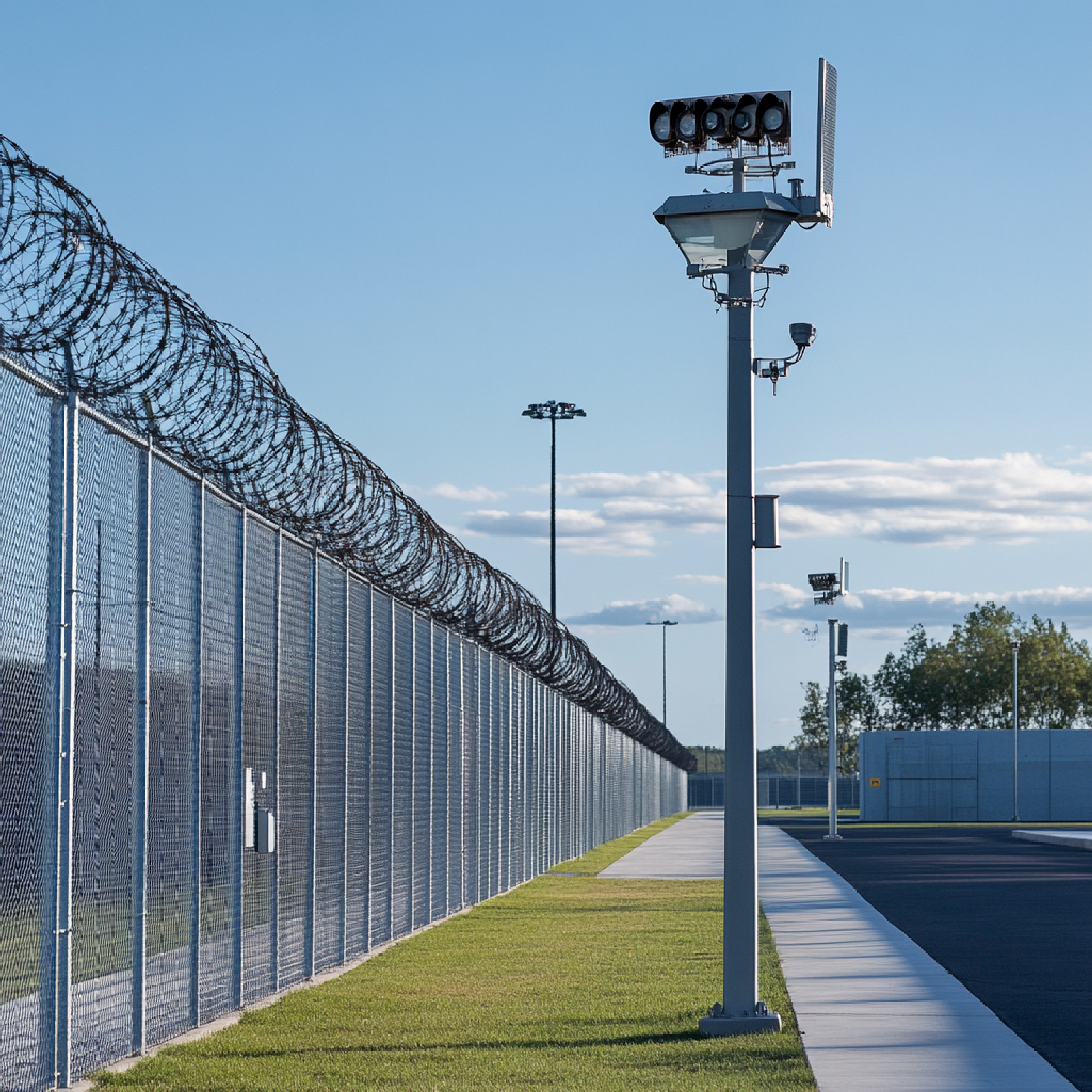
    Correctional perimeters typically combine physical barriers such as double fencing, razor wire and clear zones with electronic detection, including fence-mounted sensors, buried cable systems, microwave or radar detection, and camera coverage. Layered detection is intended to give staff advance warning of an escape attempt or unauthorized approach before a physical breach occurs.

    Video surveillance across a closed environment

    Comprehensive camera coverage of housing units, corridors, yards, visitation areas and perimeter zones supports both incident investigation and day-to-day supervision. Because correctional facilities operate continuously, video systems are typically designed for extended retention and rapid search, since incidents may not be reported or discovered until well after they occur.

    Access control and movement management

    Correctional access control governs not just entry to the facility but internal movement between housing units, program areas and secure zones. Interlocking door systems, sally ports and centrally controlled locking are common design features intended to prevent an inmate or unauthorized individual from moving freely between security zones.

    Contraband and weapons detection

    Screening technology at entry points, including walkthrough and handheld metal detectors, body scanners and mail-screening systems, is used to reduce the introduction of weapons, drugs and unauthorized devices such as cell phones. Contraband detection is an ongoing operational challenge for correctional agencies, and facilities generally combine technology with staff search procedures rather than relying on any single method.

    Duress alarms and staff safety

    Personal duress alarms that allow staff to summon help discreetly, combined with fixed panic buttons in high-risk areas, are a standard feature of correctional security design. Rapid, reliable location information is particularly important in a correctional setting given the potential for an incident to escalate quickly.

    Command and control integration

    Correctional security operations centers typically integrate video, access control, intercom and alarm systems into a single monitoring environment, allowing control-room staff to observe and respond across the facility rather than managing separate systems independently.

    Conclusion

    Correctional facility security depends on layered perimeter detection, comprehensive video coverage, tightly controlled internal movement, contraband screening and reliable staff duress capability, integrated through a command-and-control environment built for continuous, high-consequence operation.

  • Stadium and Large-Venue Security: Screening, Crowd Monitoring and Command Coordination

    Stadium and Large-Venue Security: Screening, Crowd Monitoring and Command Coordination

    Stadiums and large public venues concentrate tens of thousands of people, media, vendors and staff into a fixed footprint for a defined window of time. That combination of scale, timing and public exposure makes venue security a distinct discipline from everyday facility protection.

    Perimeter screening at scale

    Entry screening for a major event has to process large crowds quickly without creating dangerous queuing at the perimeter itself. Many venues now combine walkthrough magnetometers or AI-assisted weapons-detection lanes with bag policies and staffed pat-downs, tuning the mix of technology and staffing to the expected attendance and threat level of a given event.

    Video surveillance and crowd-density monitoring

    Venue-wide camera networks support both security monitoring and operational needs such as identifying overcrowding at concourses, exits or transit points. Crowd-density analytics can alert operators when a specific area approaches capacity, which supports both security response and general life-safety planning for evacuation.

    Access control for restricted areas

    Beyond the general admission perimeter, stadiums manage layered access to locker rooms, broadcast areas, VIP suites, loading docks and back-of-house corridors. Credentialing systems for staff, media and vendors typically combine badges with access-control integration so that movement through restricted zones is logged and can be reviewed after an incident.

    Counter-drone and airspace awareness

    Unauthorized drone activity over stadiums during events has become a more frequent operational concern, and some major venues have added counter-UAS detection capability to identify unauthorized aircraft near the venue during events, coordinating with local aviation and law-enforcement authorities on any mitigation response, since counter-drone mitigation options are tightly regulated in most jurisdictions.

    Unified command and multi-agency coordination

    Large events typically involve venue security, local police, fire and emergency medical services operating from a shared or closely coordinated command structure. A unified command center that brings together video feeds, access-control status, radio communications and public-address control lets these agencies share situational awareness in real time rather than working from separate information sources.

    Planning around specific event risk

    Security planning for a venue is not static: a regular-season game, a championship event and a concert with a different audience profile can carry different risk considerations. Venue operators generally adjust staffing, screening intensity and technology configuration event by event rather than applying a single fixed posture year-round.

    Conclusion

    Stadium and large-venue security depends on technology that can operate at crowd scale, from rapid screening to crowd-density analytics to counter-drone awareness, integrated through a command structure that allows venue security and public-safety agencies to act on the same information together.

  • School and Campus Security Technology: Access, Detection and Communication

    School and Campus Security Technology: Access, Detection and Communication

    Schools and college campuses share a difficult security profile: they must stay open and welcoming to students, staff, families and visitors, while protecting large populations across buildings that were often not designed with modern security requirements in mind.

    Layered access control

    Many K-12 campuses now control building entry with electronic locks, visitor check-in systems and single-point-of-entry designs during the school day, while allowing classrooms to be locked from inside in an emergency. University campuses typically layer broader perimeter and building access around more open pedestrian environments, since restricting movement across an entire campus is rarely practical.

    Visitor management

    Digital visitor-management systems that screen visitors against watchlists, print time-limited badges and log entry and exit have become standard in many districts, replacing paper sign-in sheets. These systems give administrators a real-time record of who is on site, which matters both for day-to-day safety and for emergency accountability.

    Weapons detection and screening

    Some districts and universities have introduced weapons-detection systems at building entrances, ranging from traditional metal detectors to newer AI-assisted scanning designed to move larger volumes of students through checkpoints with less friction than manual bag checks. Adoption varies widely by district and budget, and the technology is generally deployed as one layer among several rather than a standalone solution.

    Video surveillance and analytics

    Camera coverage of entrances, hallways, parking areas and building perimeters supports both incident response and day-to-day safety and discipline needs. Some systems add analytics for tasks such as detecting a propped-open door or unusual after-hours activity, which can be more useful on large, multi-building campuses than continuous human monitoring alone.

    Mass notification and emergency communication

    Rapid, campus-wide communication is central to school security planning. Mass-notification systems typically combine PA announcements, text and email alerts, and integration with local law enforcement, and many districts now tie lockdown procedures to a single trigger that activates locks, notifications and camera views simultaneously.

    Balancing security and learning environment

    Security leaders in education generally caution against measures that make schools feel like fortified facilities, since that can affect student wellbeing without necessarily improving safety outcomes. Physical security investments are typically paired with threat-assessment programs, staff training and clear procedures, which education-security researchers describe as at least as important as the technology itself.

    Conclusion

    Effective school and campus security combines layered access control, visitor management, appropriate detection technology, video coverage and fast communication, implemented in a way that fits the culture and openness required of a learning environment rather than working against it.

  • Retail Loss Prevention Technology: Cameras, EAS and AI in 2026

    Retail Loss Prevention Technology: Cameras, EAS and AI in 2026

    Retail security has to solve two problems at once: reduce theft and operational loss, and keep stores welcoming to paying customers. That balance shapes almost every technology decision in the sector.

    Shrink is more than shoplifting

    Retailers typically group loss into external theft, internal theft, process failures such as pricing or receiving errors, and vendor fraud. Because the causes differ, effective loss-prevention programs combine several tools rather than relying on a single system, and they measure results against the specific type of loss they are meant to address.

    Video analytics and exception-based reporting

    Modern video management systems can flag specific patterns for review, such as high-value transactions without a matching item scan, repeated returns, or unusual dwell time near high-shrink categories. Exception-based reporting narrows a large volume of camera footage down to the clips most likely to matter, which is essential in stores with dozens of cameras and limited loss-prevention staff.

    Electronic article surveillance and RFID

    Electronic article surveillance (EAS) tags and gates remain a baseline deterrent at store exits. Item-level RFID adds a further layer by giving retailers near real-time visibility into inventory location, which supports both loss prevention and out-of-stock reduction. The two technologies are increasingly deployed together rather than as alternatives.

    Point-of-sale integration

    Connecting video to point-of-sale and self-checkout transaction data lets a system correlate what a camera captured with what was actually rung up. This is particularly relevant for self-checkout, where scan-avoidance and mis-scanning account for a meaningful share of shrink at many retailers, and where store layout and camera placement affect how well a system can verify a transaction.

    Access control and back-of-house protection

    Loss prevention extends beyond the sales floor. Receiving docks, stockrooms and cash offices benefit from access control, audit trails and camera coverage focused on internal theft and vendor-fraud risks, which studies consistently identify as a significant share of total retail shrink.

    Balancing security with customer experience

    Overly visible or intrusive security measures can affect how customers perceive a store. Retailers increasingly favor systems that operate quietly in the background, use data to focus staff attention where it is most useful, and avoid treating every shopper as a suspect.

    Conclusion

    Retail loss-prevention technology works best as a layered, data-driven program rather than a single device. The strongest deployments combine video analytics, EAS or RFID, point-of-sale integration and access control, and they measure outcomes against the specific categories of loss each layer is designed to reduce.

  • How to Evaluate a DAS or DTS Vendor: A Buyer’s Guide

    How to Evaluate a DAS or DTS Vendor: A Buyer’s Guide

    Choosing a distributed fiber sensing platform requires more than comparing maximum range and brochure specifications. Performance depends on interrogator design, fiber installation, algorithms, integration and the vendor’s ability to support commissioning and long-term tuning.

    Start with the use case

    Pipeline security, rail monitoring, power-cable temperature sensing and perimeter protection require different performance priorities. Define the events, distances, response times and operational outputs before comparing products.

    Look beyond maximum range

    Range without useful signal quality is not enough. Spatial resolution, sampling, dynamic range, localization accuracy, temperature accuracy and environmental tolerance should be evaluated against the real site.

    Evaluate analytics

    For DAS, classification quality and false-alarm control can matter more than raw sensing sensitivity. Ask how models are trained, adapted and validated for the deployment environment.

    Integration and APIs

    The platform should connect cleanly with VMS, PSIM, SCADA, GIS or command-center software. Open APIs and exportable event data reduce long-term lock-in.

    Pilot before scale

    A representative pilot is essential. Test the actual fiber, installation method, noise environment and operator workflow. The best vendor is the one that can demonstrate repeatable performance on the buyer’s infrastructure, not merely on a laboratory specification sheet.

    Conclusion

    How to Evaluate a DAS or DTS Vendor: A Buyer’s Guide should be evaluated as part of a broader operational architecture. The strongest deployments combine suitable sensing technology, resilient communications, clear procedures and measurable performance rather than relying on a single device or headline specification.

    For further technology context, see FOTAS distributed fiber sensing and SAMM.

  • Integrated DAS and DTS: Combining Acoustic and Thermal Intelligence

    Integrated DAS and DTS: Combining Acoustic and Thermal Intelligence

    DAS and DTS observe different physical phenomena, but together they can provide a richer view of critical infrastructure. Acoustic events may indicate movement or mechanical activity while temperature changes reveal thermal stress, fire or abnormal operating conditions.

    Complementary sensing

    DAS detects vibration and acoustic signatures; DTS measures distributed temperature. Combining both allows the same corridor to be monitored for security events and asset-condition changes.

    Power and cable networks

    DTS can identify thermal loading while DAS detects nearby digging, disturbance or unusual vibration. The combination supports both reliability and physical protection.

    Pipeline corridors

    DAS can classify activity and acoustic events while DTS contributes thermal context where product temperature or leak-related effects are relevant.

    Unified analytics

    The challenge is turning two large data streams into usable alarms. Edge processing, event correlation and GIS visualization can help operators focus on meaningful anomalies.

    Procurement implications

    Buyers should evaluate integration at the data and workflow level, not simply whether two interrogators can be installed in the same cabinet. Shared timing, location mapping, APIs and alarm management are central to real operational value.

    Conclusion

    Integrated DAS and DTS for Critical Infrastructure Monitoring should be evaluated as part of a broader operational architecture. The strongest deployments combine suitable sensing technology, resilient communications, clear procedures and measurable performance rather than relying on a single device or headline specification.

  • DTS for Tunnels, Cable Routes and Linear Fire Detection

    DTS for Tunnels, Cable Routes and Linear Fire Detection

    Distributed Temperature Sensing provides continuous temperature measurements along optical fiber, making it useful where heat must be monitored over long or difficult-to-access routes.

    How DTS differs from point detection

    Traditional temperature sensors measure specific locations. DTS creates thousands of measurement points along one fiber and can show how heat develops spatially over time.

    Tunnel applications

    In road and rail tunnels, DTS can support linear heat detection and help operators identify the approximate location and development of abnormal temperature conditions.

    Power cables

    High-voltage cables can develop hotspots that limit loading or indicate deteriorating conditions. DTS provides a thermal profile along the route and supports dynamic operational decisions.

    Industrial routes

    Conveyors, cable trays, pipelines and storage areas can benefit from continuous thermal monitoring where point sensors leave gaps.

    Design considerations

    Response time, spatial resolution, fiber type, installation geometry, calibration and integration with the fire or SCADA system should be evaluated together. DTS is strongest when operators can convert temperature data into clear actions.

    Conclusion

    DTS for Tunnels, Cable Routes and Linear Fire Detection should be evaluated as part of a broader operational architecture. The strongest deployments combine suitable sensing technology, resilient communications, clear procedures and measurable performance rather than relying on a single device or headline specification.

  • DAS for Border and Long-Perimeter Monitoring

    DAS for Border and Long-Perimeter Monitoring

    Long boundaries are difficult to secure with point sensors alone. Distributed Acoustic Sensing can turn fiber installed along a route into a continuous detection layer, providing location-aware vibration and acoustic information over many kilometres.

    Why DAS fits long perimeters

    A single interrogator can monitor a long fiber path, reducing the need for powered electronics at every detection point. This is attractive for remote fences, pipelines, rail corridors and large critical-infrastructure boundaries.

    Event classification

    The main challenge is not detecting vibration but identifying what created it. Machine-learning models can help distinguish footsteps, vehicles, digging, fence interaction, weather and background activity.

    Sensor fusion

    DAS becomes far more useful when alarms cue cameras, thermal imagers or radar. Fiber provides location; optical sensors provide visual confirmation.

    Deployment factors

    Cable installation method, soil type, fence coupling, fiber route and local noise strongly affect performance. Calibration must therefore be site-specific.

    Operational value

    The strongest use case is persistent awareness over distance. DAS should be treated as part of a layered system rather than a standalone answer to every perimeter-security problem.

    Conclusion

    DAS for Border and Long-Perimeter Monitoring should be evaluated as part of a broader operational architecture. The strongest deployments combine suitable sensing technology, resilient communications, clear procedures and measurable performance rather than relying on a single device or headline specification.