
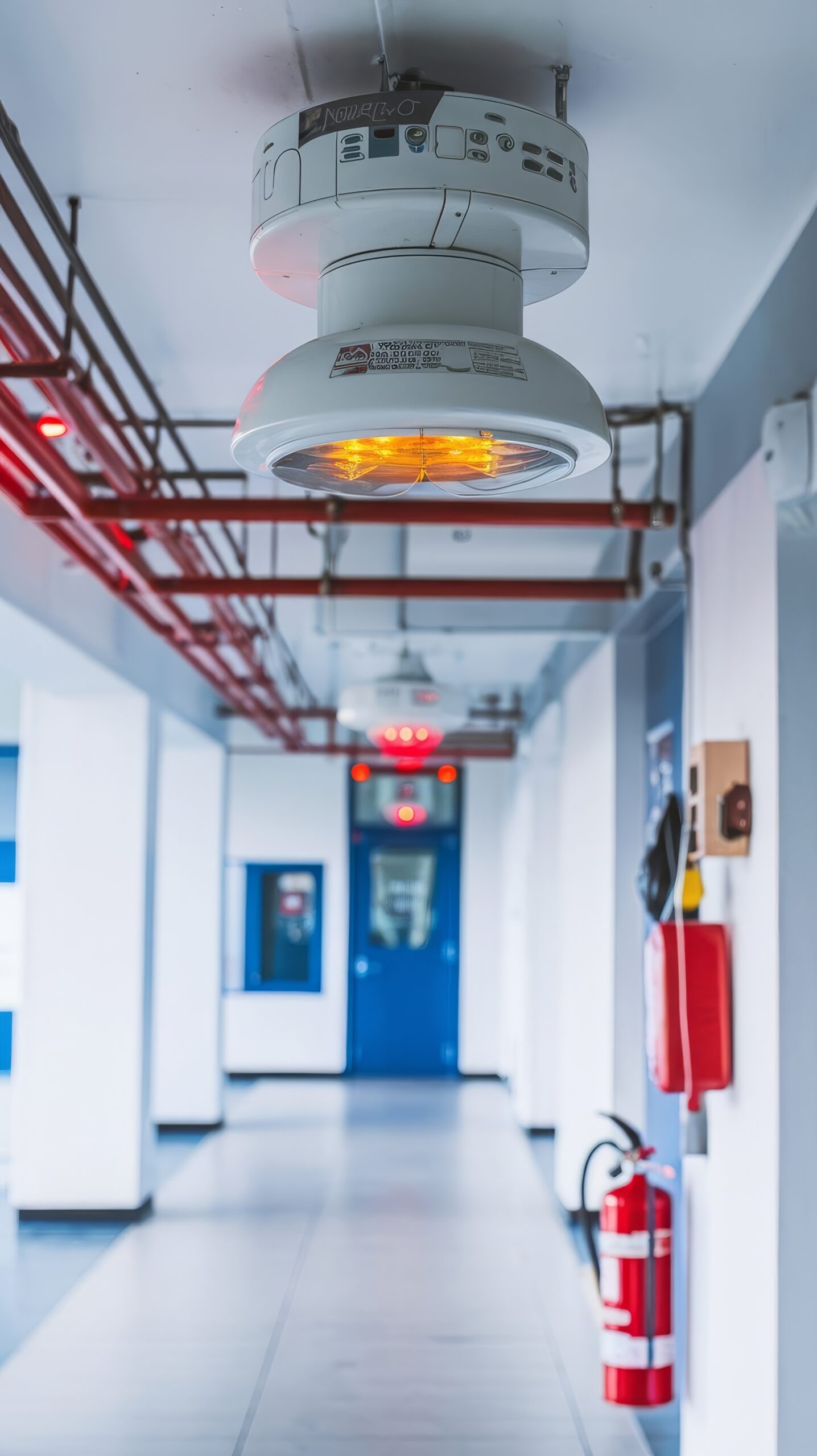
High-ceiling spaces challenge the assumption that smoke will quickly reach a detector mounted at the highest point. Warehouses, atria, aircraft hangars and production buildings can delay or redirect smoke through temperature gradients, ventilation and large internal volumes.
The design question is therefore not simply which detector has the longest range. Engineers must identify the fire signatures, airflow and response objective, then select and validate a detection method. More guidance is available in Articles & Analysis and the Fire Safety archive.
Understand smoke movement first
Buoyant smoke can cool as it rises and may stabilize below the roof, a condition commonly described as stratification. Heating, roof temperature, air handling, racking and stored goods can change the plume. A design based only on clear ceiling height may miss these interactions.
Compare available detection approaches
Point smoke detectors are familiar and provide individual device locations, but response can be delayed when smoke takes time to reach the ceiling. Optical beam detectors monitor obscuration across a long path and can cover broad open areas, although alignment, structural movement and obstructions require attention. Aspirating smoke detection draws air through a pipe network to a central detector and can sample at selected heights, but pipe transport time, airflow balance, contamination and maintenance access must be engineered.
Account for the operating environment
- Map normal and emergency ventilation modes.
- Review roof geometry, cranes, banners, racks and future storage changes.
- Consider dust, condensation, sunlight and temperature variation.
- Provide access for alignment, sampling-hole inspection and detector service.
Use performance-based evidence where needed
NFPA research on high-ceiling detector spacing shows why ceiling height deserves specific evaluation. Computational analysis, smoke tests or other approved engineering methods may be needed for unusual spaces. Spacing and acceptance criteria depend on the adopted codes, project documents, listed device instructions and the authority having jurisdiction; a single universal distance is not appropriate.
Commission the complete signal path
Testing should demonstrate that the selected fire signature reaches the sensing path and produces the intended alarm at the correct panel location. For beam systems, verify alignment, obscuration response and trouble conditions. For aspirating systems, check airflow supervision, pipe integrity, transport behavior and each sample point. Confirm interfaces to notification, smoke control and monitoring without assuming that one detector test proves every sequence.
Preserve a repeatable baseline
Document detector locations, beam paths, pipe calculations, airflow measurements, alarm thresholds, test material, environmental conditions and response times. Reassess the design when occupancy, racking, ventilation or ceiling obstructions change. A repeatable baseline makes later maintenance more useful than a simple pass label.
Leave a Reply